Most “best day trips from Rome” articles rank fifteen places equally and leave you no smarter than before you opened the tab. This one does not. The honest editorial position: roughly twelve places sit inside a four-hour transit radius of Roma Termini, and only seven of them earn a full day of your trip. The rest are guilt-trips that look good on Instagram and feel terrible at 9 p.m. when you are still on a coach south of Salerno.
The seven that work: Pompeii, Tivoli, Naples, Ostia Antica, Orvieto, Castel Gandolfo, and (with caveats) Florence. Amalfi, Cinque Terre, Pisa as a stand-alone, and the deeper Tuscan loops mostly do not. Below: the why, the 2026 prices, the train logistics, and the pairings that fit into one day.
The honest day-trip rule for Rome
Rome’s geography is more limiting than the map suggests. The high-speed corridor (Frecciarossa, Frecciargento, Italo) gives genuinely fast access to Naples (one hour ten) and Florence (one hour twenty); the regional network handles the Lazio and Umbria belt cheaply if slowly. Beyond that the time math collapses. Anything more than two and a half hours each way means more time in transit than at the destination: you are not really visiting the place, you are taking a photograph of having visited it.
Three rules before you book:
- One destination per day. Tour operators sell “Pompeii and Amalfi Coast in one day” because Americans with five-day Rome trips will buy it. The honest answer is that you will see Pompeii and a bus window.
- Trains beat coaches almost every time. Exception: destinations with no station near the actual sight (Tivoli’s villas, the Castelli Romani lakes, the Val d’Orcia hill towns). There a guided coach saves the second-leg taxi-and-walk.
- Book the train one to two months ahead. Frecciarossa and Italo both use dynamic pricing on the Rome-Florence-Naples corridor. The same Rome-to-Florence seat is EUR 19 sixty days out and EUR 89 the day before. Single biggest preventable cost on a Rome trip.
The day trip everyone books: Pompeii (and the Vesuvius pairing)
Pompeii is the day trip you have to take if it is your first time in this part of Italy. It is also more logistically demanding than the brochures suggest.
The fast version is by train. Frecciarossa from Roma Termini to Napoli Centrale runs about fifty direct services a day, takes one hour ten minutes, and costs EUR 15 to EUR 50 in standard class depending on lead time. From Napoli Centrale you transfer to the Circumvesuviana commuter line that crawls south to Pompei Scavi-Villa dei Misteri in about forty minutes for EUR 3.20. The Circumvesuviana is hot, crowded, and a regular pickpocket target: nothing in back pockets. Door to door from Termini is a hair over two hours each way, leaving five to six usable hours on site.
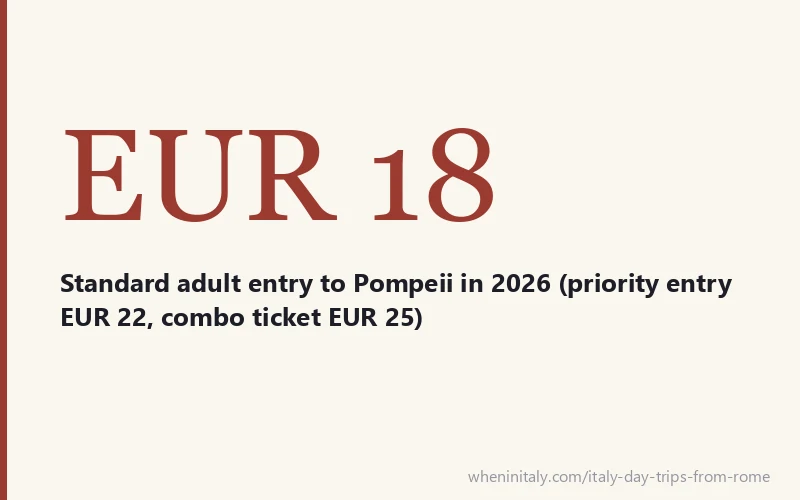
Ticket prices for 2026: EUR 18 standard adult, EUR 22 for the “Pompeii Express” priority entry, EUR 25 for the “Pompeii+” combo adding the suburban Villa of the Mysteries and the Boscoreale villas. EU citizens 18 to 25 pay EUR 2; under 18 is free. The site now has a hard daily cap of 20,000 visitors, with timed entry slots between March and October. From March 2, 2026, the official ticketing channel is vivaticket.it. Buy ahead. The walk-up queue in July is brutal and there is no shade.
The Vesuvius pairing is the obvious add-on and works if you start early. Reputable operators do Pompeii in the morning, Vesuvius crater in the afternoon (about a thirty-minute walk to the Gran Cono rim from the bus drop-off). Crater access requires a pre-booked ticket (EUR 10 to EUR 12, released about thirty days ahead), is closed in bad weather, and is suspended on orange or red weather alert days. No walk-up. If the crater is closed and you have booked a tour, operators usually swap in a winery visit on the volcano’s slopes, where the volcanic soil produces the Lacryma Christi reds and whites.
Skip Pompeii if you have children under eight, if it is July or August and you cannot face direct sun in the high thirties Celsius, or if you have done it before. The smart substitute is Herculaneum (Ercolano Scavi on the Circumvesuviana, smaller, better-preserved upper floors, half the crowds, a third of the walking) or, even better, Ostia Antica thirty minutes from central Rome (covered below).
Tivoli: two UNESCO sites, one easy day
Tivoli sits thirty kilometres east of Rome and contains two UNESCO sites a fifteen-minute drive apart. As a logistical day trip it is the easiest in this guide, and the one most people skip for yet another Vatican add-on.
Villa d’Este is the classic: a sixteenth-century cardinal’s villa set into a hillside, with a baroque garden of fifty-one fountains terracing down to the valley. The Hundred Fountains corridor and the hydraulic Organ Fountain (still plays, on the half hour from 10:30 a.m.) are the highlights. UNESCO 2001. Winter hours, valid October 26 to January 25, 2026: 8:45 a.m. to 5:15 p.m., last entry 4:15 p.m. Heavy rain on the Aniene can shut the fountain supply for a few days, so check villae.cultura.gov.it in winter.
Hadrian’s Villa (Villa Adriana) is the larger and quieter: roughly 120 hectares of an emperor’s retreat built between 117 and 138 CE, with a partly-reconstructed Canopus pool, the Maritime Theatre island library, and ruined baths scattered across olive terraces. UNESCO 1999. Adult entry EUR 15 standalone. The combined “Le Villae” ticket (Villa Adriana + Villa d’Este + Sanctuary of Hercules Victor) is EUR 25 to EUR 28 and is the right purchase: you cannot reasonably do both villas without it, and the ticket is valid for three days.
Getting there: cheapest is the regional train from Tiburtina or Termini to Tivoli station (about fifty minutes, EUR 5 each way), then a local CAT bus or short taxi up to Villa d’Este. A separate CAT line connects the two villas. The COTRAL bus from Ponte Mammolo metro is EUR 2.20 and more direct but slower. For most travellers the honest answer is the guided day-trip coach: typically EUR 110 to EUR 160 with both villas plus a Tivoli town lunch, removing the two hours of inter-site logistics. With kids, Villa d’Este’s gardens are near-perfect; the 51 fountains let them run.
Florence as a day trip: doable but rushed
Florence is on the Frecciarossa main line: roughly 109 trains a day, fastest in one hour twelve minutes, typical one hour seventeen, fares EUR 25 to EUR 90 depending on lead time. As a transit problem, trivial. The problem is what happens once you arrive.
A realistic 6-hour Florence day on the 8:00 a.m. Frecciarossa back at 7:00 p.m.: fifteen minutes from Santa Maria Novella station to the Duomo on foot, ninety minutes for the cathedral and baptistery (skip the dome climb, it eats two hours), forty-five for Ponte Vecchio and an Oltrarno stroll, two hours for the Uffizi (timed entry, book at uffizi.it), an hour for lunch and gelato, half an hour back to the station. That is the maximum useful Florence day from Rome and it is genuinely tiring. No Accademia (Michelangelo’s David), no Bargello, no San Lorenzo, no Brancacci frescoes, no Fiesole. You see less of Florence than a one-night stop allows, for half the cost difference.
Editorial position: do this only if you have had to cut Florence from your trip and the day is the only way to honour it. Otherwise, swap two of your Rome nights for two Florence nights. The Frecciarossa makes the reversal trivially easy, and the second day in Florence (Accademia, Oltrarno, evening Piazzale Michelangelo) is the day that justifies coming.
Amalfi Coast as a day trip: usually a bad idea
Yes, you can. No, you mostly should not. The Amalfi day trip from Rome is the single most-booked and most-regretted excursion sold from the city, for the same reason: the math is cruel.
Roma Termini to Napoli Centrale is one hour ten by Frecciarossa. From Naples connect to the Circumvesuviana to Sorrento (about an hour, with a change). From Sorrento the SITA bus along the SS163 corniche to Positano takes 40 minutes if traffic is light, 90 in summer; on to Amalfi another 30 to 40. Total transit: four to five hours each way. On a 14-hour day you get four hours on the actual coast.
Branded “Amalfi Coast in a day from Rome” coach products pull you out at 6:30 a.m., drive south on the A1, drop you in Positano for two hours, run the SS163 to Amalfi for another ninety minutes, and have you back in Rome by 10 p.m. EUR 100 to EUR 160 group, lower in shoulder. What you actually see: cliffs from a bus window, one town’s harbour, a quick limoncello, a photo of Positano from the viewpoint above. No Ravello, no dinner on the coast, no swimming, no real sense of why people love this place.
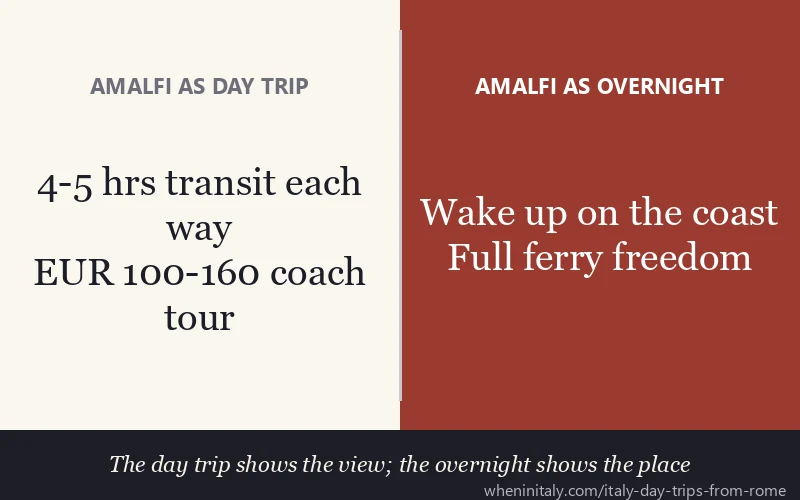
This is worth it in exactly one scenario: you are coming to Italy once in your life, you have a fixed Rome itinerary, and the alternative is “I will never set foot on the Amalfi Coast.” Under that constraint the SS163 view alone justifies the day. Under any other (you are coming back, your nights are flexible, you would consider Naples instead) the answer is two nights based out of Sorrento or Positano, or swap this day for Naples and let Amalfi wait for the next trip.
The underrated picks: Naples, Orvieto, Assisi, Castel Gandolfo, Ostia Antica
These are the five day trips that consistently outperform expectations and rarely appear at the top of generic listicles.
Naples is the single most underrated day from Rome. Frecciarossa one hour ten, EUR 15 to EUR 50. Morning at the National Archaeological Museum (Pompeii and Herculaneum frescoes and mosaics, the Alexander Mosaic, the Secret Cabinet); cheap pizza lunch in Spaccanapoli or the Quartieri Spagnoli at one of the originals (Da Michele, Sorbillo, Di Matteo); afternoon for the historic centre churches, the Veiled Christ at Cappella Sansevero (book ahead), and a sunset Lungomare walk to Castel dell’Ovo. You will not exhaust Naples in a day, but you will get a better Italian-city experience than most week-long tours of Rome deliver.
Orvieto sits on a tufa plateau in southern Umbria, an hour twenty from Termini on the Intercity (EUR 12 to EUR 25, no direct Frecciarossa). The cathedral facade is one of the great Gothic-Romanesque sights in central Italy; the interior holds Signorelli’s Last Judgement frescoes that influenced Michelangelo. The Pozzo di San Patrizio is a sixteenth-century double-helix well shaft you can walk down. A funicular from the station carries you to the old town. Small enough for a half-day, which means lunch on the piazza is genuinely unhurried.
Assisi is a quieter pick: two hours by Intercity, or two hours fifteen with a change in Foligno, EUR 10 to EUR 35. The Basilica di San Francesco is the obvious draw (Giotto’s frescoes of the saint’s life), but the medieval old town is the real reward, especially in late afternoon after the day-trip coaches leave. The station sits down in the valley at Santa Maria degli Angeli; a local bus or short taxi gets you up. Better as an overnight, but works as a day if you start early.
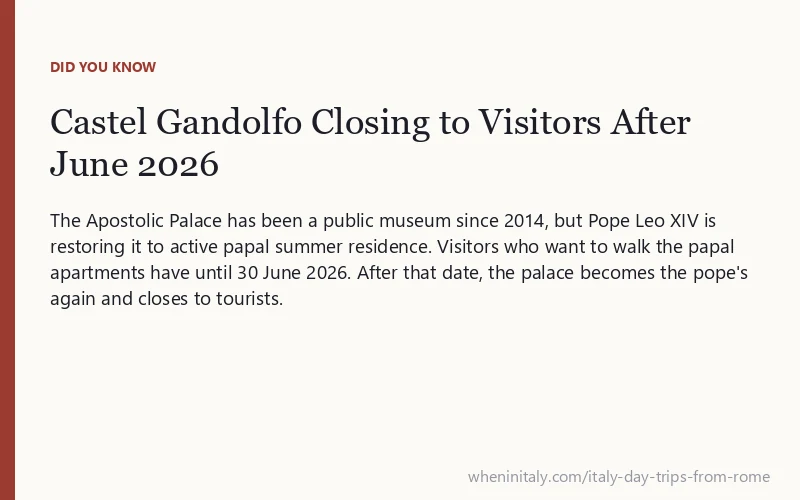
Castel Gandolfo and the Castelli Romani lakes sit on the volcanic crater rim south-east of Rome. Regional trains from Termini reach Castel Gandolfo in about an hour for EUR 2.20. Important 2026 update: the Apostolic Palace, a public museum since 2014, is closing to visitors after June 30, 2026 as Pope Leo XIV restores it to active papal summer residence. If you want to walk the papal apartments, you have until the end of June. After that the palace becomes the pope’s again, but the lakeside village, the Barberini gardens (verify access separately), Lake Albano below, and the broader Castelli Romani circuit (Frascati for wine, Nemi for strawberries) remain excellent for quiet picnic-and-lake-swim days.
Ostia Antica is the smartest of the five and the answer for anyone who looks at the Pompeii logistics and balks. Rome’s ancient port city sits thirty minutes from central Rome on the Metromare (formerly Roma-Lido) line, covered by a single EUR 1.50 metro ticket from Piramide. Entry EUR 18 (free first Sunday of the month, free under 18). The site is enormous, well-preserved (apartment buildings and the theatre survive), and almost empty by Pompeii standards. If you have done the Forum and Palatine and want more Roman ruins on your terms, with no Frecciarossa to book and no Circumvesuviana to survive, this is the answer.
Tuscany (Val d’Orcia) and wine country
Tuscany is the day trip that sounds romantic and breaks down on the timetable. The Val d’Orcia hill towns (Pienza, Montepulciano, Montalcino) are roughly two and a half hours south of Florence by car: four hours from Rome. There is no useful train option to the hilltops themselves; Chiusi and Buonconvento are the nearest stations, with hire car or tour minibus completing the leg.
A Val d’Orcia day from Rome works only as a guided coach: EUR 130 to EUR 220 per person, pickup 7 a.m., return around 9 p.m. A reputable operator runs a tight loop of Pienza (lunch and pecorino), Montepulciano (Vino Nobile tasting), and either Montalcino (Brunello, pricier tastings) or Cortona (the “Under the Tuscan Sun” town, photogenic). What you get: cypress avenues, two tastings, a working-farm lunch, the landscape. What you do not get: San Gimignano, Siena, or any sense of having slept in Tuscany.
The closer alternative is Frascati in the Castelli Romani, twenty minutes from Termini by regional train, where the Frascati DOC wineries are walkable from the town centre and the porchetta is excellent. Not Brunello country, but wine country, a third of the price, and back to Rome for dinner.
If wine and a slow lunch is the goal, Frascati outperforms Tuscany on every metric except prestige. If the cypress-tree photo is the point, the long Val d’Orcia coach is the only option, and it is worth it once.
Trains, prices, and what to book in advance
The single biggest cost lever on Rome day trips is when you buy your train ticket. Both Trenitalia (Frecciarossa, Frecciargento, Frecciabianca, Intercity, and Regionale) and Italo (private competitor on the high-speed corridor) use dynamic pricing: cheapest 30 to 60 days out, sharp rises in the final week.
A working framework for 2026:
- High-speed corridor (Rome to Naples, Florence, Bologna, Venice, Milan, Turin): book through trenitalia.com, italotreno.com, or an aggregator like Trainline. Expect EUR 15 to EUR 25 booking early on Naples or Florence, EUR 50 to EUR 90 walk-up. Italo is usually EUR 5 to EUR 15 cheaper than Trenitalia on head-to-head routes and runs newer trains with leather seats in every class. Trenitalia has more departures per hour and a wider network.
- Regional trains (Tivoli, Castel Gandolfo, Frascati, Civita Castellana): Trenitalia only; Italo does not sell Regionale. Walk-up at the station or buy on the Trenitalia app. Prices are fixed (EUR 2.20 to EUR 5 typical), no reward for booking ahead. Validate paper tickets in the green machines before boarding.
- Intercity to Orvieto and Assisi: book a few days ahead through Trenitalia for the modest discount (EUR 12 to EUR 25). No meaningful Italo competition on these.
- Pompeii’s Circumvesuviana: EAV operates this. EUR 3.20 cash or contactless at the Napoli Centrale entrance to the underground line. Do not try to combine with your Frecciarossa booking.
Two practical tips. The official Trenitalia and Italo apps both work in English and accept foreign cards; aggregators (Trainline, Omio, ItaliaRail) add EUR 2 to EUR 4 for one combined interface. The cheapest Trenitalia fare is “Super Economy” (non-refundable, non-changeable); Italo’s equivalent is “Low Cost.” A first-class upgrade on the one-hour Naples run is rarely worth the EUR 30 premium; on a four-hour Milan run it is.
The last word: do fewer day trips, do them well, and use the train system that connects Rome to half the country in under three hours. The places that fit a day are some of the most concentrated landscapes and ruins in Europe. The places that do not fit a day are not your fault for missing. They are next trip.
Sources and references
- Pompeii official ticket prices 2026 — pompeiisites.org
- Pompeii ticket prices 2026 breakdown — thepompeii.com
- Pompeii tickets 2026 vivaticket guidance — pompeiicity.com
- Frecciarossa Rome to Naples timetable and fares — italotreno.com
- Frecciarossa Rome to Florence pricing and frequency — Trainline
- Mount Vesuvius crater access fee and pre-booking — vesuvionline.net
- Mount Vesuvius National Park bookings — vesuviusnationalpark.it
- Villa d’Este Tivoli winter 2026 hours — villae.cultura.gov.it
- Villa d’Este opening hours and best time to visit — tivolitickets.com
- Hadrian’s Villa entrance fee and combo ticket — entrance-fee.com
- Combo Villa d’Este + Hadrian’s Villa skip-the-line — Headout
- Italo vs Trenitalia comparison 2026 — treniamo.it
- Italo vs Trenitalia for English-speaking travellers — tiltedmap.com
- Ostia Antica visiting guide 2026 — museos.com
- Ostia Antica official archaeological park — ostiaantica.beniculturali.it
- Roma-Lido (Metromare) ticket info — rome.us
- Amalfi Coast day trip from Rome — Rick Steves Travel Forum
- Is the Amalfi day trip from Rome worth it — dangerous-business.com
- Castel Gandolfo Apostolic Palace closing to public 2026 — ZENIT
- Apostolic Palace and Gardens visit info — villepontificie.va
- Orvieto train from Rome — Trainline
- Assisi train from Rome — ItaliaRail