Key takeaways
- A Capri day trip is genuinely realistic only from Sorrento (25-minute hydrofoil, EUR 22-24) or Naples (45-50 minutes, EUR 24-26). From Positano or Amalfi it works in summer with effort. From Rome it eats the full day in transit.
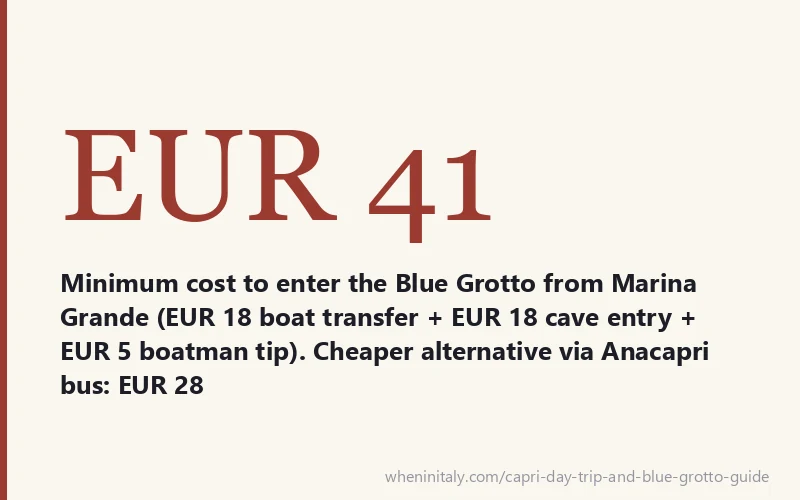
- The Blue Grotto costs roughly EUR 41 minimum (boat transfer EUR 18 + cave entry EUR 18 + boatman tip ~EUR 5) for a rowing-boat passage that lasts 60 to 90 seconds inside. The cave is closed whenever swell rises, which happens often in winter and on roughly a third of summer days.
- The cheap alternative: take the orange Anacapri-to-Grotta-Azzurra bus (EUR 2.40), pay only the EUR 18 entry plus tip, and walk down the cliff staircase to the same boat dock. Total per person: about EUR 28.
- Capri town is the postcard (the Piazzetta, Faraglioni viewpoint, Prada and Gucci windows). Anacapri is the working village with the chairlift, Villa San Michele, and the land entrance to the Blue Grotto. Most visitors should split the day between both.
- A new EUR 5 per-person landing fee (April 1 to October 31) is now baked into ferry tickets. Off-season it drops to EUR 2.50.
- No private cars for non-residents from April 1 to November 2 and again from December 22 to January 6. Penalties run EUR 430 to EUR 1,731. Plan on foot, bus, funicular, and small boats.
The honest Capri day trip at a glance
A Capri day trip is one of the most over-promised excursions in Italy and one of the easier ones to get right with realistic expectations. From a Sorrento or Naples base, the math is forgiving: 25 to 50 minutes each way at EUR 22-26 per leg, plus the EUR 5 landing fee folded into the ticket from April through October. That leaves five or six usable hours on the island, enough for the funicular up to Capri town, a Faraglioni boat circuit or the Monte Solaro chairlift, lunch, and one or two viewpoints. From Positano and Amalfi the day still works in season (April to early November) but with a thinner schedule. From Rome it is a 4-to-5-hour door-to-door journey each way, more transit than travel. The Blue Grotto is the wild card: the most famous attraction on the island operates only when the sea is calm enough, and even on a perfect day the actual visit lasts about a minute. This guide treats every cost, time and decision in 2026 numbers, then explains what to skip when the weather refuses to cooperate.
From which base? Sorrento vs Naples vs Positano/Amalfi vs Rome
The base matters more than the day, because the ferry math is what kills or saves a Capri day trip.
Sorrento (the cleanest base). Hydrofoils run from Sorrento’s Marina Piccola every 30 to 60 minutes from April through October, the fastest about 17 to 20 minutes with SNAV or Alilauro Gruson, the average closer to 25 minutes. One-way fares start around EUR 21-24. Operators on this route: Alilauro Gruson, NLG (Navigazione Libera del Golfo), SNAV, Caremar, and Laser Capri. In high season the last return departs around 19:45; in winter it pulls back to 18:40. Sorrento sits 50 minutes by Circumvesuviana train from Naples, a logical launchpad even for travellers based further north.
Naples (faster only on paper). Two ports, two different experiences. Hydrofoils and high-speed catamarans depart Molo Beverello in front of Castel Nuovo; conventional ferries leave Calata Porta di Massa, a 15-minute walk or short shuttle from Beverello. The Beverello hydrofoil takes about 45 minutes at roughly EUR 24-26. The Caremar conventional ferry from Calata Porta di Massa is the cheapest way across at around EUR 14-20 but takes 75 to 90 minutes. Operators: Caremar, NLG, SNAV, Alilauro. Naples-based travellers gain frequency and lose the scenic factor compared to Sorrento.
Positano and Amalfi (seasonal only). NLG runs hydrofoils from Positano roughly April 1 through November 3, about half a dozen sailings a day in peak season, a 30-to-40-minute crossing starting around EUR 29. From Amalfi the ferry is closer to 50-60 minutes at EUR 23.50-25.50 (landing fee included). Rough seas regularly cancel sailings, advance booking is non-negotiable in July and August, and a missed return strands the visitor in Sorrento or Naples overnight. Outside the April-to-October window there is essentially no service.
Rome (don’t). There is no direct ferry. The realistic itinerary is Frecciarossa from Roma Termini to Napoli Centrale (about 1 hour 10 minutes), a 15-minute taxi or transfer to Beverello, then a hydrofoil to Capri. Door-to-door is 4 to 5 hours each way, leaving perhaps 4 hours on the island. Day trips from Rome to Capri exist as packaged tours; almost all of them are exhausting.
The cleanest base is Sorrento. The cheapest is Naples via Calata Porta di Massa. The most romantic is Positano in June. The worst is Rome.
The Blue Grotto: is it worth it in 2026?
The honest answer: it depends on the weather and the queue, and visitors should make the decision on the morning of, not the night before.
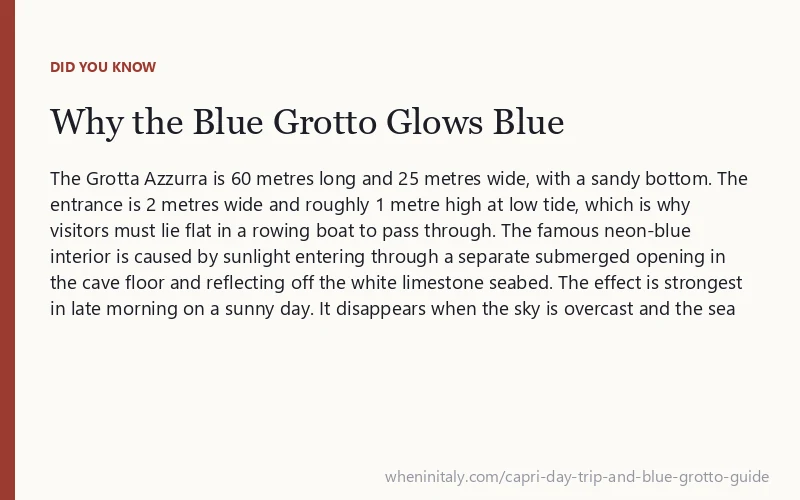
The cave itself. The Grotta Azzurra is a sea cave on the northwest coast, 60 metres long and 25 metres wide, with a sandy bottom about 150 metres deep. The entrance is 2 metres wide and roughly 1 metre high at low tide, which is why visitors must lie flat on the floor of a four-person rowing boat to pass through. The famous neon-blue interior is caused by sunlight entering through a submerged opening and reflecting off the white limestone seabed. The boatman rows a small loop inside the cave for 60 to 90 seconds, often singing, then exits.
The cost stack from Marina Grande. A motorboat transfer from Capri’s main harbour to the cave entrance runs about EUR 18-24 round trip. The cave entry itself, paid at a floating ticket office bobbing outside the entrance, is EUR 18 for adults (free for EU citizens under 18, EUR 14 for EU citizens aged 18-25, free for children under 6). The rowboat skipper expects a EUR 5 tip as a working norm. Total: EUR 41 minimum, plus whatever queue time the day delivers (often 60-90 minutes in July and August).
The cheap alternative. Take the orange Anacapri-to-Grotta-Azzurra bus from Piazza Cimitero in Anacapri to the cliff terminus near Via Grotta Azzurra. The bus is about EUR 2.40 one way. From the bus stop, walk down a cliffside staircase to the same floating ticket office and the same rowboats. Pay only the EUR 18 entry plus tip. Total per person: about EUR 28, and the queue time is often shorter because waiting happens on solid stairs rather than bobbing on the water. This is the route When in Italy recommends for anyone who is fundamentally curious but unwilling to pay EUR 41 for 90 seconds.
The closure problem. The cave is closed whenever swell exceeds roughly 30 to 40 centimetres at the entrance, because the rowboat physically cannot pass safely. Closures are routine from November through March and happen on roughly a third of summer days. Boatmen do not commit to opening until they arrive at the entrance around 09:00 each morning, and the cave can re-close mid-day if conditions shift. There is no published refund policy from operators that sell pre-paid Blue Grotto packages; in practice, motoscafisti operators reroute to a Faraglioni circuit with no Blue Grotto stop.
The verdict. On a flat-calm spring or autumn morning with the Anacapri bus approach and a 20-minute queue, the Blue Grotto is a beautiful 90 seconds and worth doing once. On a busy summer afternoon with a 90-minute queue and swell rolling in, it is a coin flip with bad odds. Check the morning weather, ask the Marina Grande boatmen for the day’s status, and don’t pre-book.
Capri town vs Anacapri: which side?
The island has two municipalities and they feel like different worlds. Most day trippers see one and assume Capri is one place; the better day visits both.
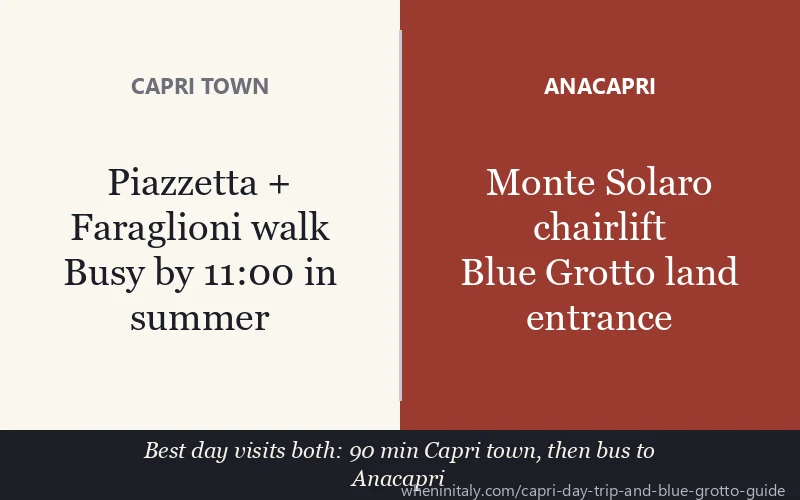
Capri town sits on the eastern half of the island at about 140 metres above sea level, reached from Marina Grande by the funicular (4 minutes, EUR 2.40 from the office or EUR 2.90 onboard, runs every 10-15 minutes from 06:30 to 23:00 in season). The social heart is the Piazzetta (officially Piazza Umberto I), a tiny square of cafe terraces under a clock tower. From here, the famous Via Camerelle runs through the Prada/Gucci/Hermes shopping district to Via Tragara, ending at the Punta Tragara viewpoint over the Faraglioni rocks (a 15-minute walk from the Piazzetta). This is the postcard Capri: glamorous, expensive, crowded by 11:00 in summer, and genuinely beautiful at the edges.
Anacapri sits on the western half at about 290 metres, reached from Capri town by orange bus (15 minutes, EUR 2 per ride) or taxi. The vibe is older, calmer, more residential. The main square is Piazza Vittoria, from which radiate three of the island’s most rewarding stops: the Monte Solaro chairlift (the island’s highest viewpoint at 589 metres), Villa San Michele (Axel Munthe’s clifftop home), and the orange bus down to the Blue Grotto land entrance. The shopping is smaller, the prices are lower, the crowds are thinner, and the views from the chairlift summit are arguably the best on the entire island.
Most one-day itineraries collapse if the visitor stays only in Capri town. The honest split is roughly: 90 minutes in Capri town and around the Piazzetta, 90 minutes for the Punta Tragara walk and Faraglioni view, then bus over to Anacapri for the chairlift and Villa San Michele. Lunch wherever the queue is shortest.
The five must-do experiences once you’re on the island
After hundreds of trips through, these are the stops that justify the ferry ticket.
1. The Faraglioni boat tour. A 2-hour group circuit around the island runs about EUR 25-30 per person with operators like Laser Capri or Motoscafisti from Marina Grande; private boats start around EUR 200 and climb toward EUR 400-500 for half a day. The standard route circles the island, passes Villa Malaparte, and slows through the central arch of the Faraglione di Mezzo (the middle of the three Faraglioni rocks), where superstition holds that a kiss inside the arch promises lasting love. Most circuits include a Blue Grotto attempt; this is a legitimate way to combine the two.
2. The Monte Solaro chairlift. A 12-minute single-rider chair ride lifts visitors from Anacapri to the 589-metre summit of Monte Solaro, the highest point on the island. Round-trip ticket: EUR 14 (EUR 11 one way, useful for hikers walking back down). Hours: 09:15 to 18:00 in June, July and August, 09:15 to 17:00 April-May and September-October, 09:30 to 16:00 in winter. The summit terrace serves coffee and beer, and the view sweeps from the Sorrentine peninsula across to the Faraglioni and out to Punta Carena. On a clear day this is the single best photograph on the island.
3. Villa San Michele. Built between 1896 and 1907 by Axel Munthe, the Swedish doctor and writer (and personal physician to Queen Victoria of Sweden), whose 1929 memoir The Story of San Michele turned the house into a literary pilgrimage site. Entry EUR 12 (EUR 8 students, free under 12). Open daily, with seasonal hours running 09:00 to 19:00 in June through August and tightening to 09:00 to 15:30 in winter. The Sphinx terrace looks straight down over Marina Grande and the Bay of Naples. Closed in February.
4. The Punta Tragara viewpoint and Via Tragara walk. A 15-minute level walk from the Piazzetta along Via Camerelle and Via Tragara delivers visitors to a stone terrace with the most-photographed view of the Faraglioni rocks. Free. From Punta Tragara a stepped path called the Pizzolungo continues along the cliffs toward the Arco Naturale (a 200-metre natural limestone arch); allow 90 minutes round trip if combining the two.
5. Via Krupp and Marina Piccola. Via Krupp, the serpentine cliff path commissioned by industrialist Friedrich Alfred Krupp in 1900-1902, reopened in April 2025 after years of closure for rockfall safety work. It descends from the Augustus Gardens above Capri town to Marina Piccola, the small swimming harbour on the south coast. The path is generally accessible May through October when conditions allow; visitors should check the morning of as occasional closures still occur. Marina Piccola itself is the standard Capri swimming spot, with two pebble beaches separated by the Scoglio delle Sirene rock (where Homer’s sirens supposedly sang to Odysseus).
Day trip or overnight?
The case for an overnight on Capri is real, and most day trippers underestimate it.
The transformation happens at 18:00, when the last hydrofoils to Sorrento, Naples, Positano and Amalfi have departed and the day-trip volume drains off the funicular. The Piazzetta, which was elbow-to-elbow at lunch, slips into a Mediterranean evening tempo: aperitivo at one of the four corner cafes, the church bells, the swallows, the staff finally able to sit. The Punta Tragara walk at sunset is one of those experiences that is memorable in a way the same walk at noon is not, because it is empty. Anacapri after dark feels almost rural.
The cost is significant. Hotel rates on Capri run roughly 3x mainland equivalents in season: a clean three-star room that books for EUR 120-150 in Sorrento is closer to EUR 350-450 on Capri. Even modest options struggle below EUR 250 in July and August. Restaurants follow the same multiplier; a casual pasta-and-house-wine lunch that costs EUR 25 in Sorrento costs EUR 45-55 on the island.
The honest decision rule: if the budget allows one splurge night on the trip, an overnight on Capri delivers more dramatic value than splurging on a single dinner anywhere on the mainland. If the budget does not allow it, day-trip from Sorrento and accept that the 17:30 hydrofoil queue at Marina Grande is part of the experience.
What does it cost in 2026?
A realistic per-person budget for a Capri day trip from Sorrento, with the Blue Grotto included, breaks down like this in 2026:
| Item | Cost (EUR) | Notes |
|---|---|---|
| Sorrento-Capri hydrofoil round trip | 44-48 | EUR 22-24 each way; landing fee included Apr-Oct |
| Capri landing fee (Apr 1 - Oct 31) | 5 | Folded into the ferry ticket; EUR 2.50 in winter |
| Funicular Marina Grande to Capri town | 2.40 | One way; EUR 2.90 if bought onboard |
| Anacapri bus (round trip from Capri town) | 4 | EUR 2 each way |
| Blue Grotto from Marina Grande (transfer + entry + tip) | 41 | EUR 18 boat + EUR 18 entry + EUR 5 tip |
| Blue Grotto via Anacapri bus (entry + tip + bus) | 28 | The cheap route |
| Monte Solaro chairlift round trip | 14 | EUR 11 one way |
| Villa San Michele entry | 12 | Free under 12 |
| Faraglioni boat tour (2-hour group) | 25-30 | Per person, group basis |
| Casual lunch (pasta + drink) | 25-35 | Anywhere away from the Piazzetta |
| Lunch at Da Luigi ai Faraglioni | 100-150 | Beach club + restaurant; EUR 120 day pass |
| Da Luigi shuttle from Marina Piccola | 10 each way | Operates from 10:00 to closing |
A frugal day with the Anacapri-bus Blue Grotto, chairlift, and casual lunch lands around EUR 110-130 per person all-in. A standard day with the Marina Grande Blue Grotto, chairlift, Villa San Michele, and a sit-down lunch in Capri town lands around EUR 165-195. A splurge day with a Faraglioni private boat or Da Luigi lunch jumps quickly past EUR 300-400.
Da Luigi ai Faraglioni deserves its own note. The beach club restaurant is the only private property allowed to operate at the base of the Faraglioni rocks. A full-day pass runs about EUR 120 per person and includes a sun bed, facilities, and a credit toward the bar or restaurant. The shuttle from Marina Piccola costs about EUR 10 each way. Lunch tables book months in advance for July and August; off-season they can sometimes be had on a few days’ notice.
Best time, with kids, with limited mobility
The sweet spot. Late April through mid-June and late September through October are the right windows. Sea is generally calm enough for the Blue Grotto (though never guaranteed), ferries run their full April-October schedules, the Faraglioni boats are operating, and crowds are manageable. July and August are brutally busy, with two-hour Blue Grotto queues, packed funiculars, and Piazzetta cafes turning tables hard. November through March is genuinely quiet but ferry frequency thins, the Blue Grotto is closed more often than not, the funicular shuts down for maintenance from January through Easter (replaced by a bus), and Villa San Michele closes for all of February.
With kids. The Monte Solaro chairlift accepts children from age 8 unaccompanied and from age 4 with an adult on the same chair (the chair is a single-seat lift, so the child sits on the parent’s lap; some staff are stricter). Villa San Michele works for any age; the gardens are flat enough for a stroller. The Blue Grotto is hit-or-miss with small children who cannot lie flat and quiet during the 60-second cave passage; the boatmen are patient but the entrance is genuinely tight. The Faraglioni boat circuit is generally fine for school-age children who tolerate boats.
With limited mobility. Capri is hard. The funicular and buses are accessible, and Capri town’s Piazzetta and main shopping streets are essentially level. But the walk to Punta Tragara involves stairs, the Anacapri-to-Blue-Grotto cliff staircase is steep and unrailed in places, and the Blue Grotto itself requires lying flat in a small boat (functionally unworkable for wheelchair users). Villa Jovis is a 45-minute uphill walk with 200 metres of elevation gain. Villa San Michele has steps. The Monte Solaro chairlift requires stepping on and off a moving single chair and is not wheelchair-accessible. The most rewarding accessible day combines the funicular up to Capri town, the Piazzetta, the level shopping streets, the Augustus Gardens, and a Faraglioni boat circuit from Marina Grande.
No-cars practicality. From April 1 through November 2 and again from December 22 to January 6, non-resident vehicles cannot disembark or circulate on the island. Penalties run EUR 430 to EUR 1,731. This applies to rental cars and motorbikes. There are exceptions for residents, emergency services and verified accessibility vehicles. Plan around the funicular, orange buses, taxis, and small boats. Luggage from the ferry to a hotel is best handled by the hotel’s own porter service or by the licensed luggage porters at Marina Grande, since rolling a suitcase through the funicular and across cobbled lanes is its own form of cardio.
Sources and references
- Blue Grotto Capri – Complete Guide 2026 (Capri.com)
- Blue Grotto (Capri) – Wikipedia (cave dimensions, entrance height)
- Blue Grotto opening times and tickets (bluegrotto.tours)
- Capri Tourism — official site (capritourism.com)
- How to visit the Blue Grotto by land via Anacapri bus (AmalFeet)
- Capri 2026 ferry schedules and prices (capri.com)
- Sorrento – Capri ferries 2026 (capri.com)
- Naples – Capri ferries 2026 (Ferryhopper)
- Positano – Capri 2026 ferry schedules (positano.com)
- NLG hydrofoil routes (nlg.it)
- Capri 2026 funicular and bus schedules
- Monte Solaro chairlift official site (capriseggiovia.it)
- Villa San Michele official site (villasanmichele.eu)
- Villa San Michele opening hours and prices (Capri.com)
- Villa Jovis access and tickets (Capri.com)
- Via Krupp 2025 reopening (Finestre sull’Arte)
- Capri car ban 2026 dates and penalties (Cronache della Campania)
- Capri 2026 landing fee and tourist tax changes (Travel and Tour World)
- Da Luigi ai Faraglioni beach club official site
- Faraglioni boat tours from Capri (Capri.com)