Key Takeaways
- The Gran Cono crater hike is short (about 4 km round trip from the upper car park, roughly 140 m of elevation gain) and takes most visitors 2.5 hours including the rim walk. It is not a summit climb in any mountaineering sense.
- An entry ticket to the Gran Cono trail (Sentiero #5) costs EUR 10 in 2026 and must be pre-booked online; the park sells timed slots up to 30 days ahead and the summer slots routinely sell out 7 to 14 days early.
- A licensed guide accompanies every group on the trail. This is mandatory and built into the EUR 10 fee, so visitors do not need to book a separate guide.
- Three base towns serve the volcano: Ercolano (shortest road, 9 km), Pompei (13 km, with the off-road Busvia option), and Naples (no direct public route, only organised tours). Ercolano is the operationally simplest base.
- Vesuvius last erupted in March 1944 and sits at “base” / green alert level as of May 2026 according to the INGV Osservatorio Vesuviano in Naples.
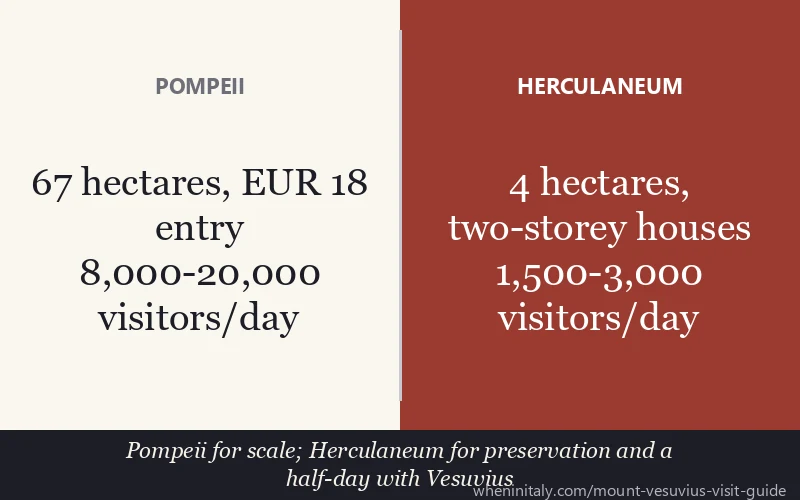
- For a same-day archaeology pairing, Herculaneum is the editorial pick: 4 hectares of carbonised wood and standing two-storey houses, against Pompeii’s 67 hectares and 8,000 to 20,000 daily visitors.
The honest visit at a glance
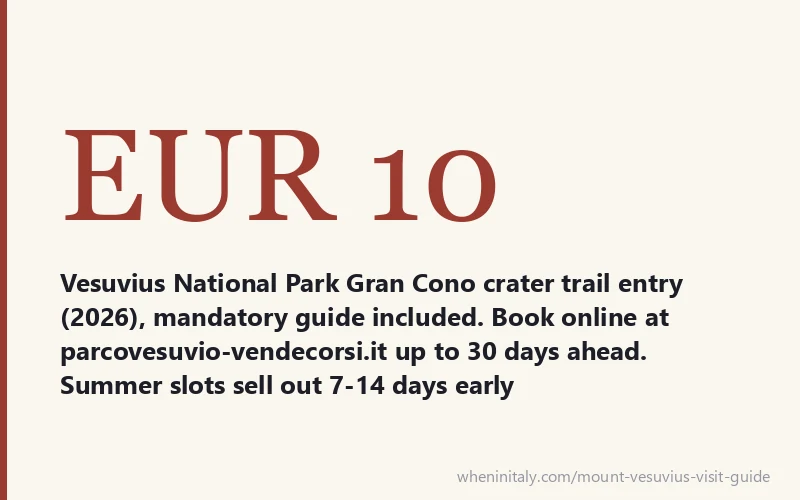
A Mount Vesuvius visit in 2026 looks like this in practice. A bus or shuttle drops visitors at Quota 1000, the upper car park at exactly 1,000 m above sea level. From there, a single trail (Sentiero #5, the Gran Cono) climbs in switchbacks across loose volcanic gravel up to 1,175 m, where a railed path runs partway around the crater rim. A park guide leads each group. The crater itself is an elliptical bowl 580 m wide at its maximum diameter, with visible fumaroles on the inner walls. Allow about 30 to 40 minutes uphill, 20 to 30 minutes on the rim, and 25 minutes back down: roughly 2.5 hours from bus stop to bus stop. The volcano is not the day’s only stop for most visitors. It pairs naturally with Pompeii or Herculaneum, both reachable on the same Circumvesuviana railway line. The friction lives in two places: the Vesuvius National Park ticket is mandatory, online-only, and books out in summer; and the choice of base town (Ercolano vs Pompei vs Naples) materially changes how long the day takes and how much it costs.
The three bases: Ercolano, Pompei, or Naples?
The single most useful decision happens before booking any ticket: which base to use for the volcano leg. Each option exists for a reason, and the right one depends on which archaeological site is being paired with the day.
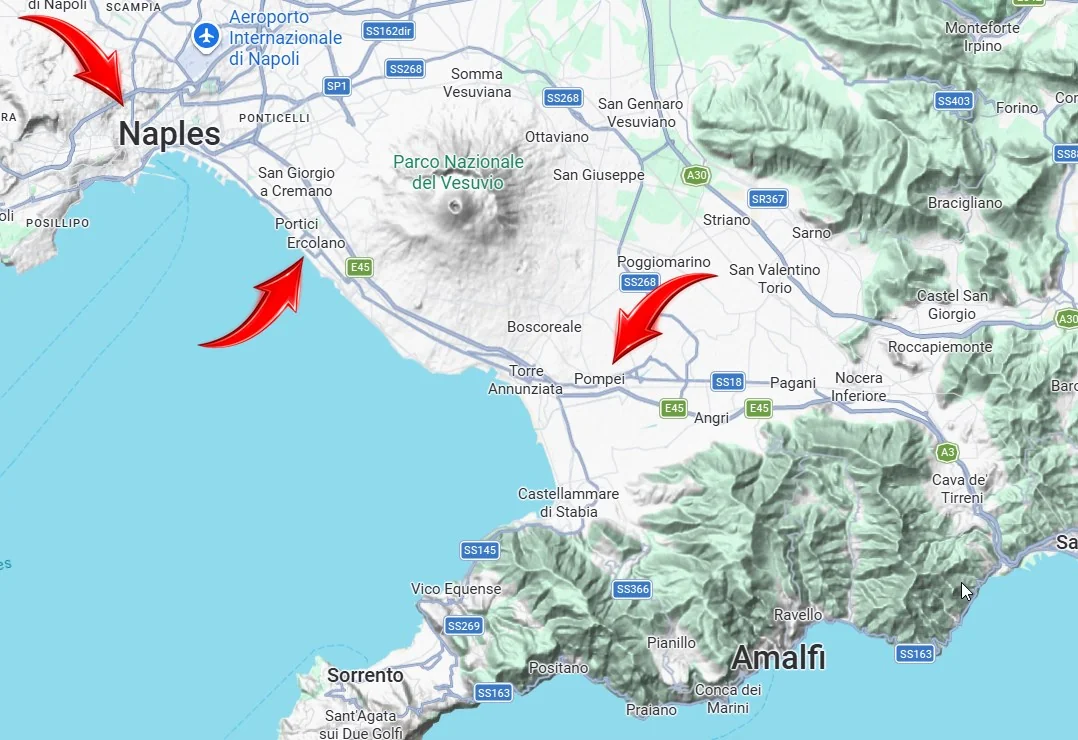
Ercolano (Ercolano Scavi station). This is the shortest road approach, about 9 km from the station to Quota 1000 via the SP4 Strada Provinciale del Vesuvio (drive route in Google Maps). The dominant operator here is Vesuvio Express, a private shuttle running from a kiosk on the square in front of Ercolano Scavi station. Round-trip transport is around EUR 17 to 22 (May 2026), with departures roughly every 30 to 40 minutes from 09:00 onwards. Summer service runs until 17:00; winter service ends earlier, around 14:00. The journey takes about 30 minutes each way. Ercolano is the operationally simplest base, which is why most independent visitors choose it. It is also where Herculaneum sits, two minutes’ walk from the same station.
Pompei (Pompei Scavi-Villa dei Misteri station). The road from Pompei is longer (about 13 km) and uses the historic Matrone road, a route that winds through the lava beds of the 1944 eruption (Pompei Scavi to Vesuvius in Google Maps). The signature operator here is Busvia del Vesuvio, a 4x4 service operated by the Torquato Tasso cooperative of Sorrento, with exclusive concession to use the Matrone road. The 4x4 leg through the volcanic landscape is the unique selling point and the reason this option costs more (around EUR 22 round trip in 2026, climbing higher with combo tickets). For travellers anchoring the day on Pompeii, this base saves the train transfer to Ercolano. There is also a public alternative: EAV bus line 808 runs from Pompei Piazza Anfiteatro toward Vesuvius for EUR 3.10 one way, with a journey time of around 55 minutes and departures throughout the morning (8:30, 9:50, 10:45, 11:30, 12:00, 13:00, 13:30, 14:00, 14:30, 15:45). It is the cheapest route by a wide margin and the slowest by a wider one.
Naples (Piazza Garibaldi or the cruise port). There is no direct public bus from Naples to Vesuvius (Napoli Centrale to Vesuvius in Google Maps). Visitors arriving from Naples either take the Circumvesuviana to Ercolano Scavi and switch to a shuttle there, or join an organised group tour that handles the transfer end to end. The skip-the-confusion appeal of a Naples-departing tour is real, but it adds an hour or more to the day’s total transit and removes the ability to set the visit’s pace. The “When in Italy” recommendation: skip Naples-direct bus tours if mobility allows the train change. The Circumvesuviana from Napoli Garibaldi to Ercolano Scavi is a 25-minute ride for under EUR 3.
The clean rule: pair Ercolano with Herculaneum, pair Pompei with Pompeii, and treat Naples as a transit hub rather than a base.
The Gran Cono crater hike: what to expect
The Gran Cono, Italian for “Great Cone,” is the formal name of Sentiero #5, the only trail in the Vesuvius National Park that reaches the active crater rim. The numbers, verified against the park’s 2026 trail data: total route length 4,010 m round trip, maximum altitude 1,175 m, starting elevation 1,000 m at Quota 1000 (the upper car park), average grade around 14%. Most visitors take 30 to 40 minutes to walk up.
The surface is the first thing visitors notice. The trail traverses ash and lapilli from the 1944 eruption, a coarse black gravel that crunches underfoot and slips backward on the steeper hairpins. Closed-toe sturdy shoes are mandatory at the trailhead. The park staff turns visitors back at the gate if they show up in sandals or open-toed footwear; this is not a soft enforcement.
A licensed guide from the Permanent Vesuvius Volcano Base (PPVV) accompanies every group along the entire trail. The guide handles geological commentary, manages timing on the rim, and enforces the no-stopping-on-the-narrow-section rule. The Vesuvius National Park describes the guide requirement plainly: “Each group will be accompanied by a guide from the Vesuvius Volcano Permanent Base throughout the duration of the excursion.” Visitors do not need to bring or book their own guide; one comes with the entry fee.
At the top, the crater rim path runs partway around the bowl. The crater is elliptical, with a maximum diameter of 580 m, and the inner walls show active fumaroles, gas vents that release sulphurous steam at temperatures the volcano has held stable for years. There is a railing on the volcano-facing side. On clear mornings, the view stretches west across the Bay of Naples to Capri and Ischia and east into the Apennines. By 11:30 in summer, haze and convective clouds typically build across the bay and the panorama dulls; this is the operational reason morning slots are worth booking.
There is one shop and a small bar at Quota 1000, but no food, water, or toilets along the trail itself. Carry a water bottle. The practical framing: Vesuvius rewards visitors who show up early, in good shoes, with water already in the pack. Arrive at noon expecting facilities and the volcano will not oblige.
Tickets, booking, and the EUR 10 mistake to avoid
The Vesuvius National Park entry ticket for the Gran Cono trail costs EUR 10 in 2026. A reduced ticket of EUR 8 applies to specific eligibility categories. This fee includes the mandatory guide. Tickets are sold exclusively online, exclusively through the official park ticketing portal at parcovesuvio-vendecorsi.it, and are released for purchase up to 30 days in advance.
There is a recurring scam pattern on this volcano that is worth naming directly. Third-party sites sell “Vesuvius tickets” at marked-up prices (EUR 18, EUR 25, sometimes EUR 30 or more), packaging the EUR 10 entry with a transport leg or a Pompeii combo. Some are legitimate operators (GetYourGuide, Tiqets, and the established local shuttle companies all bundle entry with transport, which is genuine value). Others simply resell the EUR 10 ticket at a markup with no added service. The clean test: if a site is selling only the park entry ticket with no transport, no skip-the-line claim, and no tour guide above the mandatory PPVV guide, the right price is EUR 10. Anything materially above that is a resale margin.
The official portal accepts credit cards, requires the cardholder’s personal details at booking, and issues a timed slot. Visitors should arrive at Quota 1000 at least 20 to 30 minutes before the slot start. Latecomers can be denied entry if a fresh group has already departed.
In the May to October window, weekend slots and morning slots routinely sell out 7 to 14 days ahead. November to March, walk-up availability is more forgiving but the trail closes in winter winds above 50 km/h, so booking too far ahead carries weather risk.
Pompeii or Herculaneum: which to pair with Vesuvius?
This is the single most-asked editorial question Vesuvius generates, and the conventional answer (Pompeii, because it is famous) is the wrong one for a meaningful share of visitors.
The numbers tell the story. Pompeii covers 67 hectares of excavated city and receives somewhere between 8,000 and 20,000 daily visitors at peak season, with an annual total around 3.5 to 4 million. Herculaneum (Ercolano Scavi) covers 4 hectares and receives around 1,500 to 3,000 daily visitors, with an annual total of roughly 300,000 to 500,000. Standard adult entry to Pompeii is EUR 18 in 2026, with a Pompeii+ ticket at EUR 25 that adds the suburban villas (Villa of the Mysteries, Villa of Diomedes, Villa Regina at Boscoreale). A combined Pompeii + Herculaneum ticket runs EUR 22 and is valid for 48 hours. From 2 March 2026, official tickets shifted from TicketOne to vivaticket.com.
The preservation difference is the editorial gold. Pompeii was buried under pumice and ash, with multi-storey buildings collapsing under weight. Herculaneum was hit by pyroclastic surges of superheated gas and mud that carbonised wood instead of burning it: standing two-storey houses, intact wooden beams, original stairs, even carbonised loaves of bread are routinely visible. Pompeii is the larger story; Herculaneum is the better-preserved one.
For a same-day Vesuvius pairing, the time arithmetic favours Herculaneum. A thorough Herculaneum visit takes 1.5 to 2 hours; Pompeii’s 67 hectares cannot be done justice in less than 3 hours and most thoughtful itineraries allow 4 or 5. Pairing Vesuvius (2.5 hours plus shuttle time) with Herculaneum (1.5 to 2 hours) plus the Ercolano Scavi station, which sits between them, produces a comfortable half-day. Pairing Vesuvius with Pompeii produces a long, hot day that ends with rushed last galleries.
The case for Herculaneum in plain editorial terms: this is not the dramatic story of Pompeii. It is the quieter story of how Romans actually lived. The wood of the doorframes survived. The second floors stand with their windows in place. The Villa of the Papyri held a library of carbonised scrolls now being unrolled by computational physicists. Visitors who only see Pompeii tend to leave thinking the ancient world was monumental. Visitors who see Herculaneum tend to leave understanding it was domestic.
The opinion piece, plainly: Herculaneum is the connoisseur’s pick and the more forgiving Vesuvius pairing. Pompeii is the right call only if the broader itinerary requires the larger site for its symbolic weight, or if the visitor is not pairing with Vesuvius at all and can give Pompeii a full day.
What’s the eruption status in 2026?
Mount Vesuvius is currently at green alert (level “base”) and presents no short-term eruption risk according to the INGV Osservatorio Vesuviano, the Naples-based observatory of Italy’s National Institute of Geophysics and Volcanology that has monitored the volcano continuously since 1841.
The numbers from the most recent INGV bulletin (March 2026): 87 minor seismic events in the prior month with a maximum local magnitude of 1.3, mostly below magnitude 1.0; stable fumarolic temperatures at the crater; no magmatic ground deformation detected via the GNSS network; and declining hydrothermal gas trends for SO2 and CO2. The INGV summary on Vesuvius reads: “Since the last eruption in 1944, the volcano has been in a quiescent stage characterized only by low seismicity and fumarolic activity. No precursory phenomena indicate a possible resumption of the eruptive activity in the short-term.”
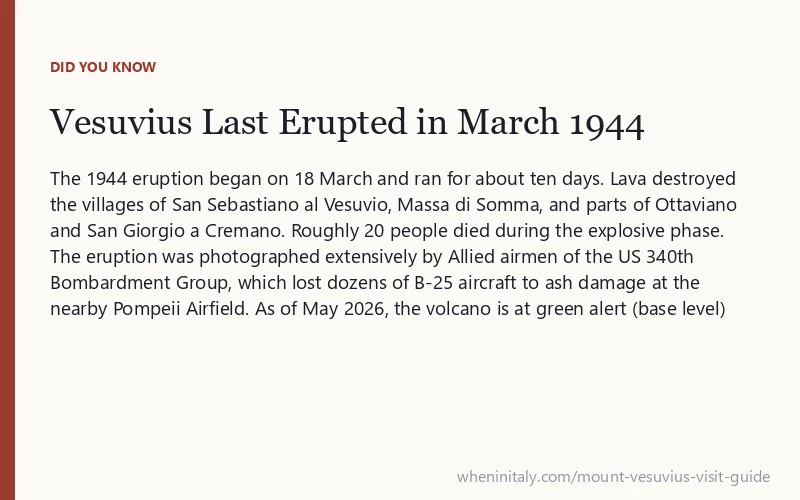
The 1944 eruption is the reference point for the modern volcano. It began on 18 March 1944 and ran for about ten days. Lava destroyed the villages of San Sebastiano al Vesuvio, Massa di Somma, and parts of Ottaviano and San Giorgio a Cremano. Roughly 20 people died during the explosive phase, a number kept low by mass evacuations. The eruption was photographed extensively by Allied airmen of the US 340th Bombardment Group, which lost dozens of B-25 aircraft to ash damage at the nearby Pompeii Airfield. Those photographs are the most-circulated images of a Vesuvian eruption in the modern era.
The longer-horizon picture is more sobering. The Italian Department of Civil Protection’s Vesuvius emergency plan defines a “red zone” of 25 municipalities housing approximately 700,000 residents who would be subject to mandatory pre-emptive evacuation in the event of an eruption. A wider impact zone of about 3 million people lives close enough to be materially affected. The plan budgets 72 hours for evacuation: 12 hours to organise, 48 hours to transfer people outside the red zone, and a 12-hour safety margin. Visitors should know the plan exists, but it is not an active concern in May 2026. The volcano is monitored 24 hours a day, and any eruptive precursors would be flagged days to weeks in advance. The trail also closes pre-emptively in adverse weather (high winds, thunderstorms), which is a much more common reason for a cancelled visit.
Best time of year, best time of day
The Vesuvius sweet spots are May to early June and mid-September to mid-October. These windows offer the clearest air, the most reliable summit visibility, manageable temperatures (typically 18 to 24 degrees Celsius at the trailhead, 10 to 15 at the rim), and the lightest crowds. Slots at this time of year can usually be booked 3 to 7 days ahead.
July and August are the months to avoid if scheduling allows. The combination of Mediterranean afternoon haze, urban-source pollution from the Naples conurbation, and convective cloud build-up over the mountain typically erases the panorama by 11:30. Trailhead temperatures hit 30 to 35 degrees Celsius with no shade above the bus stop. Slots sell out 10 to 14 days ahead and the Vesuvio Express shuttles run at near-capacity. Closures for high winds spike in the shoulder of summer thunderstorm season.
Within any given day, morning slots win. The 09:00 and 09:30 slots from the park’s opening, paired with the first or second Vesuvio Express shuttle from Ercolano Scavi, give the cleanest photographs and the calmest crater rim. Afternoon visitors regularly find the panorama gone by the time they reach the top. The park opens at 09:00 year-round and closes between 15:00 (winter) and 18:00 (July to August), with shoulder-season hours of 16:00 (March, October) and 17:00 (April to June, September).
Closures: the park closes pre-emptively at sustained winds above 50 km/h, in active thunderstorms, and on days of declared volcanic-monitoring procedures. Cancellations are announced on the park website; refunds for closed-trail days are issued automatically by the official portal but can take 7 to 10 working days.
What to bring, with kids, with limited mobility
Footwear and clothing. Closed-toe sturdy shoes are mandatory and enforced at the trailhead. Trail runners or light hiking boots are ideal; sneakers work. A light windbreaker is needed even in summer because the temperature drops 10 to 15 degrees Celsius between Quota 1000 and the crater rim, and the wind on the rim is steady. Sunglasses and sunscreen are essential because there is zero shade above the bus stop. Carry at least 0.5 to 1 litre of water per person (no water sold on the trail) and a small snack.
With kids. The trail is short and the gradient is moderate, but the surface is loose volcanic gravel and the route has no shade. The Vesuvius National Park considers age 6 the practical threshold for kids to walk the full trail under their own power. Under 4, a child carrier is required (no strollers; the gravel and steepness make them unusable). Ages 4 to 6 typically need to be carried on the steeper hairpins. The crater rim is railed on the volcano-facing side and is safe with attentive supervision. Avoid July and August with kids; the heat and lack of shade make it punishing for small children.
With limited mobility. The Gran Cono trail is not wheelchair-accessible. The surface, the gradient, and the narrow rim sections rule out wheelchairs and most mobility aids. There is one accessible alternative: a flat 1.5 km route through the pine forest at lower elevation, which does not reach the crater. For visitors who specifically want to see inside the crater with limited mobility, a small number of operators run special accessible tours that drive a vehicle higher up the access road and use an assistant to help guests view the rim. These need to be arranged at least a week in advance; the standard shuttle services do not accommodate them.
The forgettable but important things. A fully charged phone (the park map sits behind the QR code on the entry ticket), a small day-pack rather than a shoulder bag (both hands free on the gravel), and a printed copy of the booking confirmation as backup if cell service drops at Quota 1000. The bar at the upper car park accepts cards; the trailhead does not.
The Vesuvius visit is, in the end, a short volcanic walk wrapped in a substantial logistical envelope. The walk itself is uncomplicated. The booking, the base choice, and the pairing with Pompeii or Herculaneum are where the day is made or lost. Get those three right, arrive in the morning, in proper shoes, with the entry ticket pre-purchased on the official portal, and the only active volcano on the European mainland delivers a memorable couple of hours above the Bay of Naples.