Mount Etna is the highest active volcano in Europe, the most active in the world, and the closest active stratovolcano to a major international airport anywhere on the continent. It is also a working ski resort, a UNESCO World Heritage site (since June 2013), Sicily’s first DOC wine region, and the only major European volcano with both a public cable car and a 110 km narrow-gauge ring railway around its base. This guide pulls together what you actually need to plan a visit in 2026: the current eruption picture, the price of every cable-car ticket, why the south and north sides feel like different mountains, and the rules that changed after January 2026’s flank eruption.
Mount Etna at a Glance
A single stratovolcano dominates eastern Sicily between Catania and Messina, with a basal circumference of roughly 140 km and a footprint of 1,190 km2. Etna’s four interconnected summit craters (Bocca Nuova, Voragine, Northeast Crater, and the Southeast Crater Complex) erupt almost continuously, most often through Strombolian explosions and lava fountains that drain harmlessly into the uninhabited Valle del Bove on the eastern flank.
| Detail | Current value |
|---|---|
| Summit elevation | 3,403 m at the Voragine rim (rebuilt during the August-September 2024 eruptions, per INGV; Etna’s height changes with every significant summit eruption) |
| Location | Eastern Sicily, Metropolitan City of Catania; ~30 km north of Catania, ~50 km southwest of Taormina |
| Current status (May 2026) | Ordinary degassing with intermittent Strombolian activity at Bocca Nuova, Voragine, and Northeast Crater; January 2026 Valle del Bove flow field cooling |
| Last eruption | 1-12 January 2026 flank eruption from a fissure at ~2,000-2,100 m on the upper western wall of Valle del Bove (Monte Simone vents) |
What’s Happening on Etna Right Now (May 2026)
If you’re visiting in late spring or summer 2026, you’re arriving in a quiet phase that follows three months of very loud headlines. The Northeast Crater erupted on Christmas Eve 2025 with lava fountains 400-500 m high and an ash plume to 11,000 m: its first eruption in 28 years. A week later, on 1 January 2026, a new fissure opened on the upper western wall of the Valle del Bove at about 2,000-2,100 m, near the long-dormant Monte Simone cone (last active 1811-1812, a 214-year repose interval). The resulting 3.2 km lava flow field reached as low as 1,365 m before the vents stopped feeding it overnight on 11-12 January. An INGV drone survey on 13 January confirmed the entire field was cooling.
As of early May 2026, INGV Catania reports the summit area back to ordinary degassing with intermittent Strombolian activity at the three summit craters. The fresh January flow forms a black glassy ribbon down the western Valle del Bove wall, still steaming in places and visibly distinct from older weathered flows: it is the most prominent new feature visible from rim viewpoints. Crucially, infrastructure was untouched. No vineyards in the flow path, no road closures of substance below the summit zone, and Catania-Fontanarossa airport reopened after a handful of December and January ash advisories.
What changed with the January eruption is the rule book. New municipal ordinances issued in January 2026 cap guided groups at 10 hikers per certified guide, require 15-minute spacing between groups, and impose a 200 m exclusion belt around any active lava flow. Sunset and night-time lava-watching tours were curtailed (excursions allowed only until dusk), which triggered a brief guide strike in early January 2026: the first such strike in decades. Drone surveillance is now reported as actively used to enforce the 10-person cap. Going into summer 2026, expect the standard summit-crater tour to operate but with reduced ceilings and tighter group sizes. Check the INGV-OE weekly bulletin within seven days of departure (volcano.si.edu mirrors it in English) and confirm with your guide outfit on the day.
South Side vs North Side: Which to Choose
This is the most consequential decision in your Etna planning, and most articles fudge it. The two flanks share a volcano and almost nothing else.
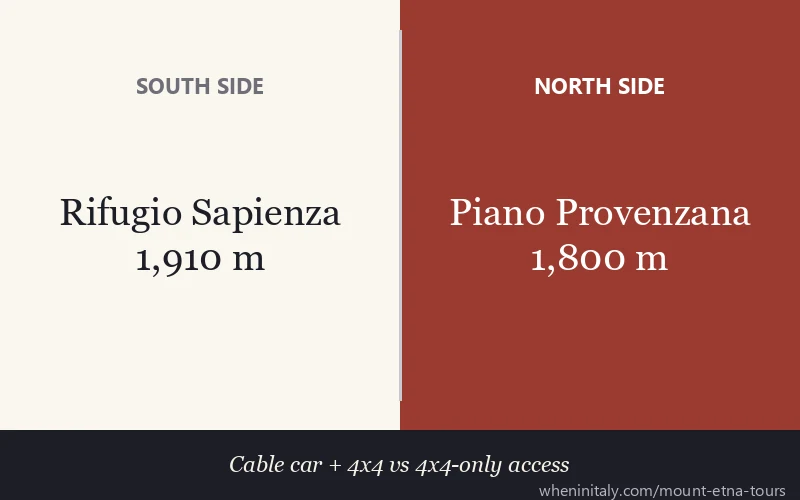
The south side runs out of Rifugio Sapienza at 1,910 m above Nicolosi. It is the busy, infrastructured, postcard side: Italy’s only Etna cable car (the Funivia dell’Etna), a 22-room alpine hotel with the only restaurant serving dinner at altitude, a paved piazzale where the AST bus from Catania drops off, and the Silvestri Craters walkable across the road. Drive time from Catania is about an hour up the SP10/SP92. The crowds are real, especially July-August and on cruise-call days, but so is the convenience: park, ride a cable car, walk a crater, eat pizza, drive home. This is the side for first-timers, families with younger kids, non-hikers, and anyone arriving without a car.
The north side centres on Piano Provenzana at 1,800 m above Linguaglossa, on a high lava plain inside the Pineta Ragabo (the highest pine forest in Sicily, over 3,000 ha of Pinus nigra laricio). There is no cable car here at all: the only mechanised way up is a fleet of 4x4 Unimog buses that climb to ~2,900-3,000 m. The basecamp is markedly less commercial: a small cluster of bars, a couple of restaurants, gear-rental kiosks, and the STAR Etna ticket office set against the still-raw 2002 lava channels. Most Taormina-pickup tours actually default to the north side because it’s geographically closer to the Ionian coast and far less crowded. The north slope is also the heart of Etna DOC wine country (Passopisciaro, Solicchiata, Castiglione di Sicilia, Randazzo are all within a 20-30 minute drive) and the north flank of any 4x4 ride opens onto views of the Ionian Sea with Taormina and Calabria on the horizon. The trade-off: post-eruption ash falls more often on this side, the entire 2002 ski resort was wiped out by lava and rebuilt on top of itself, and getting up here without a guided tour or rental car is essentially impossible.
A useful shorthand: south side for cable-car convenience and cruise-day efficiency, north side for landscape, quiet, and a wine pairing.
Getting There
From Catania. The classic itinerary is the SP10/SP92 drive: ~36-40 km, ~1 hour through Gravina di Catania, Mascalucia, and Nicolosi, climbing through lower lava fields and pine forests to the Rifugio Sapienza terminus. From Catania-Fontanarossa airport (CTA) it’s ~39 km / 45-50 min via the Tangenziale Ovest. If you’re not driving, the AST “Catania-Etna” bus departs daily from Piazza Papa Giovanni XXIII (in front of Catania Centrale rail station) at 08:15, arrives Rifugio Sapienza at ~10:15, and returns at 16:30: a single round trip per day, EUR 6.60 paid on board, no reservation. Locals call it “l’autobus dell’Etna.” Miss the 16:30 return and you’re stranded at the refuge: no taxis are stationed there.
From Taormina, Giardini Naxos, Letojanni, Mazzarò. Drive time is ~45-60 min by car (A18 motorway south, then either SP toward Nicolosi for the south side or SS120 toward Linguaglossa for the north). Public transport is effectively absent. The only chain is bus or train Taormina-Catania (~1h to 1h 10min, EUR 5-8), then the single AST bus up: a ~3h 50min one-way schlep that only works if you’re prepared to overnight in Catania. There is no public transport at all from Taormina to Piano Provenzana. This is why the Taormina-Etna day-trip market is dominated by small-group tour operators (Etna People, Etna Experience, Sicily Active, Go-Etna, Sicily Adventure) that bundle hotel pickup from the entire Ionian-coast cluster into a fixed 6-10 hour itinerary, typically EUR 65-115 per adult for half-day or full-day formats. The Taormina pickup adds roughly EUR 25 per person on top of the meeting-point price (Go-Etna’s Etna Nord Top Crater Tour is EUR 89 at Piano Provenzana vs EUR 114 from Taormina): the visible cost of not having a car.
A note on Catania-Fontanarossa. The airport sits roughly 30 km from Etna’s active summit craters, closer than London Heathrow is to central London. Ash plumes can reach the runway in well under an hour with the right wind. In the first nine months of 2025 alone, INGV/ENAV issued 12 separate ash-related flight-management advisories at CTA (about a 30% rise on 2024). The 26-30 December 2025 paroxysm caused 75 documented flight delays. If your trip falls inside an active eruption window, give yourself flight-rebook flex and have a backup plan: arriving flights typically divert to Palermo (~3h coach to Catania), Comiso (~1.5h), or Trapani (~4.5h).
The Funivia dell’Etna Cable Car
The south-side cable car climbs from Rifugio Sapienza at 1,910 m to the upper station of La Montagnola at about 2,500 m: 650 m of elevation in 12-15 minutes. Cabins were renewed in spring 2023. The lift is the gateway to the higher reaches of Etna Sud, doubles as Sicily’s main ski lift in winter, and has been destroyed at least twice by lava (1983 and 2001-2002) and rebuilt each time. The upper station sits on a parasitic cone formed by the 1763 Montagnola eruption, one of Etna’s largest historical flank events.
2026 prices (effective 1 March 2026, per Etna Volcanological Guides):
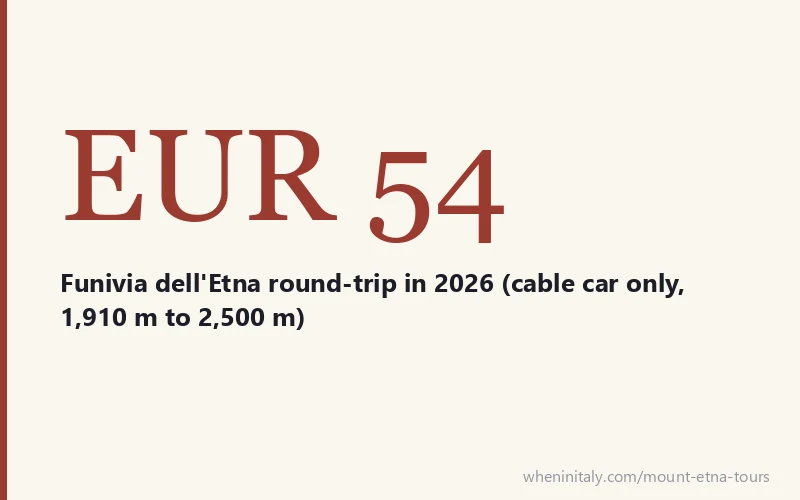
- Cable car round-trip only, 1,910 m to 2,500 m: EUR 54 adult, EUR 30 child (5-10), free under 5
- Cable car + 4x4 Unimog + certified guided walk to ~2,750-2,900 m (the “Tour 3000” / Best Seller package): EUR 78 adult, EUR 50 child
- Winter cable car + snowcat + guide: EUR 89 adult, EUR 50 child
- Full summit-crater tours to ~3,300 m, booked through guides: EUR 159-199
Maintenance windows. The cable car will be replaced by 4x4 buses on the same 1,920-2,500 m route during two confirmed 2026 windows: 8-23 April 2026 and 5-14 May 2026. Service continues but is slower and weather-dependent. If you have these dates booked, plan for it.
At La Montagnola (the 2,500 m upper station), there’s a panoramic terrace, a snack bar branded “Bar Etna Mobility” that doubles as the upper ticket office (one of the highest year-round bars in Italy), restrooms, and a rental kiosk for jackets (EUR 4-5), trekking boots (EUR 5-10), and poles (EUR 5). Helmets are typically supplied by the guide on summit packages. If you arrived underequipped, this is your safety net.
The cable car operates daily, weather and volcanic activity permitting: roughly 08:30-17:45 in high season (April-November) and 08:30-16:00 in winter, with last descent ~15 minutes before close. Tickets can be bought on site or pre-purchased at ticketonline.funiviaetna.com. In peak summer and on weekends queues can run 30-60 minutes; book online 1-2 days ahead.
Going Higher: Guide Rules and Altitude Thresholds
Above the cable-car top station, the rules get specific and they changed twice in 2025-2026. Here’s the current picture, by Comune.
South side (Etna Sud). Per Nicolosi Ordinance 13/2025 (11 September 2025), free hiking is capped at roughly 2,500 m above sea level. Between 2,500 m and ~2,750 m, only certified Alpine or Volcanological Guides may escort visitors. There is a 300 m horizontal exclusion belt around the Southeast Crater base.
North side (Etna Nord). Per Linguaglossa Ordinance 61/2025 (11 September 2025) and Castiglione di Sicilia Ordinance 17/2025 (10 September 2025), the same 2,500 m guide threshold applies, with a stricter 500 m exclusion buffer around the Southeast Crater base. Above ~2,750 m the north side is a “transit-only, no stopping” helmeted zone.
Both sides. Maximum 10 hikers per certified guide, with 15-minute spacing between groups, drone-monitored since January 2026. After the January 2026 flank eruption, an additional 200 m no-approach rule applies to any active lava flow, and excursions are cut off at dusk (no night-time lava-watching).
The institutional authority is the Collegio Regionale delle Guide Alpine e Vulcanologiche della Sicilia (C.R.G.A.V.S.), one of only two volcanological guide colleges in Italy and the only body legally entitled to certify Etna guides under State Law 6/1989 and Sicilian Regional Law 28/1996. Volcanological-guide certification requires a four-year training cycle plus 60 hours of supervised volcanic-terrain practice. Penalties for unguided access are not a simple fine: violators are reported under Article 650 of the Italian Penal Code, which can carry criminal sanctions.
The free-access ceiling drops automatically when INGV raises the volcanic phase from F0 (Attention) to F1 (Pre-Alarm). The 2,500 / 2,750 figures are the September 2025 ceiling and have been lower (1,800-2,000 m) during major paroxysms in 2024-25. Reputable Collegio-registered operators include Guide Vulcanologiche Etna, Gruppo Guide Etna Nord, Etna Summit Craters, Geo Etna Explorer, Etna Experience, and Etna People. Guide fees typically run EUR 59-95 per person for half-day group tours up to 2,750-3,000 m, separate from the cable-car or 4x4 ticket.
The Family Option: Silvestri Craters and Rifugio Sapienza Walking
If you want the Etna landscape without the guide, the altitude rules, the cable car queue, or the 4x4, this is your answer. The Crateri Silvestri are a pair of extinct adventitious cones born from the 1892 flank eruption (173 days, lava fountains reportedly reaching 400 m), sitting essentially at the roadside between the SP92 hairpins and the Rifugio Sapienza parking. They are the only Etna craters routinely walked into without a guide because they sit ~600 m below the 2,500 m altitude threshold. Named after Orazio Silvestri, the 19th-century Catania volcanologist who first studied them.
The Lower Silvestri at ~1,886 m is a wide, shallow bowl you can walk down into in five minutes: even toddlers can manage the rim and the bowl. The Upper Silvestri at ~1,986 m (some sources cite up to 2,020 m) is a steeper, more classically conical cone with a brick-red oxidised rim contrasting against the surrounding black scoria fields: count on a 10-15 minute steepish climb on loose lapilli, better suited to ages ~6+. The full 3.3 km loop from the Sapienza parking takes about an hour. The colour duality (rust-red rim against jet-black lapilli) is iron-oxide weathering of basaltic scoria, the same chemistry that reddens Mars: late afternoon light brings it out best.
Free to walk. Parking at Sapienza runs EUR 4-5 full day in the blue-stripe paid zones. Funivia dell’Etna sells an optional EUR 5 “Silvestri Craters: natural heritage” guided experience (08:30-17:00 daily) but the underlying roadside access remains free. The Lower Silvestri rim and roadside viewpoint are reachable on a short, mostly level path from the SP92 and pass for many wheelchair users with an off-road stroller or carrier. Snow can cover the cones December through March, making the upper-crater scramble slippery or impassable in winter.
The Silvestri are also the default fallback when the cable car or summit area is closed: low altitude, low eruption sensitivity, almost always open even when the upper mountain is shut.
The Circumetnea Railway
Most articles mention the Circumetnea in passing. Here is the editorial fact most miss: as of 2026, the railway is broken in two by metro construction, and you can no longer board it at the historic Catania Borgo terminus.
The Ferrovia Circumetnea is a 110 km, 950 mm narrow-gauge line opened in stages 1895-1898. It traces a near-complete loop around Etna’s base: Catania to Misterbianco, Paterno, Adrano, Bronte (the pistachio capital), Maletto, Randazzo (medieval lava-stone town), Linguaglossa, Giarre, and Riposto on the Ionian coast. It is at once a working commuter line (still carrying schoolchildren), a vintage rail experience, and the cheapest, most contemplative way to see the volcano without a guide, summit access, or a 4x4. Highest station is Maletto at ~924 m; the track itself peaks at ~960 m near Roccacalanna, higher than many Alpine railways.
Since 17 June 2024, the Catania Borgo to Paterno section has been suspended for the conversion of that stretch into the standard-gauge Catania Metro extension. Replacement buses run via the SS121, and the historic Borgo terminus is no longer served by trains. From 16 March 2026, a further suspension was added between Paterno and Santa Maria di Licodia Sud, again with bus replacement. The practical access pattern in 2026: take the Catania metro (line 1) from Stesicoro to Nesima (~15 min), then the FCE replacement bus along the SS121 to reach the still-operating train at Santa Maria di Licodia Sud. From there, a revised timetable serves Riposto with about three through-trains a day. End-to-end Catania-Riposto plan a full day; the Linguaglossa-Randazzo half (~90 min by train) is the most photogenic stretch and many visitors do only that.
A few practical notes. Trains run Monday-Saturday only; suspended Sundays and public holidays. A daily hop-on/hop-off ticket runs ~EUR 8 (some sources cite EUR 13 for a two-direction day ticket). Sit on the left-hand side of the train when travelling clockwise from Riposto toward Randazzo for the best volcano views. The line was severed in March 1981 by a Randazzo eruption whose fast-moving flows cut the Circumetnea, the SS120 highway, and the parallel state railway between Taormina and Randazzo: the FCE was rebuilt across the new lava field, the parallel state line never was. The original 1937 Fiat “Littorina” ALn 56.06 in restored maroon-and-white livery still runs occasional tourist services (chiefly Bronte-Randazzo). For wine travellers, the dedicated Etna Wine Train (Strada del Vino dell’Etna, separate operator) departs Linguaglossa at ~09:15 on Thursdays and Saturdays March-November, combining the rail journey with a bus shuttle to two wineries plus a Castiglione/Randazzo village stop: EUR 175 adult, EUR 95 teen, EUR 65 child, minimum 48-hour booking.
Etna DOC Wine
Etna DOC was Sicily’s very first DOC, granted in August 1968, nine months before Marsala. It is one of the most distinctive volcanic-soil wine regions on earth, and a serious counterweight to anything else you do on the volcano: cool a summit hike with a 10:00 cable car morning and a 14:00 winery lunch and you’ve understood Etna in a single day.
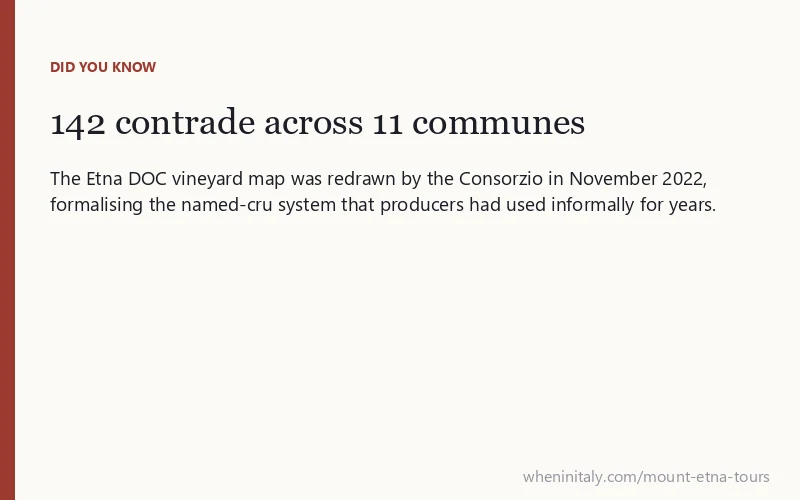
The appellation arcs around the volcano’s north, northeast, east, and southeast flanks at roughly 400-1,100 m above sea level (some Carricante and Nerello Mascalese plots, notably I Vigneri’s, climb to ~1,300 m, among the highest commercial vineyards in Europe). The terroir is mapped Burgundian-style as 142 single-vineyard contrade (the original 133 plus 9 added on the November 2022 Consorzio map), spread across 11 communes. Castiglione di Sicilia alone holds 41 contrade and Randazzo’s 25 makes the north slope by far the densest cluster.
The grapes. Reds are built on Nerello Mascalese (minimum 80% in Etna Rosso, with up to 20% Nerello Cappuccio): perfumed, savoury, frequently compared to Burgundy and the northern Rhone. Whites are built on Carricante, with the appellation’s pinnacle being Etna Bianco Superiore, Sicily’s only DOC sub-zone restricted to a single commune: Milo, on the cooler east flank at 600-1,000 m, with direct sea views.
The volcano’s loose sandy ash repels phylloxera, so pockets of ungrafted, pre-phylloxera vines well over a century old still produce wine. Tenuta delle Terre Nere’s parcels in Calderara Sottana exceed 130-140 years; Frank Cornelissen’s Magma vines in Barbabecchi date to around 1910. The Consorzio voted unanimously on 10 November 2023 to apply for DOCG status, with new rules covering minimum aging, lower yields for single-contrada wines, and minimum vine age for Contrada designations. Italian wine press in October-November 2025 reported the application could take effect with the 2026 harvest, though final ministerial approval was still pending at the time of writing.
The producer shortlist worth a visit (north slope unless noted): Cornelissen (Solicchiata, cult), Passopisciaro / Vini Franchetti, Tenuta delle Terre Nere (Randazzo), Benanti (southeast slope, historic), Pietradolce (Solicchiata), Graci (Passopisciaro), I Vigneri (Salvo Foti, traditional palmenti), and on the east slope for Bianco Superiore, the small Milo cantine.
Tasting prices. Average winery cellar tour with tasting runs ~EUR 47 per person (Winalist appellation average). Donnafugata Etna tastings start at EUR 35-55. Frank Cornelissen’s published 2026 rates: Classic tasting EUR 40 (5 wines, ~2h), Magma tasting EUR 210 (6 crus including Magma, ~2.5h), Private Classic EUR 350 for up to 8 people. Multi-winery guided day tours from Catania or Taormina commonly run EUR 100-180 per person shared, EUR 500-700+ private for small groups. Plan 1.5-2.5 hours per cantina (vineyard walk + cellar + 4-6 wine tasting); a self-driven day fits two wineries plus lunch, guided full-day tours commonly hit two or three. Cult producers want 2-4 weeks lead time, especially May-October and around the September-October harvest. Mid-tier flagship estates need 1-2 weeks.
When to Visit
Etna is a four-season mountain, but each season is best at one specific thing.
January-March is two completely different mountains stacked on one. The southern ski area at Rifugio Sapienza opened the 2025-26 season on 31 January 2026, the northern lifts at Piano Provenzana typically hold snow longer and may run into early April. Peak snow depth historically falls in the second week of February (~25-31 cm at the Sapienza area). Spectacular fire-and-ice contrasts when active vents glow against fresh snow. The Sant’Agata festival in Catania (3-5 February 2026, full cycle 30 January-12 February) is recognised as the world’s third-most-attended religious celebration after the Hajj and Holy Week in Seville.
April-May is the wildflower window. Snow line retreats to ~2,000 m in April; the lower-slope orchards (almond, then cherry) blossom. From mid-May the Genista aetnensis (Etna broom) turns the 1,000-1,800 m belt gold, peaking mid-May to mid-June, with saponaria pink carpets above 1,800 m late May. Le Contrade dell’Etna 2026 (the wine industry’s appellation showcase) runs 19-20 April. Important: the Funivia is replaced by 4x4 buses on the same 1,920-2,500 m route during two confirmed 2026 maintenance windows: 8-23 April and 5-14 May. Service continues but is slower.
Late May through mid-June is the sweet spot the locals quietly recommend: hillsides still gold from broom, snow cleared from Sapienza, the summit opens up by mid-June, and Sicily’s coast hasn’t yet filled with August crowds.
July-August delivers the longest summit-access window (snow cleared to 3,300 m), 17-hour days, and cool 6-10 C summit temperatures while Catania bakes at 30-35 C. Sunset on the south-side summit ridge is the headline shot. The trade-off: cruise-day crowds at Sapienza, cable-car queues 30-60 minutes, accommodation snapped up around Ferragosto (15 August), and the heaviest Italian holiday week is roughly 10-20 August. Avoid this window with very young children unless air-conditioned hotels and short transfers are non-negotiable.
September-October is the harvest play. Nerello Mascalese is hand-picked in the second week of October on the higher contrade (weeks later than coastal Sicilian grapes because vineyards sit 400-1,000 m on the volcano’s slopes). Etna Days (the consorzio’s wine event, ~mid-September) and Le Contrade dell’Etna’s autumn tastings run in this window. The Bronte Pistachio Festival is biennial: full editions in odd years (2025 ran 10-12 + 17-19 October), with a smaller market-only version expected in 2026. Weather stays in the 10-20 C band, ideal for hiking. October-November is also when Etna birch (Betula aetnensis) and the Piano Provenzana beech grove turn gold, orange, and red: the most underrated Etna month for landscape photography.
December. First dustings of snow above 1,800 m. Smoke plumes from village hearths and farmers burning brush make for layered atmospheric shots at sunset. Cable car running, ski area not yet officially open. Avoid 25 December (AST bus suspended), 1 January (same), and the immediate aftermath of any active flank eruption: the post-Christmas-Eve-2025 window saw repeated summit closures, tightened group caps, and a guide strike.
What to Wear and Pack
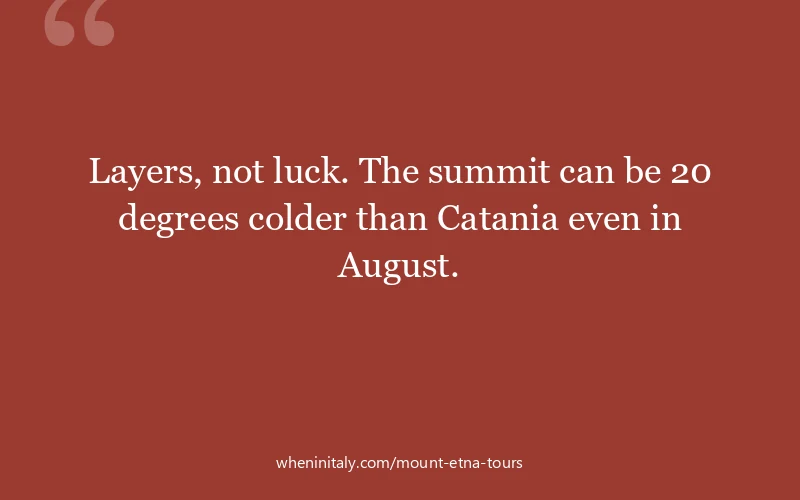
Etna isn’t technical, but it punishes the underprepared. The shock most visitors don’t expect is the gradient: a 30 C August morning in Catania becomes 8-12 C with biting wind at the cable-car top station 90 minutes later, and the summit can sit 20-25 C colder than the coast. The terrain is the second surprise.
Cooled lava and volcanic sand are razor-sharp; soft-soled trainers shred within hours and grit funnels straight into low shoes on the descent. Sandals are explicitly forbidden by guide ordinances.
| Season | What to wear (cable-car top + above) |
|---|---|
| Summer (Jun-Sep) | Long technical trousers (not shorts: sun, sand, lava abrasion). Moisture-wicking base T-shirt, light fleece, packable windproof or waterproof shell. Ankle-supporting hiking boots with stiff soles (no trainers). Brimmed sun hat, sunglasses (UV is intense and lava reflects), high-SPF sunscreen. Light gloves above 2,500 m. 1.5-2 L water per person. |
| Shoulder (Apr-May, Oct-Nov) | Thermal base layer top + bottom, thicker fleece, fully waterproof and windproof shell. Waterproof boots with grippy lugged sole. Light gloves, beanie, neck buff. 1.5 L water. Sunscreen + sunglasses (snow patches above 2,500 m reflect even in shoulder months). |
| Winter (Dec-Mar) | Treat the upper mountain as a winter touring outing. Merino base layers top + bottom, heavy fleece or down midlayer, insulated waterproof shell jacket, winter trekking or ski pants, winter trekking boots stiff enough to take crampons. Wool socks, insulated waterproof gloves plus thin liner, beanie under helmet (helmet supplied above 2,750 m), neck buff, gaiters, ski goggles or wraparound glacier glasses, sunscreen (snow + altitude = serious UV). Crampons and snowshoes typically supplied by the guide. Snow chains in the car for SP92 and Mareneve. |
Rental safety net. If you arrive underequipped, the rental sheds at Rifugio Sapienza (1,910 m) and the Funivia base both rent jackets at EUR 4-5, boots at EUR 5-10, and poles at ~EUR 5. Some operators (Etna Way, for example) include rental gear free of charge in their tour price, and summit-crater treks usually bundle helmet, boots, and poles. Communicate sizing in advance.
Safety, Gases, and Emergencies
Etna releases several thousand tons of SO2 per day even when “quiet,” and active vents push that higher. Standard N95 / FFP2 dust masks do nothing against SO2. Some guides carry proper gas filters for summit work; ask before booking if you have respiratory sensitivities. The summit zone is unsuitable for visitors with severe respiratory or cardiovascular conditions.
Other recurring hazards. Fast-building summer thunderstorms above 2,000 m: lightning risk on exposed ridges is real. Cooled-lava traps (skin-tearing edges, ankle-rolling blocks): why stiff-soled boots are not optional. Snow cornices and ice above the cable car December-April. Mobile coverage: 4G is typically fine to Rifugio Sapienza, patchy above the cable car, with recognised dead zones in the Valle del Bove. Don’t plan a self-rescue around your phone above 2,500 m.
Current restrictions (as of May 2026, post-January eruption). Maximum 10 hikers per certified guide, drone-monitored. 200 m no-approach distance from any active lava flow. Excursions cut off at dusk: no night-time lava-watching tours operating. Guide-mandatory above 2,500 m on both flanks (Nicolosi Ord. 13/2025 south, Linguaglossa Ord. 61/2025 and Castiglione Ord. 17/2025 north). Helmet-required, transit-only, no-stopping zone above 2,750 m on the north side. The free-access ceiling drops automatically with each INGV phase escalation.
Emergency numbers. 112 for the unified European emergency line (carabinieri, fire, ambulance dispatch). 118 for medical emergencies in Italy. CNSAS Sicilia (Soccorso Alpino e Speleologico Siciliano, the Italian Alpine Rescue Corps) handles mountain rescue across Etna; they coordinate via 112/118 and can be reached directly through cnsas.sicilia.it. INGV Catania (ct.ingv.it) publishes the weekly bulletin and real-time eruption updates: check it within seven days of going up. The Smithsonian Global Volcanism Program at volcano.si.edu/volcano.cfm?vn=211060 mirrors the bulletin in English.