The Amalfi Coast is one of the most-Googled destinations in Italy, which means most of what you read about it has been written by people repeating each other. This guide is opinionated. It assumes you have a finite number of days, a real budget, and questions that the listicles do not answer: where should I sleep, do I really need a car, can my mother walk it, when does the ferry season actually start, and is Sorrento on the Amalfi Coast (no, it is not).
What follows is the practical 2026 picture. Specific fares, specific distances, real tradeoffs.
What “the Amalfi Coast” actually is
The Costiera Amalfitana is roughly 50 kilometres of coastline on the southern side of the Sorrentine Peninsula. It runs from Punta Campanella in the west (the tip of the peninsula, opposite Capri) east to Vietri sul Mare just north of Salerno. UNESCO has listed it as a World Heritage cultural landscape since 1997.
The thirteen towns worth knowing, west to east along the SS163 coast road: Positano, Praiano, Furore, Conca dei Marini, Amalfi, Atrani, Ravello (perched 335 metres above Amalfi), Scala, Minori, Maiori, Cetara, Erchie, and Vietri sul Mare. Capri sits offshore. Ischia and Procida belong to the Bay of Naples and are a different trip.
Sorrento, despite half the internet calling it “the Amalfi Coast,” is on the north side of the peninsula, facing Naples Bay, not the Gulf of Salerno. You can stay there and visit the Amalfi Coast every day. Plenty of people do. But you are commuting in, not waking up in it. This matters for the base decision below.
Where to stay: the base decision
This is the question that dominates Amalfi Coast searches, and the honest answer is “depends on what kind of trip you are running.” Six real options, with the case for each.
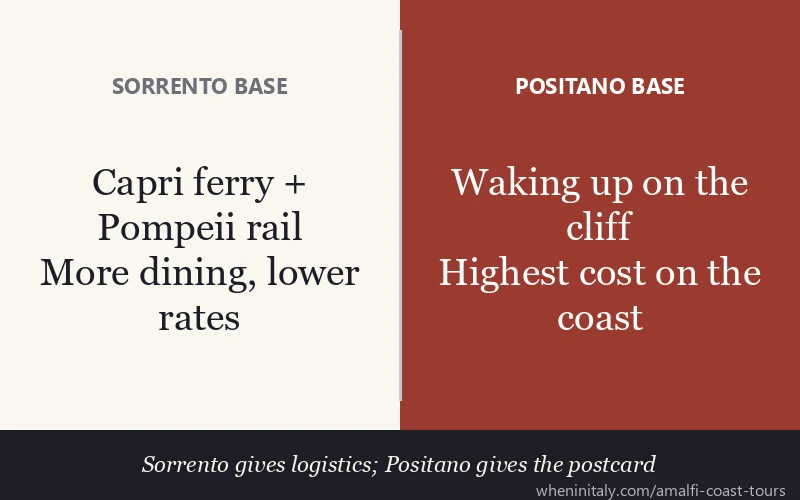
Sorrento. The transport hub. Direct Circumvesuviana train to Naples and Pompeii, year-round ferries to Capri (about 25 minutes, EUR 22 one-way), SITA bus into the Amalfi Coast proper, no cliff-edge driving to reach your hotel, and parking that actually exists. It is the largest town in the area, which means more dining options at every price level and a lower base hotel rate than Positano. The cost is the commute: every Amalfi Coast day starts with a ferry or a one-hour bus. Best for first-timers, families, multi-stop Italy trips, and anyone who wants Pompeii and Capri in the same week without changing hotels.
Positano. The postcard. Vertical, gorgeous, and the most expensive bed on the coast. Almost every hotel involves stairs, sometimes a lot of them, because the town pours down a cliff and there is no street-level option for most of it. In July and August the foot traffic chokes the centre. If you want the photograph and the romance and you are paying for a peak experience, this is the place. If you are watching budget or carrying knees, it is the wrong call.
Praiano. Five kilometres west of Positano along the SS163, with the same Lattari Mountains dropping into the same Mediterranean, and rentals starting around EUR 110-200 per night for ocean-view rooms that would cost three times that in Positano. The town is quieter, the restaurants are better value, and you are still on the SITA bus line. Best for travellers who want the Positano look and feel without the Positano markup.
Amalfi village. The geographic middle of the coast, the main ferry hub, and one of the few coastal towns where a flat seafront walk is genuinely possible. Easier to navigate than Positano, less expensive, and your bus or ferry to anywhere else on the coast leaves from your front door. Best for ferry-day-trip itineraries and for anyone who wants the coast without the climb.
Ravello. 335 metres above Amalfi, reached by switchback bus or taxi. The classical music town: the Ravello Festival runs July 4 to September 5 in 2026, with concerts at Villa Rufolo’s terrace garden over the sea, including the traditional dawn concert at 5:15 AM on August 11. Quieter than the coast below, cooler in summer, and the gardens (Villa Rufolo, Villa Cimbrone) are part of the point. You will need to descend by bus or taxi for ferries and beaches. Best for culture-focused travellers, summer escapees, and anyone whose ideal evening is a cliff-side concert rather than a beach club.
Salerno. The contrarian pick that quietly makes sense. A real working Italian city, Frecciarossa to Naples in 26 minutes and to Rome in about 1 hour 25, year-round ferries to Amalfi (42 minutes, EUR 12) and Positano (about 1h 15m, EUR 17), hotel prices roughly half of Positano’s, and a centro storico that is actually lived in rather than performed. The trade is that you are commuting east-to-west into the coast each day, and the towns west of Praiano (and Sorrento) are noticeably further. Best for budget-conscious travellers, train-based itineraries (Rome before, Sicily or Puglia after), and second-time visitors who already saw the Positano shot in their twenties.
If you cannot pick: first-timers default to Sorrento, romantic peak-experience trips to Positano, repeat visitors and budget travellers to Salerno or Praiano.
The ferry network: how to actually move around
In high season, the ferry beats the road. The SS163 jams; the sea does not. There are three operators worth knowing.
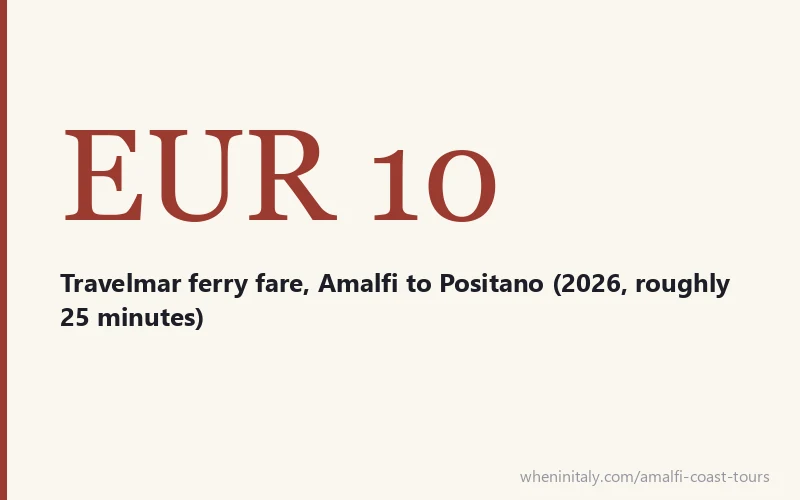
Travelmar runs the workhorse Salerno-Amalfi-Positano line and linking shuttles to Cetara, Vietri, Minori, Maiori. Eleven sailings daily, around 75 per week on the main route. The 2026 fares: Salerno to Amalfi EUR 12 (about 42 minutes), Amalfi to Positano EUR 10 (about 25 minutes), Salerno through to Positano EUR 17. One small bag (45 by 35 by 20 cm) is included; extra luggage is EUR 3 per piece.
NLG (Navigazione Libera del Golfo) runs Positano-Capri and shoulder-season Salerno-Amalfi. The Positano-Capri high-speed runs April 1 through November 3 in 2026: EUR 23 adult one-way, plus a EUR 5 per-person Capri landing fee that applies April through October. About 40 minutes.
Caremar and Alilauro handle Sorrento-Capri, the only year-round route in the network. Roughly 25 minutes, EUR 22-25 single, with frequent departures (Alilauro alone runs over 100 sailings weekly).
The seasonal pattern matters. Most Amalfi Coast routes start in early April and run through October. Some operators creep into late March; most are gone by early November. November to mid-March, the coast effectively closes: many hotels shutter, many restaurants close, and ferries that link the coast towns to each other do not run. If you are planning a winter trip, your ferry options collapse to the year-round Sorrento-Capri service plus whatever Travelmar runs to Salerno.
There is no hop-on day pass. Every leg is a single ticket, bought from the dock kiosk or via the operator’s site. Buy in advance for July and August on the Positano-Capri leg; the morning departures from Positano sell out by mid-morning.
A bus alternative exists. The SITA Sud “COSTIERASITA” 24-hour pass is EUR 10 (EUR 12 including Positano local lines), and a single Salerno-Amalfi ticket is EUR 2.80. In April or October, when the coast is quiet, this is the cheapest way to move. In July and August, the SITA buses sit in the same SS163 traffic as everyone else and a 90-minute ride can take three hours. Take the boat.
Driving the SS163 (and why most visitors should not rent a car)
The SS163 Amalfitana is a single carriageway clinging to the cliff for fifty kilometres. In sections it is a wide one car, not a narrow two. The locals run it on Vespas; the regional buses are the only large vehicles that handle it confidently and they assume you will yield. In peak summer the road can stop moving for hours.
Three things make a rental car a worse idea than it sounds.
The ZTL gates. Positano, Amalfi, and other coast towns enforce limited-traffic zones with automated cameras at every entry point. Drive in without a permit (which is normally tied to your hotel reservation) and you collect an automatic fine of EUR 80-90 per pass. Hotels can pre-register your plate; you must email them in advance.
The alternate-plate days. From Easter Week through the high season, the SS163 enforces an even-day / odd-day rule: cars whose plate ends in an even digit can drive on even-numbered dates, odd on odd. Scooters and motorcycles are exempt. Hotel guests get an exemption on arrival and departure dates if they show the booking; otherwise you are walking your suitcase from the parking field.
Parking is engineered to discourage you. Public hourly parking in Positano and Amalfi is EUR 5-10 per hour. Garage parking is EUR 30-60 per day in season. Free parking is, for practical purposes, a fantasy.
The honest rule: if your trip is the coast and Capri, do not rent a car. Use the ferry, the SITA bus, and the occasional taxi or NCC (private driver). If you are extending into the Cilento national park to the south or driving on to Calabria, rent a car for the post-coast leg only and pick it up in Salerno after your last coast night.
Itineraries by length
Here is what fits, honestly, in each window.
2 days. This is enough for one base and one day trip, not a “see the coast.” Sleep in Sorrento or Amalfi. Day one: settle in, walk the home town in the late afternoon, dinner at sea level. Day two: ferry to either Positano or Capri (pick one), back by early evening. You will not see Ravello and you will not hike. That is fine. Better one place properly than four places blurred.
3-4 days. The minimum for a real first visit. Three nights in Sorrento or Amalfi village. Day one: home town. Day two: Positano by ferry. Day three: Capri by ferry. Day four: Ravello by bus or taxi from Amalfi. If you base in Sorrento, swap day four for a Pompeii morning (35 minutes by Circumvesuviana) and a Sorrento afternoon.
5-7 days. The sweet spot. A week lets you actually slow down. Three nights in Sorrento (Capri day, Pompeii day, Sorrento and Bay of Naples wandering), then move bases by ferry to Amalfi or Positano for three nights (Ravello, Path of the Gods hike, the long limoncello-and-lemon-grove afternoon, a beach day at Furore or Marina di Praia). The hotel switch sounds annoying; it is worth it because you will not spend two hours commuting each morning.
10-14 days. Combine the coast with neighbours. One workable shape: 3 nights Naples (the city, plus a Pompeii or Herculaneum day), 4 nights Sorrento, 4 nights Amalfi or Positano, 2-3 nights to extend (Capri overnight, Ischia, Cilento for Paestum’s Greek temples, or south to Matera if you want a complete change of register). Most travellers who try this say the second base is what makes it stop feeling like a tour bus.
Day trips and side trips
Capri. Non-negotiable for a first trip. The ferry from Sorrento (year-round) or Positano (April-November) gets you there in 25-40 minutes. Skip the Blue Grotto queue if it is mid-summer (the wait can hit two hours and the boatmen rush you through in 90 seconds); take the chairlift up Monte Solaro from Anacapri instead, then walk down through the Phoenician Steps if the knees allow.
Pompeii. The reason to base in Sorrento or Salerno rather than only on the coast. From Sorrento the Circumvesuviana is 35 minutes, from Salerno about 35 minutes by regional train. From Positano or Amalfi you are looking at a full half-day getting there and back, which is why the day-trip tour buses exist. Allow at least four hours on site; arrive at opening or after 2 PM to dodge the worst of the cruise-ship groups.
Naples. Underrated. From Sorrento it is one direct train. From Salerno it is 26 minutes on Frecciarossa. Spend a day on Spaccanapoli, the Capodimonte museum or the Archaeological Museum (which holds most of the actual Pompeii art that has not been weathered into chalk on site), and a long pizza lunch.
Path of the Gods (Sentiero degli Dei). The classic Amalfi Coast hike. The standard route goes from Bomerano (a hamlet of Agerola, reached from Amalfi by SITA bus) downhill to Nocelle, above Positano, and onward via 1,500 stairs to Positano centre. Distance is roughly 6.5 km, elevation loss around 600 metres, time 2.5 to 3 hours plus stops. Free, no permit. The trail is in mostly full sun with little shade, which is why everyone who has done it says the same thing: shoulder season (April to mid-June, September to October), morning start. Sturdy shoes, two litres of water, a hat. Avoid July and August midday; people end up in the Positano clinic for heatstroke every summer.
Lemons, limoncello, and what to actually eat
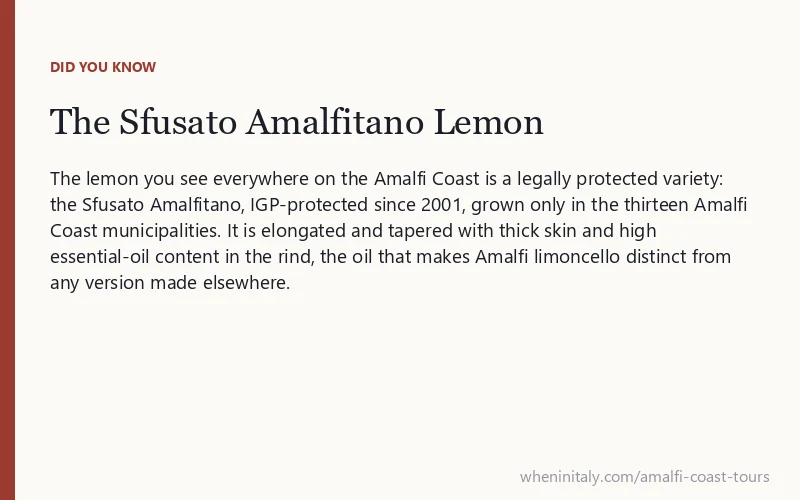
The lemon you see everywhere is a specific variety: the Sfusato Amalfitano, IGP-protected since 2001, grown only in the thirteen Amalfi Coast municipalities on terraced groves that climb the hillsides above the road. It is elongated and tapered (sfusato means tapered), thicker-skinned than a supermarket lemon, with high essential-oil content in the rind. That oil is what makes Amalfi limoncello recognisably better than the version made anywhere else: the flavour is in the peel, not the juice. If a producer cannot tell you their lemons are Sfusato (or at minimum Limone Costa d’Amalfi IGP, which also includes the Zagara Bianca and Verdello cultivars), you are buying tourist-grade.
Worth tasting: a guided limoncello tasting at a working grove (Antichi Sapori d’Amalfi or La Valle dei Mulini in Amalfi village are the two most-booked); pasta al limone (lemon-cream sauce on linguine, simple and excellent); delizia al limone (the regional sponge dessert with lemon cream); and ravioli al limone if you find them on a menu. For seafood, Cetara is the colatura di alici town: an aged anchovy sauce that is essentially a Roman-era garum survivor, served on spaghetti with garlic and olive oil. Drink local Falanghina or Greco di Tufo whites; the volcanic-soil reds (Aglianico, Taurasi) are an inland Campania thing rather than coast.
Best season, accessibility, and what to book in advance
Season. Late April through June and September through October are the sweet spots: ferries running, hotels open, weather warm, crowds manageable. July and August are hot, packed, and expensive; Positano and Amalfi village both feel like a permanent street festival. November through mid-March, the coast hibernates: many hotels close entirely (some reopen for Christmas week, then close again until Easter), most ferries between coast towns stop running, and your trip becomes a different one based out of Sorrento or Salerno with year-round services.
Weddings. May through September weekends, the coast is a wedding factory. Positano and Ravello in particular host destination weddings most weekends, which means specific restaurants get fully booked for private events on no notice. If you are travelling on a Saturday in summer, ask your hotel which venues are running closed events that week.
Accessibility. Be honest with yourself. Positano is built on stairs and the cute alleys are cobbled and steep; for visitors using a cane or who tire easily, it is possible as a brief day visit but exhausting as a base, and the climb back up is far harder than the descent. Ravello is mostly flat once you are up there (the bus does the climb). Amalfi village and Sorrento are the most accessible coast bases: sea-level promenades, fewer stairs, and Amalfi has a reasonable port-to-piazza walk. For visitors with serious mobility limits, the realistic shape of the trip is a base in Sorrento, hotel-arranged airport transfers (do not battle the regional bus from Naples airport with luggage), private boat tours instead of public ferries, and a private driver for any inland or hilltop visits.
What to book in advance. Hotels for July and August: book by February. Hotels for May, June, September: book by April. Restaurants in Positano on a Saturday in summer: book the moment you confirm flights. Ferry tickets for Positano-Capri morning departures in July/August: buy online a few days ahead. The Path of the Gods, Capri’s chairlift, and the SITA buses do not need pre-booking; just show up. Tour activities (the cooking classes, the lemon-grove visits, the private boat days) cluster heavily on the same calendar as the hotels: by the time you arrive, the well-reviewed operators are full a week out.
The Amalfi Coast rewards travellers who pick their base on purpose, take the ferry, skip the rental car, and visit when the rest of Europe is at school. Get those four right and the rest of it (the lemons, the limoncello, the ridiculous views from the SS163 bus window, the sound of the Ravello Festival drifting down from Villa Rufolo) takes care of itself.