The Vespa is a national flag in two-wheeled form. It is also a 50cc, 125cc, or 300cc machine governed by a real Italian highway code, requiring a real license. Most “Vespa tour Italy” searchers are circling two completely different products: a guided sidecar ride where you sit and someone else drives, or a self-drive rental in a convoy. The difference matters: one needs a license and the other does not, and the prices, age limits, and risk profiles are not in the same universe.
This guide walks through the format fork, the license rules (the most-asked Vespa-Italy question on Google), what each city offers, what it costs, and the safety details no one mentions until you are in a Trastevere parking lot with a helmet you are not sure how to clip on.
Vespa tour or Vespa rental: which one are you actually booking?
There are three formats sold under the umbrella word “Vespa tour,” and they are not interchangeable.
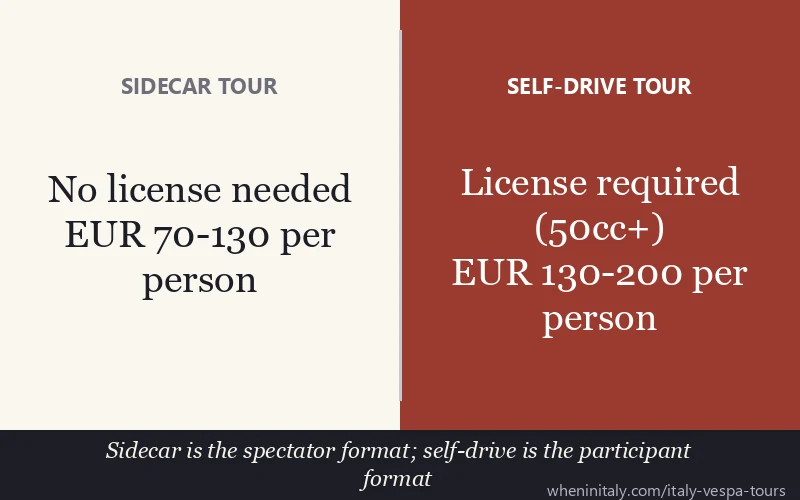
Guided sidecar tour. A driver from the operator runs the scooter. You sit in a 1960s-style sidecar (or, less commonly, on the pillion seat behind the driver). You do not need a license, you do not need driving experience, and the only thing you have to operate is the GoPro your guide may hand you. This is Rome’s signature format. Tours run 2 to 4 hours and cost roughly 70 to 130 euros per person. Two passengers in one sidecar typically share one scooter and one guide.
Guided self-drive tour. You ride your own Vespa (usually a 50cc or 125cc) in a convoy behind a lead guide. There is a short briefing in a parking lot before the group leaves. You need a license appropriate to the engine size (more on this below), prior scooter experience is sometimes required, and the format is dominant in Tuscany and Florence-to-Chianti tours. Half-day tours run 130 to 200 euros per person; full-day Tuscany loops with lunch and a winery stop run 200 to 280 per person.
Self-rental, no guide. You rent and go. Daily rentals run 40 to 100 euros plus a 500 euro security deposit pre-authorized on a card. Cheapest format, most paperwork: license category check, IDP check, deposit, insurance excess agreement. Rome, Florence, Sorrento, Catania, and Cagliari all have established rental shops.
If you have never ridden a two-wheeler and are in Italy for under a week, the sidecar is the format that matches what people are picturing when they search “Vespa tour.”
The license question
This is the single question that drives the most search traffic to Vespa-Italy content, with phrasings like “do you need a license to drive a Vespa in Italy,” “do I need a motorcycle license,” and “can you drive a Vespa without a license.” The honest answer has three layers, and you need to read all three.
Italian license categories that apply to scooters:
- AM: mopeds up to 50cc, max 45 km/h. Italians get this at 14; operators require 18+.
- A1: motorcycles/scooters up to 125cc and 11 kW, age 16+.
- A2: bikes up to 35 kW, age 18+.
- A: anything bigger, age 24 (or 20 with two years on A2).
- B: the standard car license. In Italy, a B also authorizes scooters up to 125cc and 11 kW on Italian roads.
For non-EU tourists (US, UK, Canada, Australia, etc.): you must carry your home-country driver’s license plus an International Driving Permit (IDP). The IDP is just a translation booklet you pick up before you fly (AAA in the US, the post office in the UK). It is not a license on its own. Carry both at all times when riding.
Practical cheat sheet:
- A US, Canadian, or Australian car license (with IDP) is generally accepted by Italian operators for 50cc scooters. This is why most “drive your own” Italian Vespa tours run 50cc: it is the largest engine they can put a foreign car-license holder on without friction.
- For 125cc the rules are murkier. EU car-license holders are explicitly authorized. Non-EU tourists with a car license + IDP fall into a gray zone that some operators accept and others refuse. If you want to ride a Primavera 125 or PX 125 without a motorcycle endorsement on your home license, verify with the operator in writing before booking.
- For 300cc (the Vespa GTS 300, used on some highway tours), you need a motorcycle endorsement on your home license (A or A2 equivalent). Minimum age usually 21.
- Sidecar passengers need no license, no IDP, no driving experience. Children typically allowed from age 5 or 8 (operator-specific).
One footnote: the Italian Highway Code enforces these category rules at police stops. If you are stopped riding a 125cc on a US car license without an IDP, you are riding without a valid license in the eyes of the carabinieri, and your travel insurance will not cover a hospital bill. Do not ride a category your paperwork does not authorize.
Sidecar tours: the Rome signature format
Rome turned the sidecar tour into its calling card for a reason. The historic center is a tangle of cobblestones, one-way alleys, ZTL gates, scooter swarms, and tourists in sandals walking against traffic. Putting a first-time visitor on their own scooter in this mess would be irresponsible. Putting them in a sidecar driven by a Roman who has been doing this for a decade turns the chaos into a three-hour cinematic experience.
The standard Rome sidecar loop covers Quirinale, Trevi Fountain, Pantheon, Piazza Navona, the Vatican perimeter, Janiculum Hill (panoramic stop, often timed for sunset), Trastevere, the Jewish Ghetto, Piazza Venezia, the Colosseum, plus either the Aventine “keyhole” or the orange garden. Common variants: a morning version with a cappuccino-and-cornetto stop in a real Roman bar (the autocomplete-famous “Vespa sidecar tour with cappuccino”), an evening version with gelato or aperitivo, and 4-hour extensions to Appia Antica.
Three hours is the dominant format. 2026 prices sit at 80-130 euros per passenger for a shared sidecar, higher fully private. Two adults per sidecar with one guide is standard; some operators allow a small child with an adult. Hotel pickup is sometimes included.
A few Rome operators worth searching by name: Vespa Sidecar Tour, Dearoma, Scooteroma, Bici & Baci, Beyond Roma, Spazio Museo Vespa, Walks Inside Rome. They differ in fleet quality (some run genuinely vintage 1960s sidecars; others use modern scooters with newer sidecars) and the English fluency of the guide. Read recent reviews for guide quality specifically, since this format is essentially a 3-hour conversation with a stranger driving you around.
Driving your own Vespa: what it actually feels like in Italian traffic
If you have ridden a scooter before, the Italian experience is familiar with two complications: the cobblestones and the local etiquette.
Cobblestones (sampietrini) sit under most of central Rome and large parts of Florence. Slick when wet, jarring when dry. Take corners wider than you think; painted crosswalk stripes turn into ice in rain. The “swarm” rule of Italian scooter traffic is real: at red lights, scooters filter to the front between car lanes; at green, they accelerate first and the cars wait. Following the rule is safer than fighting it. Waiting politely behind cars is what gets you rear-ended.
Roundabouts give priority to vehicles already inside. Italian drivers will not slow down for a hesitating scooter at the entrance. Commit or wait.
Helmets are legally mandatory for rider and passenger. Operators provide them (ECE 22.05/22.06 standard). The driver is fined if the passenger is helmetless. Do not ride without it for a single block.
A few things not to do: do not enter a ZTL zone (Rome and Florence both have these; cameras photograph your plate and the rental company forwards the fine). Do not ride after a glass of wine (Italian DUI limit is 0.5 g/l). Do not assume oncoming drivers will respect a double-yellow line (they will not, especially on Amalfi). Do not ride in the rain on cobblestones.
Routes worth booking, by city
Rome. The two top formats are the city-center sidecar loop (covered above) and the Appia Antica + catacombs ride. Appia Antica, the original 312 BC Roman road, is closed to most car traffic on Sundays, paved in original basalt blocks, and lined with Roman tombs and pine trees. A Vespa is the perfect vehicle for it. Some Rome tours also push out to the EUR district, the white-marble Mussolini-era expo zone south of the center with the famous “Square Colosseum” (Palazzo della Civiltà Italiana) and broad empty avenues that are far easier to ride than the centro storico.
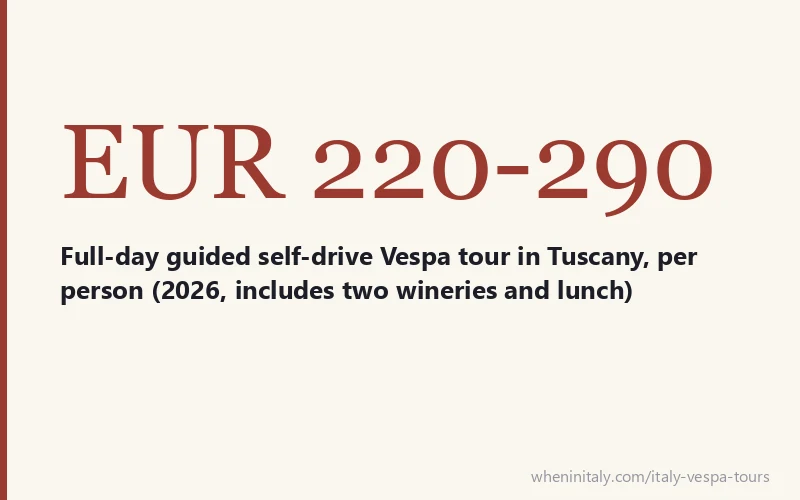
Florence and Chianti. Heartland of the guided self-drive format. The standard half-day tour leaves Florence by air-conditioned van around 8 or 9 am, transfers you to a quiet country road for a riding lesson, then puts you on a 125cc Vespa for a 2-3 hour loop through Chianti with a winery stop, lunch, and olive oil tasting. Returns by 1-4 pm. Full-day versions add a second winery and longer ride. 140-220 euros half-day, 220-290 full-day.
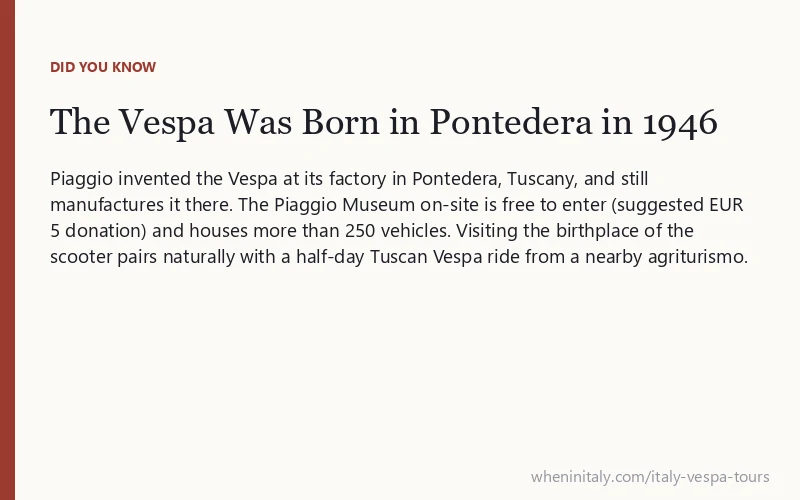
Pontedera (Piaggio Museum). The Vespa was invented in Pontedera in 1946 and is still made there. The Piaggio Museum is free (suggested 5 euro donation), houses 250+ vehicles, and pairs well with a half-day Tuscany Vespa ride from a nearby agriturismo. Worth a detour if you are a Vespa enthusiast specifically.
Sorrento and the Amalfi Coast. Self-drive tours from Sorrento run the SS163 Amalfitana, the cliff-hugging coastal road between Positano, Praiano, Amalfi, and Ravello. The road is genuinely difficult: hairpin turns, tour buses that take both lanes through corners, drop-offs without guardrails. Bookable both as self-drive (125cc with a lead guide) and as a passenger on pillion with a local driving. The passenger format solves the license problem and lets you actually look at the view, which on this road is the whole point. Mozzarella farm and limoncello stops are standard. 120-200 per person half-day.
Naples, Sicily, the lakes. Smaller scenes than Rome and Florence but established. Naples Vespa tours emphasize the chaos of the city itself (Spanish Quarter, Posillipo, the seafront). A handful of Sicilian operators run rides along the Etna foothills and the Taormina coast. Lake Como, Lake Garda, and the Dolomites have niche operators; mountain rides on a Vespa are a different physical experience (cold, wind, elevation) and best left to riders with prior scooter time.
Vespa with kids
Sidecar tours are the family-friendliest format. Operators typically allow children from age 5 or 8 in a sidecar with one adult, sometimes with a child seat or harness. Confirm with the specific operator: the cutoff varies (some say “minimum height 130 cm” instead of an age, others say 8+ regardless).
Italian law prohibits transporting children under 5 on any two-wheeler. A child over 5 can ride pillion behind an adult driver if their build supports it safely (their feet need to reach the foot pegs). This is a self-drive consideration: you cannot rent a Vespa and put a small child on the back.
A guided self-drive tour with kids is awkward: each child needs an adult driver and a properly sized helmet (operators carry kids’ helmets but availability varies in summer). For two adults and two kids over 8 it works. For one adult plus kids, or younger kids, the sidecar is the correct format. And no, Italian operators will not let you ride with a 3-year-old. This is non-negotiable.
Prices: from 50 euros to 400 per person
| Format | 2026 price | What’s included |
|---|---|---|
| Self-rental, hourly | 15-25 euros/hr | Helmet, RC liability |
| Self-rental, full day | 40-100 euros/day | Helmet, RC, deposit (~500 euros pre-auth) |
| Group sidecar tour, 2-3 hr | 70-130 euros/pp | Driver, helmet, insurance, often a coffee or gelato stop |
| Private sidecar, 3 hr | 200-350 euros total (1-2 pax) | Above plus dedicated guide |
| Half-day guided self-drive (Florence/Chianti) | 140-220 euros/pp | Vespa, helmet, lead guide, van transfer, winery, light lunch |
| Full-day guided self-drive | 220-290 euros/pp | Adds second winery, full lunch, olive oil tasting |
| Multi-day road trip (Tuscany or Amalfi loop) | 1,200-2,500 euros/pp | Bike, fuel, hotels, luggage transfer, guides, most meals |
What inflates the price: private vs shared, vintage vs modern Vespa, professional photographer, in-city pickup, peak season (May, June, September, October). What deflates it: shoulder season, shared groups, weekday morning slots.
The hidden cost on self-rental is the 500 euro security deposit pre-authorization. Not a charge, but it occupies 500 euros of your credit limit for the rental and for several days after. If your card is near its limit, this matters.
Safety, helmets, insurance, and what to wear
Helmets. Mandatory by law for rider and passenger, including children. Driver is fined if the passenger is helmetless. Operators provide ECE-certified helmets.
Insurance. Rentals and self-drive tour scooters carry mandatory third-party liability (RC). This covers people you hit, not your scooter. Damage to the bike comes off your security deposit (typically 500 euros excess). Optional zero-excess upgrades run 10-15 euros per day or 80-100 euros per Vespa per tour. For self-drive on the Amalfi SS163 without prior scooter experience, the upgrade is worth buying.
Travel insurance fine print. Most consumer travel policies (the kind bundled with a credit card or sold at booking) carry a “motorcycle exclusion” or require a separate two-wheel rider. Read your policy before riding. If you ride a category your home license does not cover, your medical evacuation insurance probably will not pay out.
What to wear.
- Closed-toe shoes that cover the ankle. Sneakers acceptable, hiking shoes better. No sandals, no flip-flops, no espadrilles. Several operators will turn you away for footwear.
- Long pants. Jeans are fine. In peak summer, lightweight long pants (linen, technical) are still better than shorts.
- Sleeves. A long-sleeve shirt or light jacket protects against sunburn at 40 km/h and against minor road rash.
- Sunglasses (the wind blows tears).
- Sunscreen on the back of the neck and the back of the hands.
- A small bag or backpack you can wear cross-body. Loose bags are dangerous on a scooter.
Best season. April to October is the riding season. Avoid August: extreme heat (35 to 40 C in Rome), peak crowds, and the Ferragosto holiday week around August 15 when many operators close. Sweet spots: mid-April to mid-June and mid-September to late October. Spring weeks see fewer cancellations.
Weather cancellations. Most operators will cancel and refund (or reschedule) for steady rain. Light drizzle is usually a “go.” Check the operator’s specific policy at booking; some require 24 hours notice for a free reschedule, awkward when Italian weather flips overnight.
A Vespa tour in Italy is, at its best, a way to see places at the speed they were meant to be seen at: 40 km/h, wind in your face, on roads laid out before cars existed. Pick the format that matches your comfort with two-wheelers, get the license question right before you arrive, and book in May or September if you can.