The Colosseum welcomed almost 15 million visitors in 2024, eclipsing 2023’s record of 12 million, and 2026 is tracking higher still. That demand has reshaped the ticket landscape: the official concessionaire, CoopCulture, now releases premium tiers in narrow time-slot windows that sell out in 60 to 120 seconds, and Italy’s antitrust authority fined six tour operators and CoopCulture itself almost EUR 20 million in April 2025 for bot-driven ticket hoarding. The result is a marketplace where knowing exactly which tier to buy, and exactly when, matters more than it ever has. This guide is the no-spin version: every tier, every upgrade, and an honest answer to which ones actually justify their price in 2026.
TL;DR / Key Takeaways
- The standard 24-hour ticket (Colosseum, Roman Forum, Palatine Hill, single entry each) costs EUR 18 plus a EUR 2 booking fee through CoopCulture, the only authorized vendor.
- Arena floor access adds drama and photos; underground (Hypogeum) access adds story and atmosphere. The combined Full Experience Arena and Underground ticket is EUR 24 and is the modal “right answer” for first-time visitors who care about the gladiatorial layer.
- Tickets release exactly 30 days before your visit date at midnight Rome time. Underground and Attic slots disappear in under two minutes during peak season.
- The night tour, now branded “Una Notte al Colosseo” (the older “Luna sul Colosseo” name belonged to a previous operator), costs around EUR 50 and runs roughly Tuesday and Thursday evenings May through October.
- The first Sunday of every month is free, but premium areas (arena floor, underground, attic) are not included on free Sundays, and the queue can stretch past two hours.
- The Roma Pass at EUR 32 (48 hours) or EUR 52 (72 hours) covers standard Colosseum entry, but does not include the arena floor or underground, which is why it rarely beats simply booking the Full Experience ticket directly.
The honest 2026 Colosseum ticket ladder
The fastest way to make a confident booking is to read the ladder once, decide which rung you want, then book on CoopCulture and stop researching. Six tiers exist in 2026, and only three of them are worth most travelers’ attention.
Standard 24-hour ticket - EUR 18 (+ EUR 2 booking fee). Single entry to the Colosseum, single entry to the combined Roman Forum and Palatine Hill site, valid for 24 hours from your Colosseum slot. Reduced to EUR 2 for EU citizens aged 18 to 25; free for under-18s of any nationality. Pick if you only have a half day, you have already seen the major archaeological sites elsewhere in Italy, or budget is the deciding factor. Skip if you are a first-time visitor with three hours and any curiosity about the show that happened on the floor.
Full Experience Arena - EUR 22. Standard ticket plus access to the wooden replica arena floor through the Gladiator’s Gate (Porta Libitinaria). Valid for two consecutive days. Pick if you want the iconic photograph, you are traveling with a teenager who watched the Russell Crowe film, or you simply want to stand where the spectacle happened. Skip if you are also doing the underground (just upgrade once).
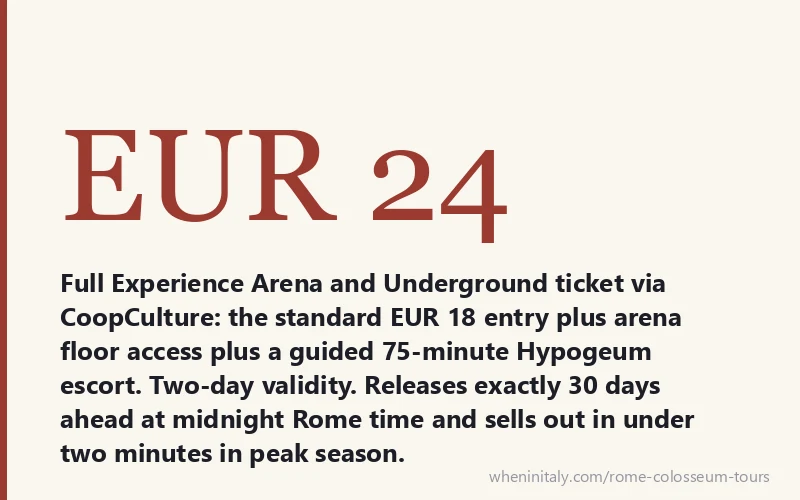
Full Experience Arena and Underground - EUR 24. The above plus a guided escort into the Hypogeum, the warren of brick chambers below the arena floor where animals, gladiators, and stage machinery were staged before being lifted up through trapdoors. Underground portion is roughly 75 minutes, max 25 people per group, guided in Italian and English in alternating slots. Pick if you want the complete physical and narrative tour and you can book the moment the 30-day window opens. Skip if you cannot commit to a precise time slot (the underground portion is non-refundable and non-transferable).
Full Experience Attic - EUR 22. Standard plus access to the third, fourth and fifth tiers via a dedicated panoramic lift to the upper balcony at roughly 40 metres. Two-day validity, includes Imperial Fora and the SUPER Sites. Does not include arena floor or underground. Pick if this is your second or third visit and you have already done the floor and the basement. Skip if this is your first visit; the view is genuinely spectacular but the ground-floor and underground stories are the ones first-timers actually came for.
Roma Pass (48-hour EUR 32 / 72-hour EUR 52). City pass covering public transport plus your first one or two state museums for free and discounts after that. Includes standard Colosseum entry but not the arena floor, underground, or attic. Pick if the Colosseum is one stop in a five-museum, transit-heavy week. Skip if the Colosseum is the centerpiece of your Rome visit (you will end up double-paying to upgrade).
First Sunday free. Free entry to standard areas on the first Sunday of every month. Pick if you are flexible, patient, and the date works. Skip if any of those three conditions is shaky; the queues can pass two hours and premium tiers are not available.
The ladder gets simpler if you reduce it to a single sentence: most first-time visitors should book the Full Experience Arena and Underground at EUR 24. Most repeat visitors should consider the Attic or the night tour. Almost no one should rely on the Roma Pass.
Skip-the-line: is the OTA upcharge actually worth it?
Almost never, and here is the structural reason. The Colosseum has only two entry queues: a slow lane for unticketed walk-ups and a fast lane for anyone with a timed ticket. CoopCulture’s official EUR 18 ticket puts you in the fast lane. So does Viator’s EUR 65 “skip the line” ticket. So does GetYourGuide’s EUR 49 version. The third-party “skip the line” label is essentially marketing on top of the same ticket the official site sells; the line you are skipping is the line of people who showed up without a reservation, and any timed ticket skips it.
That said, some OTA bookings are genuinely worth their markup, just not for the line. They are worth it when they bundle a live guide. A licensed guide explaining the engineering of the velarium awning, the gladiatorial classes (murmillo, retiarius, secutor, thraex), the imperial logistics of importing 9,000 animals for the inaugural games, and the architectural innovations that let Vespasian build the largest amphitheatre in the empire in under a decade is a meaningfully different experience from a self-guided walkthrough. Expect to pay EUR 65 to EUR 90 for a small-group guided tour with a real guide; private guides start around EUR 200. The official audio guide at EUR 5.50 is fine but it cannot answer follow-up questions or read your face when something is not landing.
The April 2025 antitrust ruling matters here. Italy’s competition authority (AGCM) fined Musement, GetYourGuide, Tiqets International, Walks LLC, Italy with Family, City Wonders, and CoopCulture itself nearly EUR 20 million for using bots to bulk-buy tickets, manufacture artificial scarcity on the official site, and force visitors onto bundled OTA packages. CoopCulture has since restructured its release windows and added bot countermeasures, but the practical impact is mixed: official tickets are easier to find when you book exactly 30 days ahead, and harder than they should be at any other time. If the official site shows your date as sold out, check again at 00:00 Rome time on the day exactly 30 days before your visit. The release is mechanical and predictable.
The arena floor tour: walking through the Gladiator’s Gate
The arena floor experience is the single most visceral upgrade available, and at EUR 22 it is also one of the cheapest. The original wooden floor was dismantled in the 19th century to expose the underground for archaeological study; what you walk on today is a partial wooden replica reinstalled in 2023, covering roughly a third of the arena’s footprint. From the center, you stand at the level the spectators paid to see, with 50 metres of three-tiered marble bleachers rising on every side. It is the photograph that anchors most travelers’ Rome album.
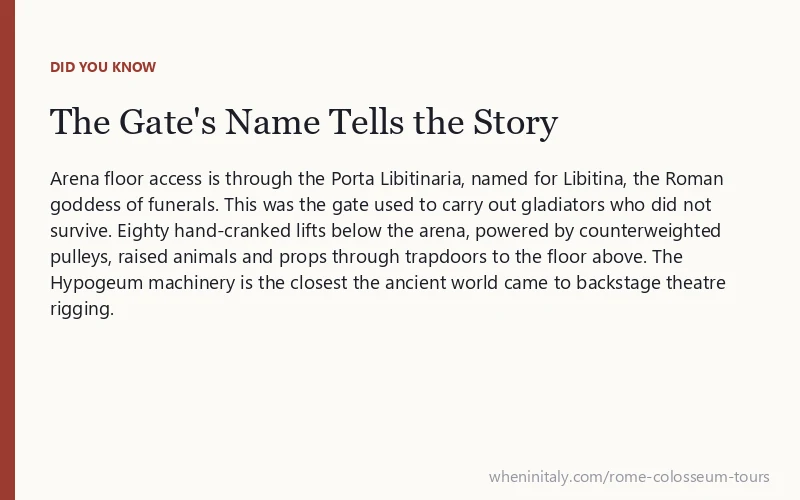
Access is through the Porta Libitinaria, the eastern gate. The name comes from Libitina, the Roman goddess of funerals; the gate was used to carry out the bodies of gladiators who had not survived the bout. Roughly 50 visitors are permitted on the floor at any given time, which is why the slot is timed and the ticket is non-flexible. Most arena visits last 25 to 35 minutes on the floor itself, embedded in a 90-minute to 3-hour overall guided tour that also covers the standard tiers and, often, the Roman Forum.
A practical note that the listicles tend to skip: the arena floor portion is uncovered and the wooden surface gets brutally hot in July and August. Mid-July arena floor slots can hit 45 degrees Celsius at noon; if you cannot move your booking to the 08:30 first slot or the 16:30 second wave, bring water and a hat that actually shades your face. The site has no shade once you are on the floor.
The arena floor pairs naturally with the underground; the EUR 24 combined ticket is a EUR 2 upgrade over arena-only and adds the entire Hypogeum. Almost everyone who picks arena-floor-only later wishes they had spent the additional EUR 2.
The underground (Hypogeum): what’s down there and is it worth the upgrade?
Yes, for most travelers who care about the story, and an unequivocal yes for anyone with even a passing interest in Roman engineering. The Hypogeum is a two-level network of brick corridors, holding cells, and machine rooms directly beneath the arena floor, used to stage the day’s events: animals waiting in cages, gladiators preparing in green-room chambers, scenery elements assembled for noon reenactments of mythological scenes. Eighty hand-cranked lifts, operated by counterweighted pulleys, raised animals and props through trapdoors in the arena floor. The system is the closest thing the ancient world produced to backstage theatre machinery, and it survived because the Colosseum was buried in centuries of debris before excavation in the 19th and 20th centuries.
A guided escort is mandatory; you cannot wander the Hypogeum on a self-guided ticket. Groups are capped at roughly 25 people, the underground portion runs about 75 minutes, and tours alternate between Italian and English in published slot windows. The space is genuinely atmospheric: low ceilings, humid air, the brickwork still showing the soot from oil lamps, the holes in the floor where the lifts terminated. It is the only part of the entire site where you get something close to silence; visitor flow is capped tightly enough that the hour-on-hour roar of the upper tiers fades.
For travelers who want to go deeper than this article allows, a separate companion guide on the underground tour walks through the practical booking strategy slot by slot, and includes annotated photographs of the chambers most tour groups stop at. The underground-specific source covers details like the Commodus passage, the western lift system, and the recently reopened sectors that are worth knowing about before you book.
The honest cons: the EUR 24 ticket sells out fast. CoopCulture releases a fixed quota 30 days in advance, and the Hypogeum slots disappear in the first one to two minutes during May, June, September, and October. Same-day availability in peak season is essentially nonexistent. If you want this tier, set a calendar reminder for 23:55 Rome time on the date exactly 30 days before your visit, and book the moment the clock turns over.
The night tour: the Colosseum after the crowds leave
The night tour (officially “Una Notte al Colosseo,” replacing the older “Luna sul Colosseo” branding that was managed by a different operator) opens the Colosseum to small evening groups after the daytime ticket holders have cleared out. Tours run roughly Tuesday and Thursday evenings from May through October, in slots typically 20:00 to midnight, and cost approximately EUR 50 (the EUR 24 Full Experience ticket plus a EUR 26 guided-tour fee). The reduced rate is around EUR 28; under-6s are free.
What makes the night tour distinctive is not just the lighting (theatrical floodlighting on the travertine, the upper tiers in shadow) but the silence. Daytime Colosseum visits absorb 30,000 to 40,000 people through the gates. The night session caps at small groups, typically under 100 visitors total spread across staggered start times, and the difference is hard to overstate. You can hear your guide without leaning in. You can stand in the upper tier and look down on the arena floor without anyone in the frame. Many tours include a brief Hypogeum descent as part of the EUR 50 ticket; verify before booking that the underground portion is included on your specific slot.
Booking is the catch. Night tickets release only 7 days before the date, not the standard 30. They sell out in the first day of release in summer. The release is on ticketing.colosseo.it (the parcocolosseo.it system); CoopCulture’s main site routes you there. If you want the night tour and you are traveling in June, July, or August, treat the seven-day release as a calendar event and book the moment the slot opens.
For a fuller treatment of what to expect at each lighting setup, the after-hours photo angles that work, and which seasonal months have the best ambient temperature, there is a deep-dive guide to the Colosseum night tour that goes slot by slot. It is worth a read before you commit a non-refundable EUR 50 booking.
A practical note on the off-season: night tours pause in November through April. Some private operators sell what they call “Colosseum at night” tours in the off-season, but these are exterior-only walking tours of the surrounding area; they do not enter the monument. If the official ticketing.colosseo.it system shows no slots for your dates, the official tour is not running, and any third-party “Colosseum night tour” listing for that period is selling something else.
Roman Forum and Palatine Hill: don’t waste the included ticket
Every Colosseum ticket from the EUR 18 standard upward includes single entry to the combined Roman Forum and Palatine Hill site, valid for the same 24-hour window. Most visitors either skip it or rush it, and both are mistakes. The Forum is where Rome actually happened: the Curia where the Senate sat, the Rostra where Cicero spoke, the Via Sacra where triumphal processions ended at the Temple of Jupiter Capitolinus. The Palatine is where the emperors lived, with the imperial palaces of Augustus, Tiberius, and Domitian still legible in the ruins. The combined site is roughly 40 hectares, and giving it less than two hours is the equivalent of seeing the Vatican Museums in 30 minutes.
The practical strategy: do the Colosseum on a morning slot (08:30 or 09:30), exit by 11:30, walk five minutes south to the Forum entrance on Via dei Fori Imperiali, and spend two to three hours working uphill through the Forum and onto the Palatine. The view from the southern edge of the Palatine over the Circus Maximus, with the Aventine rising opposite, is one of the best in Rome and almost no day-trippers reach it. Bring water (no fountains inside the Forum proper) and shoes that can handle uneven cobblestone.
Critically, the Roman Forum and Palatine ticket is single-entry. Once you exit, you cannot re-enter. Plan your route so you do not walk out of the Forum to grab lunch and then realize you missed the House of Augustus on the Palatine.
Best time of day, best time of year
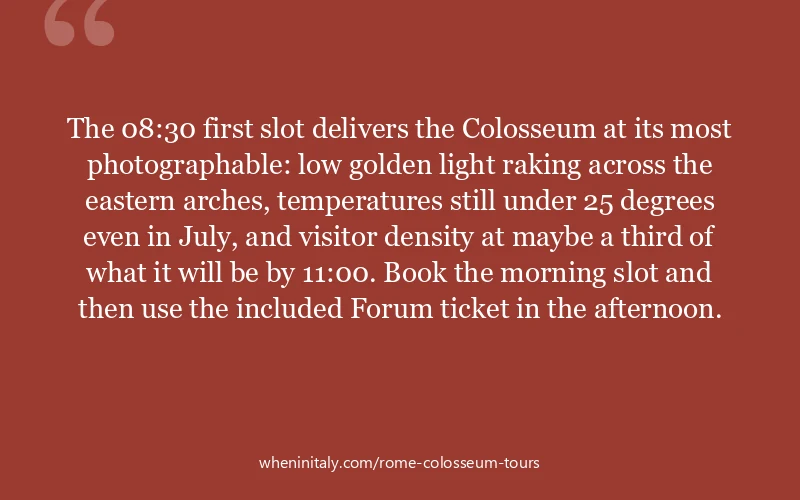
There are two good arrival slots and two terrible ones. The 08:30 first slot delivers the Colosseum at its most photographable: low golden light raking across the eastern arches, temperatures still under 25 degrees even in July, and visitor density at maybe a third of what it will be by 11:00. The 16:30+ second wave catches warmer light on the western tiers, sunset over the Forum if you climb the Palatine, and the daytime tour groups largely cleared out. The two slots to avoid are 11:00 to 14:00 (peak crowds, peak heat, peak coach-tour density) and the last slot of the day in winter (15:30 last entry from October 25 through February 28 means you have one hour before the site closes, which is not enough).
By season: late April through mid-June and mid-September through October are the sweet spot. Temperatures in the high teens to mid-20s Celsius, daylight long enough to do the Colosseum and Forum on a single ticket, and crowds noticeably below July-August levels. July and August deliver 35 to 40 degree days regularly; the arena floor without shade becomes punishing. November through March is the lowest-crowd, lowest-cost window, but expect rain on roughly one day in three and the night tour does not run.
A specific note on August: the Italian Ferragosto holiday around August 15 sees a strange inversion. Italian visitors disappear (most Italians take the entire week off and leave the city), but international tourist density spikes. Lines do not actually shorten. What does shrink is restaurant availability; many family-run trattorias near the Colosseum close for the entire two weeks around Ferragosto.
Closures to plan around: the Colosseum is closed on December 25, January 1, and May 1 (Italian Labour Day). Outside those three dates it is open every day. Last entry is consistently one hour before closing time. Summer close is 19:15 (last entry 18:15) from March 29 through September 30; the transition period from October 1 to October 24 closes at 18:30 (last entry 17:30); the winter schedule from October 25 through February 28 closes at 16:30 (last entry 15:30).
With kids, with limited mobility, with limited time
Three of the most-asked qualifications, each with a specific answer.
With kids. Under-18s of any nationality enter free, but they still need a free booked ticket; do not skip this step or the gate will turn you away. Under-6s are free across all tiers, including the night tour. The honest age recommendation is 7 and up: the walking distances inside the site (1.2 km if you do the full upper tier loop) plus the 200+ steps in some sections plus the Roman heat make the visit genuinely difficult for very young children. A six-year-old who slept well and is comfortable in the heat is fine; a tired four-year-old in 35-degree July sun is a meltdown waiting to happen. Strollers are permitted but several sections are stairs-only with no elevator alternative. Bathrooms are at the entry and exit only; nothing in the middle.
With limited mobility. The Colosseum has wheelchair access via a separate entrance on the south side, with lifts to the second tier. Standard tickets are free for visitors with disabilities and one accompanying companion. The arena floor, the underground (Hypogeum), and the attic are not wheelchair accessible; the underground in particular has narrow brick passages and stairs that no lift can resolve. The Roman Forum and Palatine are partially accessible with significant gaps; the Palatine in particular is steep terrain. CoopCulture publishes detailed accessibility maps; book the disability ticket on the official site to ensure the gate routes you correctly.
With limited time. If you have only 90 minutes total at the Colosseum, book the Standard ticket for the 08:30 slot, do a fast self-guided loop of the upper tiers, skip the Forum and Palatine, and accept that this is a sampler. If you have three hours, book the Full Experience Arena (EUR 22), do the standard tiers and the arena floor, then squeeze the Forum on the way back to your hotel. If you have four hours, book the EUR 24 Full Experience Arena and Underground and add the Forum after. If you have any less than 90 minutes, book a different day; the queue alone (even on a timed ticket) often runs 15 to 20 minutes and you will spend the visit watching the clock.
Buying tickets without getting scammed
CoopCulture is the only authorized concessionaire. The official ticketing system runs at coopculture.it and the parallel parcocolosseo.it / ticketing.colosseo.it portal for the Parco Archeologico del Colosseo. Anything else, including the dozens of look-alike domains that have sprung up around the monument, is a reseller adding a markup of 50 to 300 percent.
Reseller markup is not always illegal, and reputable global OTAs (GetYourGuide, Viator, Tiqets) sell legitimate tickets sourced from CoopCulture, often bundled with guided tours that justify some of the markup. But the ecosystem also includes outright scam sites that take your money and deliver either fake QR codes, tickets purchased in someone else’s name (the Colosseum performs ID checks at the gate, so non-matching names get refused), or nothing at all. The April 2025 AGCM ruling specifically targeted bot-driven hoarding, and CoopCulture’s countermeasures have improved, but the secondary market is still dense with bad actors.

The five-second test for any reseller URL: does it appear in CoopCulture’s authorized partner list at coopculture.it? If not, treat it as risky. Reputable global aggregators are usually fine for guided-tour bundles where the guide’s labor is the actual product; cheap “skip the line” sites that sell pure entry at 2 to 4x the EUR 18 official price are almost always scams or near-scams.
A second category of scam happens at the Colosseum itself. Touts work the metro exit and the perimeter selling “skip the line” wristbands and “official” guided tours; these are at best overpriced (EUR 60+ for what would be EUR 18 at the gate) and at worst entirely fake. The official site has no street-level sales agents. If someone outside the gate offers you a ticket, decline and walk to the official ticket office or pull up your CoopCulture booking on your phone. The Italian Carabinieri do regular sweeps but the touts return within days.
The Roma Pass tradeoff deserves a final mention. At EUR 32 for 48 hours or EUR 52 for 72 hours, the math depends entirely on how many included sites you visit and how often you use public transit. For a Colosseum-centric visit, the Pass is rarely the better deal once you want the arena floor or underground (neither is included; you book and pay separately). For a multi-museum, transit-heavy week with the Borghese, the Capitoline, the Baths of Caracalla, and the Galleria Doria Pamphilj on your list, the Pass can pencil out. Run the numbers against your actual itinerary; the marketing copy will not.
TL;DR: which tier should you actually book?
The decision matrix, compressed:
- First-time visitor, two to three hours, wants the full story: Full Experience Arena and Underground, EUR 24. Book on CoopCulture exactly 30 days ahead, 08:30 slot.
- First-time visitor, half day, wants the iconic photograph: Full Experience Arena, EUR 22. Same booking strategy.
- First-time visitor, just passing through, photo and exit: Standard 24-hour ticket, EUR 18 plus EUR 2 booking fee. Add the Forum on the way back to your hotel.
- Repeat visitor, has done the arena floor and underground: Full Experience Attic, EUR 22, for the panoramic upper tiers. Or the night tour at EUR 50.
- Family with under-18s: Full Experience Arena and Underground for the paying adult, free booked tickets for each child. Pick the 08:30 slot in summer; older kids can handle the 16:30 slot fine.
- Limited mobility: Standard ticket via the disability route (free for visitor and one companion); skip the arena, underground, and attic, which are not accessible.
- Tight budget, flexible date: First Sunday of the month, free entry to standard areas only, queue at 07:30 to be at the gate when it opens at 08:30.
- Roma Pass holder: standard entry only; book the included Colosseum reservation slot on the official site, do not assume your Pass alone gets you in.
Book on coopculture.it or ticketing.colosseo.it. Set the 30-day-ahead calendar reminder. Plan the Forum into the same day. Skip lunch around the Colosseum (the area is tourist-trap dense; the trattorias of Monti, ten minutes north, are an order of magnitude better). And if the underground tier shows sold out at the moment you book, it usually means someone got there 30 seconds before you; the next day’s quota releases in 24 hours.
Sources and References
- Parco archeologico del Colosseo — Opening Times and Tickets — official 2026 hours, ticket prices, and tier definitions
- Parco archeologico del Colosseo — Free Entry to Italian Museums — first Sunday free initiative
- Parco archeologico del Colosseo — A Night at the Colosseum — official “Una Notte al Colosseo” night tour details
- Parco archeologico del Colosseo — Full Experience Underground and Arena — official Hypogeum ticket page
- CoopCulture — Full Experience Arena and Underground — official vendor product page
- Mama Loves Rome — How to buy Colosseum tickets from the official website (2026) — practical official-site walkthrough
- Mama Loves Rome — The Colosseum at Night 2026 — night tour scheduling and seasonality
- Carpe Diem Tours — Visiting the Colosseum in 2026: A No-Nonsense Guide — operator overview cross-reference
- Wanted in Rome — Rome’s Colosseum welcomes record 12 million visitors in 2023 — visitor-volume baseline
- Wanted in Rome — Colosseum Ticket Scam Uncovered — scam ecosystem reporting
- Travel and Tour World — Rome Strengthens Tourism Management Efforts — 2025 / 2026 visitor record context
- Colosseum Rome — Ticket Prices 2026 — comparative tier pricing reference
- Colosseum Rome — Attic Tour 2026 — Attic-tier specifics
- Colosseum Rome — Underground Tour 2026 — Hypogeum tour mechanics
- HowdyEurope — Colosseum Ticket Prices 2026 — secondary-source price verification
- Reuters / AGCM coverage via Italianismo and travel press — €20m antitrust fine, April 2025 — bot-hoarding fine context
- eTuk Tours — Rome’s Colosseum Ticket Scandal — antitrust fine summary and reseller landscape
- Romewise — Colosseum Free Entry — first-Sunday queue conditions
- Tourist Italy — Colosseum Visitors’ Guide 2026 — supplementary 2026 guide
- Through Eternity — How To Visit the Colosseum in 2026 — booking-strategy cross-reference