TL;DR / Key Takeaways
- The Vatican is two paid experiences and two free events on the same day. Vatican Museums plus Sistine Chapel: EUR 20 at the door, EUR 25 with the official online booking fee, entrance via Viale Vaticano. St Peter’s Basilica: free, separate entrance via St Peter’s Square. Wednesday Papal Audience and Sunday Angelus: also free.
- Pope Leo XIV (Robert Francis Prevost, born Chicago 14 September 1955) became the first American-born pope on 8 May 2025, after Pope Francis died on 21 April 2025. The Wednesday audience continues at 10:30, now in his voice.
- The Holy Doors of St Peter’s Basilica closed on 6 January 2026, ending the Jubilee Year of Hope. The next Jubilee is 2050. More than 33.4 million pilgrims passed through Rome during the 2025 Jubilee.
- The dress code (covered shoulders, covered knees, no hats inside) is enforced strictly at both the Sistine Chapel and St Peter’s Basilica. Visitors are turned away at security regardless of ticket status. Pack a scarf.
- Best slot for the Museums: 09:00 first entry on a Tuesday, Thursday or Saturday. Worst: Wednesday morning, when the Papal Audience clogs the Square, and the last Sunday of the month, when free admission produces queues that loop the block.
- Allow 6 to 8 hours for the full Vatican day: 4 hours Museums and Sistine Chapel, 1.5 hours Basilica and Square, 1.5 hours Dome climb plus the Vatican Grottoes. Add a real lunch outside the walls.
The Vatican at a glance: two paid experiences and two free events
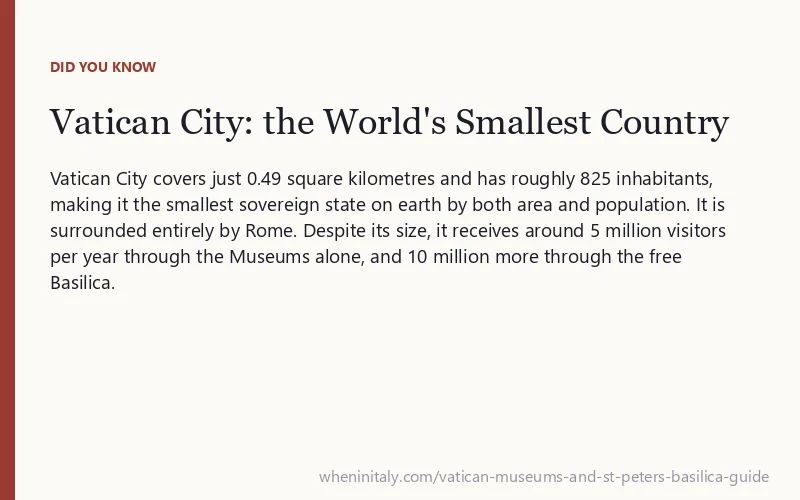
Vatican City is a 0.49 square kilometre sovereign state with roughly 825 inhabitants, the smallest country in the world, surrounded entirely by Rome. For a visitor planning the day, what matters is that the Vatican operates as four distinct visit modes through two separate entrances.
The first paid experience is the Vatican Museums plus the Sistine Chapel. One ticket, one entrance, on Viale Vaticano on the north side of the Vatican walls. Roughly 5 million visitors per year. The second paid experience is the Dome climb of St Peter’s Basilica, accessed from inside the Basilica. The Basilica itself is free and entered separately from St Peter’s Square on the east side, with security queues that can run 30 to 90 minutes in summer. The Basilica draws roughly 10 million visitors per year, harder to count precisely because entry is unticketed.
Layered on top of those two paid sites are two free events that depend on the day of the week. The Wednesday Papal Audience starts at 10:30 in St Peter’s Square (or in the Aula Paolo VI auditorium in winter), free with a ticket from the Prefettura della Casa Pontificia. The Sunday Angelus at 12:00 needs no ticket at all: arrive in the Square between 11:30 and 12:00 and look up at the Apostolic Palace window. The Pope’s brief Italian-language address and Latin Angelus prayer last about ten minutes. The two entrances do not connect directly inside the Vatican, so a tour that “exits through the Sistine Chapel into St Peter’s” is a tour-group privilege, not a public route.
Vatican Museums plus Sistine Chapel: tickets, the EUR 20 reality, sold-out windows
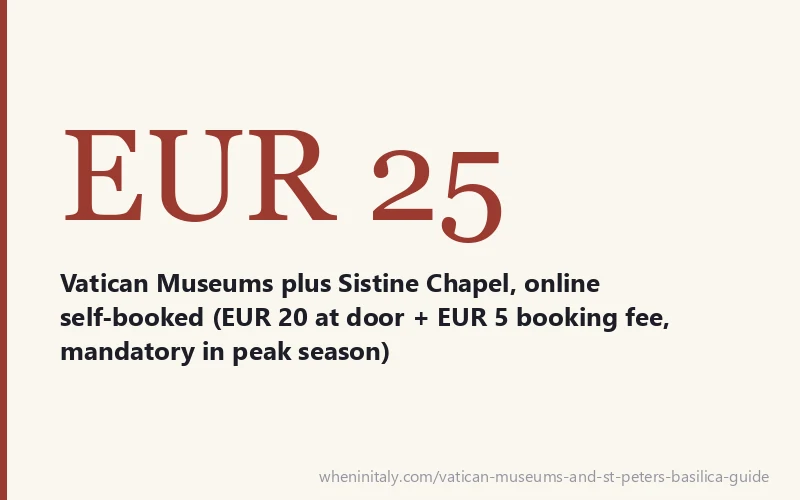
The official ticket from museivaticani.va is EUR 20 at the door, EUR 25 online (the EUR 5 booking fee is functionally compulsory in May through October because walk-up tickets sell out by mid-morning). The reduced ticket for ages 6 to 18 and students up to 25 is EUR 8. Children under 6 are free. An audio-guide bundle is EUR 39 booked in advance. The only legitimate booking portal is tickets.museivaticani.va: every other URL with “vatican” in it is a reseller marking up the same ticket by EUR 10 to EUR 50.
In peak season, summer through early October, slots sell out two to four weeks ahead. The Vatican releases new dates on a rolling 60-day window, so booking the moment dates open is the cleanest path. Standard hours are 08:00 to 20:00 Monday through Saturday, last entry 18:00, halls cleared 30 minutes before close. The Museums are closed Sundays with one exception: the last Sunday of each month is free entry, 09:00 to 14:00, last entry 12:30. This sounds appealing and is the worst single day of the month to visit. Queues on the free Sunday can hit three hours; the free Sunday is suspended when it lands on a major feast (Easter, 29 June for Saints Peter and Paul, 25 December, 26 December).
The Museums hold around 70,000 artworks across 7 kilometres of galleries and 1,400-plus rooms. The standard route, signposted in English and Italian, walks visitors through the Egyptian Museum (Museo Gregoriano Egizio), the Etruscan Museum, the Pio-Clementino classical sculpture wing (the Apollo Belvedere and the Laocoon both live here), the Gallery of Maps (1580-1583, 40 frescoed maps of Italy on a 120-metre corridor), the Raphael Rooms (the Stanze di Raffaello, frescoed by Raphael and his workshop 1508 to 1524 for Pope Julius II), and finally the Sistine Chapel. The signposted “quick” route to the Sistine takes about 90 minutes if walked briskly; a thorough visit comfortably consumes four hours.
The Sistine Chapel: what is inside and why no photos
The Sistine Chapel is structurally a chapel, not a museum gallery: 40.9 metres long, 13.4 metres wide, 20.7 metres high, the same proportions as the Temple of Solomon as described in the First Book of Kings. It is the chapel where the College of Cardinals meets in conclave to elect a new pope, most recently in May 2025.
Michelangelo painted the ceiling between 1508 and 1512 under commission from Pope Julius II (the same patron driving the Raphael Rooms next door, on the same years; the two artists were working hundreds of metres apart in mutual rivalry). The ceiling’s nine central panels run from God Separating Light from Darkness to the Drunkenness of Noah, framed by the Prophets and Sibyls. The Last Judgement on the altar wall came later, painted between 1536 and 1541 under Pope Paul III, with Christ as a clean-shaven athletic judge and a famously naked Bartholomew holding his own flayed skin (Michelangelo painted his self-portrait into that sagging skin, a private joke about his exhaustion).
The Chapel admits roughly 12,000 to 15,000 visitors per day in peak season, with about 3,500 inside at any one moment. Photography and video are not permitted, which surprises many first-time visitors. The rule traces back to the 1980s restoration, partly funded by Nippon Television in exchange for exclusive photo rights; the no-photos rule outlived the original contract and is now enforced for preservation and crowd-flow reasons. Guards in dark suits patrol the floor and call out “no photo, silenzio” through small speakers at one-minute intervals. Silence is requested but rarely fully achieved.
Tour groups that have pre-booked the privileged “exit through the back” slip out the door at the front-right corner of the Chapel directly into the corridor that leads down to St Peter’s Basilica, saving the entire walk back through the Museums and the separate Basilica security queue. Non-tour visitors retrace the route back to the Museums entrance and walk around to St Peter’s Square, a 10-minute outdoor loop.
St Peter’s Basilica: free entry, the Dome climb, the Pieta
St Peter’s Basilica is free to enter, with no ticket required. The single bottleneck is the security queue at the east colonnade entrance to St Peter’s Square, which runs 30 to 90 minutes in summer afternoons and 5 to 20 minutes at 07:00 or after 17:00. Hours are 07:00 to 19:00 in summer (April to September), 07:00 to 18:30 in winter, with closures for major papal events (the Square goes into lockdown for several hours around any papal Mass).
The Basilica covers 23,000 square metres of internal floor and seats roughly 60,000 people standing. Inside, three works dominate. Michelangelo’s Pieta (1499, marble, completed when the artist was 24) sits behind bulletproof glass in the first chapel on the right, glassed-in since a hammer attack on 21 May 1972. Bernini’s Baldacchino (1623 to 1634), the 29-metre-tall bronze canopy over the papal altar with its twisted Solomonic columns, was cast partly from bronze stripped from the Pantheon’s portico (Pope Urban VIII’s pragmatic re-use prompted the famous Roman jab “Quod non fecerunt barbari, fecerunt Barberini”: what the barbarians did not do, the Barberini did). And Michelangelo’s dome itself, designed in 1547 and still the largest unsupported brick dome in the world at 42.34 metres internal diameter, an explicit echo of and rebuttal to Brunelleschi’s Florence dome.
The Vatican Grottoes below the main floor hold 91 papal tombs and are free to enter via the staircase near the Pier of St Andrew. Entry can close abruptly when a private papal liturgy is using the lower level, so plan flexibly. The Treasury Museum off the left transept costs EUR 5 and holds vestments, papal regalia and the so-called Throne of St Peter (a 9th-century chair preserved inside Bernini’s gilded Cathedra Petri).
The Dome climb (Cupola di San Pietro) is the only paid component inside the Basilica. Two prices, two routes:
- All 551 steps on foot: EUR 10 at the kiosk inside the Basilica portico (right-hand side), EUR 17 booked online via basilicasanpietro.va.
- Elevator to the roof, then 320 steps on foot to the lantern: EUR 15 at the kiosk, EUR 22 online.
The elevator skips the first 231 steps to the Basilica roof level. The remaining 320 steps to the lantern have no elevator option and pass through an increasingly narrow, leaning spiral that follows the curve of the dome’s inner shell. Hours are 07:30 to 18:00 summer, 07:30 to 17:00 winter. The summit sits 136 metres above the Square, with a 360-degree view across Rome that for many visitors is the single best moment of the trip.
The Wednesday Papal Audience: how to get a free ticket
When the Pope is in residence, he holds a public General Audience every Wednesday at 10:30. Tickets are always free. Anyone telling you otherwise is selling you something else.
The audience runs in St Peter’s Square in good weather (capacity around 20,000), or in the Aula Paolo VI auditorium adjacent to the Basilica in winter and rain (capacity around 6,300). The format is the same in both venues: multilingual scripture readings, a short catechesis from the Pope (usually delivered in Italian, summarised after in English, French, German, Spanish, Portuguese, Arabic and Polish), greetings to pilgrim groups by language, and the apostolic blessing of attendees and the religious objects they carry.
To request a ticket, contact the Prefettura della Casa Pontificia directly. The official channels:
- Email: ordinanze@pontificalisdomus.va
- Fax: +39 06 6988 5863
- Postal address: Prefecture of the Papal Household, 00120 Vatican City State
Request one week to one month ahead. American visitors can route the request through the Bishops’ Office for US Visitors to the Vatican (visitorsoffice@pnac.org), which is faster and bundles the tickets for collection. Tickets are picked up at the Bronze Doors on the right side of St Peter’s Basilica from 15:00 to 19:00 on the Tuesday before, or from 07:00 on the Wednesday morning itself.
Practical note: a ticket guarantees entry, not a chair. Arrive by 08:00 for a seat in the front 20 rows; arrive at 09:30 and you stand at the back. The Pope passes the front rows in the open Popemobile around 09:45 to 10:00 before the audience formally begins. Pope Leo XIV has, since his election, kept Pope Francis’s habit of long pre-audience laps through the crowd.
The Pope is generally absent from audience in the second half of July and the whole of August, between Christmas and Epiphany, and during Holy Week. vaticannews.va posts a confirmed week-by-week schedule.
What is the Vatican dress code in 2026?
Shoulders covered, knees covered, no hats inside. That is the rule, and it is enforced at the Sistine Chapel security check, at the St Peter’s Basilica security check, and (more leniently) at the Museums entrance. Tour reservations and pre-paid tickets do not exempt anyone. Visitors who fail the check are turned away at the door or routed to vendors at the Viale Vaticano selling paper coverings, which works but feels like a tourist tax.
Practical translation:
- No shorts that end above the knee, for any gender, at any age. Capri pants and long Bermuda shorts that cover the knee pass.
- No sleeveless tops. A short-sleeve t-shirt is fine; spaghetti straps and tank tops are not.
- No bare midriff. Crop tops fail the check.
- No miniskirts. Skirts at or below the knee pass.
- Hats off inside both buildings, all genders, all ages. Hats are fine in the open Square and Vatican Gardens.
- Jeans are fine. The rule is modesty, not formality. Sneakers are fine.
- Visible religious tattoos generally pass without comment. Visibly offensive imagery may earn a polite request to cover.
- Children under 12 get gentler enforcement, but a child in a tank top will be redirected.
The single most useful packing item for a Vatican day in summer is a lightweight scarf (the long Italian “pareo” style works for both shoulders and knees) folded into the day bag. Throw it on at the security line, take it off in the gallery, throw it on again at the Sistine Chapel.
The Wednesday Papal Audience held outdoors in the Square has a more relaxed dress code in practice (the Square is not a sacred interior), but visitors who plan to enter the Basilica afterwards may as well dress to the stricter standard once.
Early-access and “breakfast in the Vatican” tours: when do they actually pay off?
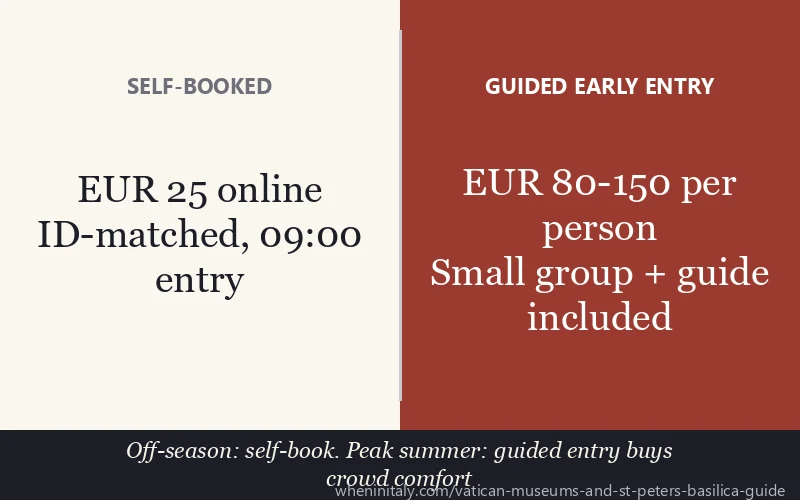
The premium tier of Vatican tickets sits at three rough levels:
1. First-entrance “early entry” tours, EUR 80 to EUR 150 per person. These promise a small group walking into the Sistine Chapel before the standard 09:00 wave hits the room. Since 2024, the Vatican has standardised the public opening at 08:00 and discontinued the truly pre-public 7am slot for tour operators, so the “early access” wording is now functionally a guaranteed-first-wave entry rather than an empty-Chapel privilege. Worth the premium only if the visit lands in mid-June through early September, when the standard 09:00 wave is already 1,000-deep and the Sistine Chapel hits 3,000 visitors before 10:30. Off-season, a self-booked 09:00 ticket gives the same first-wave experience for EUR 25.
2. Breakfast in the Pinecone Courtyard, EUR 90 to EUR 200 per person. A buffet breakfast served in the Cortile della Pigna (the Pinecone Courtyard, named for the 4-metre 2nd-century AD bronze pinecone that anchors the niche), followed by a guided walk through the Museums and Sistine Chapel. Worth the premium for first-time visitors who want a “moment” out of the trip, and for couples treating the day as an event rather than a checklist. Not worth it for return visitors who already know the layout.
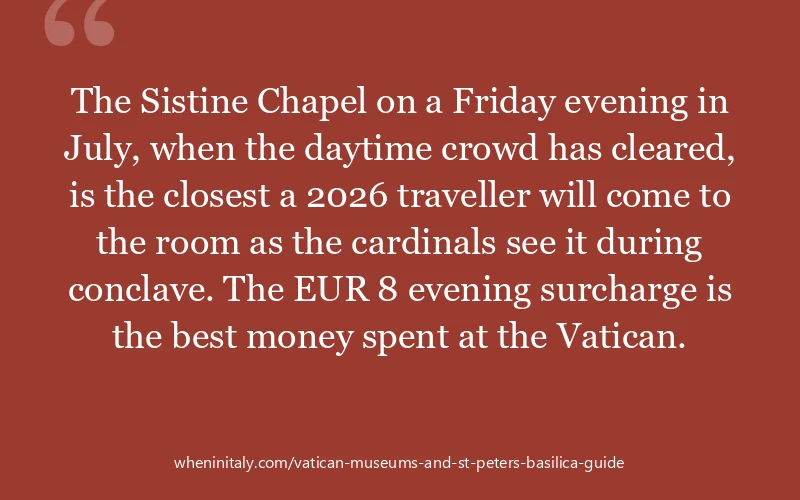
3. After-hours Friday opening, EUR 25 to EUR 33 per person. This is the underrated win. The Vatican Museums open on Friday evenings from late April to late October, typically 19:00 to 22:30, with last entry around 20:30. The standard ticket plus an EUR 8 evening surcharge gets a visitor into the same galleries at roughly one-third of the daytime crowd density, with sunset light through the Gallery of Maps windows. The Sistine Chapel at 21:00 in July, when the daytime crowd has cleared, is the closest a 2026 traveller will come to the room as the cardinals see it during conclave. Tickets must be booked online; walk-up is not offered for the evening sessions.
The premium tiers worth skipping altogether: anything advertising “skip-the-line VIP” without a specific time slot, anything routed through a third-party reseller charging more than EUR 50 over the official EUR 25, and any tour promising “private after-hours access” outside the official Friday programme (the Vatican does not licence this).
Pope Leo XIV: what changed after Pope Francis
Pope Francis died on Easter Monday, 21 April 2025, at age 88, after 12 years as the 266th pope. The 2025 papal conclave opened in the Sistine Chapel on 7 May 2025 and elected Cardinal Robert Francis Prevost on the fourth ballot, 8 May 2025. He took the regnal name Leo XIV in homage to Leo XIII (1878 to 1903, author of the social-doctrine encyclical Rerum Novarum).
Leo XIV is the first American-born pope in the 2,000-year history of the office. Born in Chicago, Illinois, on 14 September 1955, he is an Augustinian friar who served for years as a missionary in Peru (he holds Peruvian citizenship in addition to American), then ran the Augustinian order globally as Prior General from 2001 to 2013, then served as Bishop of Chiclayo, Peru from 2015 to 2023, then was called to Rome by Pope Francis to head the Dicastery for Bishops, the Vatican office that vets episcopal appointments worldwide.
For visitors, the practical changes since the transition are minimal. The Wednesday audience continues at 10:30. The Sunday Angelus continues at 12:00. The audience format is unchanged. Leo XIV has signalled a slightly more theologically conservative tone than Francis on doctrinal questions while keeping a similar pastoral warmth. He delivers his Wednesday catechesis in fluent Italian and Spanish, with occasional unscripted English asides that the Italian press has noted with affection.
The Holy Doors of St Peter’s Basilica, which Pope Francis opened on 24 December 2024 to launch the Jubilee Year of Hope, were closed by Pope Leo XIV on the Solemnity of the Epiphany, 6 January 2026. The Pope pushed the two large bronze doors shut at 9:41 in the morning, pronouncing the Latin closing formula. The next opening is scheduled for the 2050 Jubilee. Pilgrims to the Vatican in 2026 walk past the resealed doors on the right of the central facade.
What does it cost in 2026?
Question first: a standard one-day Vatican visit for one adult in 2026 runs roughly EUR 30 to EUR 60 if self-booked, EUR 100 to EUR 250 if booked through a guided tour or premium experience.
Itemised for a self-booked day:
- Vatican Museums + Sistine Chapel, online with booking fee: EUR 25
- Audio guide bundle (optional): EUR 14 added, total EUR 39
- St Peter’s Basilica entry: FREE
- Vatican Grottoes (papal tombs): FREE
- Dome climb, kiosk, all stairs: EUR 10
- Dome climb, kiosk, lift plus stairs: EUR 15
- Dome climb, online, all stairs: EUR 17
- Dome climb, online, lift plus stairs: EUR 22
- Treasury Museum: EUR 5
- Wednesday Papal Audience ticket: FREE (request via Prefettura)
- Sunday Angelus: FREE (no ticket)
- Reduced Museums ticket (ages 6-18, students under 26): EUR 8 plus optional EUR 5 booking fee
- Children under 6: FREE
For a guided or premium itinerary:
- Standard 3-hour group tour with skip-the-line entry: EUR 60 to EUR 90 per person
- Small-group “first entrance” tour: EUR 80 to EUR 150
- Breakfast in the Pinecone Courtyard plus tour: EUR 90 to EUR 200
- Private guide for 2 to 6 people, half-day: EUR 250 to EUR 400 total (not per person)
- After-hours Friday opening, April to October: EUR 25 standard ticket plus EUR 8 evening surcharge, around EUR 33 total
- Bramante Staircase access (the famous double-helix designed by Bramante in the early 1500s, normally closed to the public): bundled into specialised tours at EUR 150 to EUR 250
The single highest-leverage saving is booking the Museums online directly at tickets.museivaticani.va rather than through any reseller. Roughly EUR 20 to EUR 50 difference for the same EUR 25 official product.
Best time of day, with kids, with limited mobility
Best slots, ranked. First, 09:00 first-wave entry on a Tuesday, Thursday or Saturday in the shoulder season (April, May, late September, October). Second, the Friday evening 19:00 to 22:30 opening in summer. Third, 14:00 entry on any standard weekday: the morning wave thins out by mid-afternoon and the Sistine Chapel becomes physically walkable rather than shuffled. For St Peter’s Basilica specifically, 07:00 to 08:00 weekday morning delivers no security queue, golden interior light through the dome’s lantern, and the Pieta nearly to oneself.
Slots to avoid. Wednesday morning, when the Papal Audience occupies St Peter’s Square from roughly 09:00 to noon, security perimeters compress the access points, and the Museums catch overflow crowd from audience attendees who tour after. The last Sunday of every month when free admission produces queues of 90 minutes to 3 hours. Easter weekend, 15 August (Ferragosto), 25 December and 26 December, when much of the city is shut and what is open is mobbed. The first slot after major papal events, when Square security relaxes and crowds spill toward the Basilica.
Total time budget. Allow 6 to 8 hours for a full Vatican day: 4 hours for Museums and Sistine Chapel, 1.5 hours for Basilica and Square, 1.5 hours for Dome climb plus the Vatican Grottoes, plus a real lunch outside the Vatican walls (the cafeteria inside the Museums exists but is a tourist-canteen experience; better to walk five minutes to Borgo Pio for a proper Roman lunch).
With kids. The Museums work well for children 6 and older: the Egyptian Museum’s mummies, the Hall of Animals (a marble-zoo room of Roman sculpture in the Pio-Clementino wing), and the gold-and-fresco overload of the Gallery of Maps usually hold attention. The Sistine Chapel itself is a five-minute experience for most children; do not over-promise it. The Basilica is wide-open and easier for kids to navigate. The Dome climb is not recommended for children under 6 or any child uncomfortable in tight enclosed spaces: the final 320 steps pass through a passage that leans inward with the dome’s curve and has no exit point until the top. Strollers are permitted in the Museums but must be folded for the Sistine Chapel.
With limited mobility. The Vatican Museums are accessible: elevators serve the major levels, wheelchairs are available free at the entrance (deposit required), and the standard route can be walked or rolled in full apart from a few stepped passages with marked alternative routes. The Sistine Chapel itself is on the standard route. St Peter’s Basilica is fully accessible at ground level, including the Vatican Grottoes via a separate elevator (ask at the Pier of St Andrew). The Dome climb is not accessible: even the elevator option ends at the roof level with 320 unavoidable stairs to the lantern. Visitors with limited mobility who want a high view of Rome are better served by the Castel Sant’Angelo terrace ten minutes away, or the Janiculum Hill viewpoint a 25-minute walk south.
Sources and References
- Vatican Museums official prices and tickets — official EUR 20 / EUR 25 pricing, reduced categories
- Vatican Museums official opening hours — 08:00 to 20:00 Mon-Sat, last Sunday free
- St Peter’s Basilica official Dome climb page — kiosk and online dome pricing, hours
- Basilica + Dome with lift, official EUR 22 product — confirms the EUR 22 online lift+stairs rate
- Prefettura della Casa Pontificia, official ticket page — Vatican-side instructions for free Audience tickets
- Pontifical North American College Visitors Office — alternative US-route for ticket requests
- Vatican News: Pope Leo XIV closes Holy Door, 6 January 2026 — official closing of the Jubilee Year of Hope
- Catholic News Agency: Pope Leo XIV closes St Peter’s Holy Door — 33.4 million pilgrim count, 9:41 closing time
- Vatican News: Leo XIV is the new Pope, 8 May 2025 — election announcement
- USCCB: Cardinal Prevost elected Pope Leo XIV — biographical detail, 267th pope
- Wikipedia: Pope Leo XIV — birth date, Augustinian background, Peru ministry
- Wikipedia: 2025 conclave — fourth ballot, 8 May 2025
- Wikipedia: 2025 Jubilee — opening 24 December 2024
- Vatican.va: Bernini’s Square — official architectural description
- ArchEyes: St Peter’s Square by Bernini — 1656 commission, 1667 completion, 284 columns
- Smarthistory: Bernini, Saint Peter’s Square — academic art-history source on the colonnade design
- Vatican rules and regulations — dress code enforcement notes for the Sistine Chapel and Basilica
- Sistine Chapel dress code — shoulders, knees, hats, midriffs
- Through Eternity: Breakfast in the Vatican — Pinecone Courtyard breakfast experience description
- Wandering Carol: Vatican breakfast tour — confirms 2024 Vatican policy change on pre-public early access
- The Vatican Tickets: opening hours and Friday evening sessions — late April to late October Friday evening windows
- Romewise: Vatican Museum tickets — independent reference on the official vs reseller distinction
- Romewise: St Peter’s Dome climb — 551 step total, 320 above the elevator stop, 136-metre summit height
- Basilica San Pietro FAQ on Papal Audience — official Basilica-side guidance