Key Takeaways
- Italy runs two parallel spa traditions in 2026: ancient natural thermal baths (Saturnia, Sirmione, Bagno Vignoni, Ischia, Bormio, Merano) shaped by Etruscan and Roman geology, and a modern urban day-spa network anchored by QC Terme, founded in 1982 by brothers Saverio and Andrea Quadrio Curzio.
- Some of the country’s most famous thermal pools are completely free. Saturnia’s Cascate del Mulino are open 24 hours a day, year-round, with sulphurous water emerging at 37.5 degrees Celsius. Bagni San Filippo, Bagni di Petriolo, and the Parco dei Mulini downstream of Bagno Vignoni cost nothing to enter.
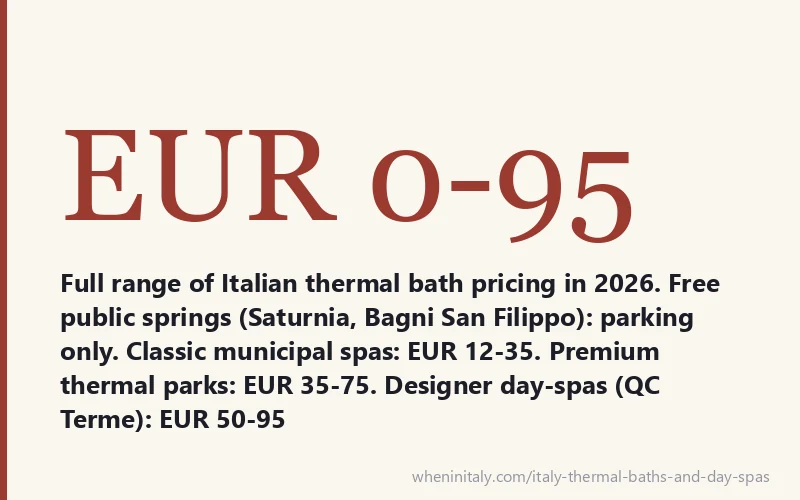
- Day-pass prices in 2026 split into three clear tiers: free public springs (parking around 2.50 EUR per hour), classic thermal-park tickets in the 12 to 35 EUR range (Terme dei Papi at 12 EUR weekday, Terme Merano around 27 EUR for three hours), and modern designer day-spas in the 50 to 95 EUR range (QC Termemilano, QC Pré-Saint-Didier, Terme di Sirmione).
- Ischia is the densest thermal island in the Mediterranean: six municipalities and at least six major thermal parks (Negombo, Poseidon, Castiglione, Tropical, Aphrodite Apollon, plus several smaller gardens) all fed by the same volcanic system that erupted the Green Tuff Ignimbrite roughly 56,000 years ago.
- Swimsuits are mandatory in almost every Italian thermal pool. The exception is South Tyrol, where saunas at places like Terme Merano are strictly nude for hygiene reasons. Bring water shoes for natural springs, a towel or rent one (most QC properties include robe, slippers, and towel in the entry price), and visit on weekdays whenever possible. Sunday afternoons are universally the worst time.
- Skip Chianciano on a first thermal trip. Its medical-spa heritage skews older and clinical. The Saturnia free Cascate, Bagno Vignoni’s piazza, and Ischia’s Negombo deliver more of what most travelers picture when they think “Italian hot spring.”
Italy’s two spa traditions: ancient thermal baths and modern day-spas
Italy holds wellness travelers in two very different embraces. The first is geological. Etruscan and Roman engineers built bathing complexes wherever volcanic activity pushed mineralised water to the surface, and many of those same springs still flow at the same temperatures their builders measured two thousand years ago. The Bullicame source feeding Viterbo’s Terme dei Papi emerges at 58 degrees Celsius, and Dante name-checked it in canto XIV of the Inferno. Bagni di Petriolo’s wild pools were already a documented Roman destination by the time Cicero, Pope Pius II, and the Medici and Gonzaga families made detours there.
The second tradition is contemporary and urban. QC Terme, the modern-spa network founded in Milan in 1982, now operates ten properties spanning Bormio, Pré-Saint-Didier, Milan, Turin, Rome, San Pellegrino, the Dolomites, Sicilia, and Chamonix-Mont-Blanc, with international expansion into New York. These are designed environments: heated pools, salt rooms, vaporariums, scenographic lighting, and a curated multi-hour pathway through 30 to 60 wellness “experiences” per location. The vibe is Milanese aesthetic rather than Etruscan ritual, and the price tags are correspondingly higher.
Most travelers want both. A Tuscany road trip that mixes Saturnia’s free Cascate at sunrise with Bagno Vignoni’s Adler Spa Resort in the afternoon delivers the full spectrum of what Italian thermalism actually means in 2026. The rest of this guide breaks down where to go for each register.
The Tuscany cluster: Saturnia, Bagno Vignoni, Bagni San Filippo, Petriolo
The single highest concentration of thermal water in Italy sits inside a 90-minute drive of Siena. Five names matter most.
Terme di Saturnia (Manciano, Grosseto). The famous turquoise terraces of the Cascate del Mulino are a free public spring, open 24 hours a day, year round, no booking, no gate. Sulphurous water emerges from the source at 37.5 degrees Celsius and cools slightly across the cascading travertine pools. The only cost in 2026 is parking at 2.50 EUR per hour, payable by coin, card, or the EasyPark app. The original parking strip immediately next to the pools has been closed and replaced by a larger lot roughly 450 metres away. The paid Terme di Saturnia Spa and Golf Resort sits on the same water source a few kilometres uphill and runs in a different price universe (resort day passes typically 25 to 50 EUR off-season and considerably more in summer). For first-time thermal visitors the free Cascate beat the paid resort. The Instagram visual is the public springs, not the indoor pools.
Bagno Vignoni (San Quirico d’Orcia, Val d’Orcia). The only Italian village whose central piazza is a 49-by-29-metre rectangular pool of steaming thermal water. The Renaissance basin was built in the sixteenth century directly over springs the Romans had already plumbed. Bathing in the historic piazza pool itself is forbidden, but three on-site spa hotels tap the same source: the five-star Adler Spa Resort Thermae (multiple indoor and outdoor pools, Finnish sauna, Turkish bath, herbal caldarium), Hotel Posta Marcucci (indoor and outdoor thermal pools with Val d’Orcia views), and Hotel Le Terme. Day passes at the smaller spas typically run 25 to 40 EUR. Walk fifteen minutes downhill from the piazza and the Parco dei Mulini delivers a free alternative: ancient water mills, canal-fed cascades, and natural rock pools where the same thermal flow has been doing its work for centuries.
Bagni San Filippo (Castiglione d’Orcia). Forty minutes south of Bagno Vignoni and just east of Monte Amiata, the Fosso Bianco delivers Tuscany’s most photogenic free thermal experience: a forest stream where 48-degree-Celsius sulphurous water has, over millennia, sculpted a colossal white limestone formation locals call the Balena Bianca, the White Whale. Access is permanently free with no gates or hours. Parking on Via Fosso Bianco costs 2.50 EUR per hour. The path is uneven, root-crossed, and slick after rain, so wear shoes that can handle mud. Early mornings and late afternoons are quietest.
Bagni di Petriolo (Monticiano). Wild thermal pools tucked among the Farma and Basso Merse nature reserves, where 43-degree-Celsius water rises straight from the rock. Free. Roman remains and a fortified medieval thermal wall built by Siena in 1404 still stand on the riverbank, making Petriolo a rare archaeological-bathing hybrid. Two paid neighbours, Petriolo Thermal Baths and Mercure Terme Spa, sit metres from the wild pools if travelers want pool decking, lockers, and Kneipp paths.
Terme di Montepulciano and Terme di Chianciano. Two adjacent classic thermal towns 2 miles apart. Chianciano’s six-hundred-square-metre Theia Thermal Baths, Sillene pools, and Sensory Spa rank it among the most clinically equipped wellness centres in Europe, but its medical-cure heritage shows: most visitors are over fifty and many are on prescribed treatment cycles. Skip Chianciano on a first Tuscan thermal trip and prioritise the wild pools above. A night-bathing session at Terme di Chianciano with dinner runs 54 EUR, without dinner 39 EUR, if a clinical-modern pivot does appeal.
The northern thermal towns: Sirmione, Merano, Bormio, Abano
Northern Italy hosts the country’s biggest thermal towns and its most architecturally ambitious modern complexes.
Terme di Sirmione (Lake Garda). The Boiola spring, discovered by a Venetian diver named Procopio in 1889, rises sulphurous from the lakebed off the Sirmione peninsula and feeds what the operator now calls Spa and Thermal Garden (the rebrand of Aquaria, with all prior bookings still honoured under the old name). Day-pass pricing in 2026 sits in the 50 to 60 EUR range Monday to Friday and 60 to 75 EUR on weekends and holidays, with shorter five-hour and evening tickets bringing the entry point down to about 40 to 55 EUR.
Terme Merano (South Tyrol). Matteo Thun designed this glass-and-cube complex in the centre of Merano, with twenty-five indoor and outdoor pools spread across a single integrated structure. A three-hour pool ticket runs roughly 23 to 27 EUR in 2026, full-day pool 30 to 35 EUR, and combined pool plus sauna 40 to 50 EUR. South Tyrol applies the alpine sauna convention: clothing in the pool zones, fully nude in the saunas (towels mandatory on the wood). Italians from south of the Po who don’t know that rule routinely embarrass themselves, so consider this fair warning.
Bormio (Valtellina). Three sites cluster around the same Roman-era source, and most travelers visit only one. Bagni Vecchi, now operated by QC Terme, preserves the original Roman bathing chambers including the spectacular tunnel pool carved into the mountainside, with valley views from outdoor pools at roughly 70 EUR for a daytime entry. Bagni Nuovi sits a few hundred metres downhill in a nineteenth-century Liberty-style palace. QC Terme Bormio is the modern third site in town. Bagni Vecchi is the most distinctive of the three and the one to choose if forced to pick.
Abano Terme and Montegrotto Terme (Veneto, near Padua). The Euganean Spa basin is the largest thermal infrastructure in Europe: more than 100 establishments and over 200 indoor and outdoor pools across two adjacent towns 10 to 15 km from Padua. Most visitors stay in a spa hotel rather than buying a day pass; the model here is multi-night fango-balneotherapy treatment, with cures dating back to the Roman cult of Aponus, the god of thermal water from whom Abano takes its name.
Ischia: the world’s most thermal-dense island
Ischia is a roughly trapezoidal volcanic island southwest of the Campi Flegrei caldera in the Bay of Naples, with the entire island sitting inside a caldera formed when the Green Tuff Ignimbrite erupted about 56,000 years ago. The volcanic plumbing keeps roughly 1,320 people per square kilometre supplied with what the island’s tourism board calls “one of the greatest and most important hydrothermal heritages in the world.” Six municipalities (Ischia, Barano, Casamicciola Terme, Forio, Lacco Ameno, Serrara Fontana) host an unusual concentration of thermal parks. Six matter most:
- Negombo (Lacco Ameno). The most acclaimed of the parks, set inside a botanical garden on Baia di San Montano. Twelve thermal pools at varying temperatures, sea access, and a layout that feels closer to a tropical resort than a clinical spa. Adult full-day tickets ran 70 EUR in summer 2025 with afternoon-only entry from 3:30pm at 40 EUR; 2026 pricing tends to follow the prior summer with modest increases.
- Giardini Poseidon (Forio). The largest of the parks by area. Twenty-plus pools terraced into a hillside above Citara beach. Full-day 45 EUR, afternoon 40 EUR.
- Castiglione (Casamicciola Terme). Built around an ancient spring above the Bay of Naples, with terraced pools and panoramic sea views.
- Tropical (Sant’Angelo, Serrara Fontana). Nine pools (one seawater) wrapped in tropical and exotic planting, indoor-spa temperatures from 26 to 40 degrees Celsius.
- Aphrodite Apollon (Sant’Angelo). Twelve pools from 20 to 40 degrees Celsius, a covered hydrotherapy pool, and two seawater pools at different temperatures continuously flushed to preserve their composition. The most southerly park, on one of the island’s most picturesque promontories.
- Casamicciola Terme, the original spa town named after the practice itself, hosts several smaller historic establishments worth a stop alongside the modern parks.
Most travelers do Ischia as a multi-night base from Naples or Sorrento (ferries from Naples Beverello and Mergellina, hydrofoils from Sorrento). One-park-per-day is the right pacing. Two parks in one day is a budget mistake (two 50 EUR tickets) and an enjoyment mistake (each park is built for a four-to-six-hour visit).
The QC Terme network: modern day-spa across Italy
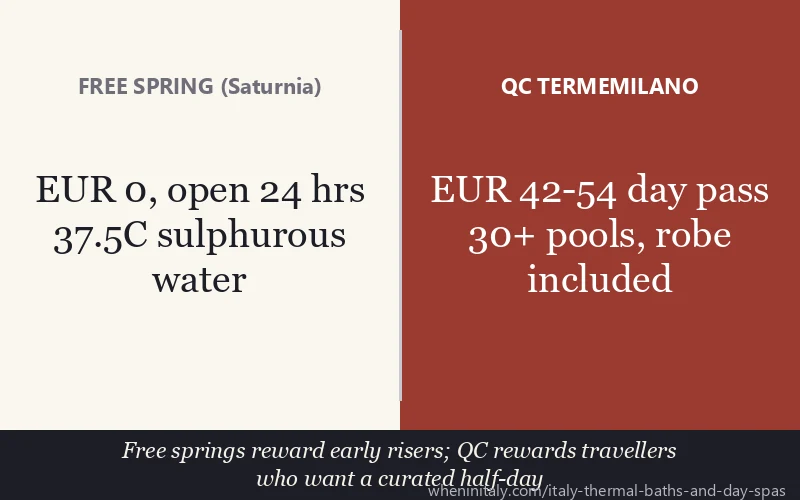
QC Terme is the most recognisable Italian wellness-spa brand, founded in 1982 by Saverio and Andrea Quadrio Curzio with what their corporate history describes as a mission “to modernise thermal balneotherapy, the ancient practice of bathing in mineral springs.” The network covers ten properties in 2026, all sharing the same approach: a multi-hour pathway through 30-plus heated pools, saunas, vaporariums, and relaxation zones, with a robe, slippers, and towel included in the entry price. The four most relevant for an Italy trip:
QC Termemilano (Porta Romana, Milan). The flagship, housed in a converted nineteenth-century horse-drawn-tram depot. The grounds preserve a restored ATM “Ventotto” tram in the courtyard, repurposed as a sauna in agreement with Milan’s heritage authorities. An underground warren of stone rooms holds warm and cold pools, geyser pools, jacuzzi waterfalls, and saunas. The 2026 day-pass landscape: roughly 42 EUR for weekday evenings, around 54 EUR for peak weekend slots, with various five-hour and split-window tickets in between. Booking ahead is non-optional on weekends. The robe, slippers, and towel are included.
QC Termeroma (Fiumicino, south of Rome). Same formula in a Roman setting, opened to relieve pressure on the Milan flagship. Day passes typically 60 to 90 EUR by day and time slot.
QC Pré-Saint-Didier (Aosta Valley). Outdoor heated pools facing Mont Blanc, located 1.2 miles from the Pré-Saint-Didier town centre in Palleusieux. The Mont Blanc view from the open-air pool at sunset is the headline experience. Day-pass pricing has risen sharply in recent seasons; expect 66 to 70 EUR for daytime entries in 2026 and higher for some platform-sold premium tickets (one third-party platform shows from 82 EUR). Book direct via qcterme.com for the best rate.
QC Bagni Vecchi (Bormio). The Roman-tunnel pool inside the mountain plus open-air pools with Valtellina views. Day pass approximately 70 EUR. Of all the QC properties, this one combines the network’s modern operational polish with a genuinely ancient bathing chamber, which is rare.
QC Sicilia (Acireale, opened 2022) and QC San Pellegrino (Lombardy) round out the Italian footprint, with QC Dolomiti and QC Chamonix-Mont-Blanc adding alpine variants outside the standard Italian itinerary.
The shorthand: QC properties deliver consistent, high-design wellness with predictable amenities. They are not where to go for an authentic Etruscan bathing experience, and they are pricey relative to local thermal-park alternatives. But the design quality, robe-included logistics, and reliability are genuine differentiators when treating a spa visit as a centerpiece of a city day rather than a road-trip side trip.
Are there free thermal springs in Italy?
Yes, and several are among the country’s best-known thermal sites at any price. Italy’s geothermal geology is generous: water emerges hot, mineralised, and often abundant from sources that long predate any modern hotel. In 2026 the five public springs most worth knowing:
- Saturnia Cascate del Mulino (Tuscany, Maremma). The reference: 24/7 access, sulphurous water at 37.5 degrees, terraced travertine pools, parking 2.50 EUR per hour.
- Bagni San Filippo Fosso Bianco (Tuscany, Val d’Orcia). The Balena Bianca limestone formation; 48-degree water; free year-round.
- Bagni di Petriolo (Tuscany, Monticiano). Wild river pools at 43 degrees with Roman and medieval ruins on the bank.
- Bagno Vignoni Parco dei Mulini (Tuscany, Val d’Orcia). The free downstream alternative to the village’s paid spas.
- Bagnaccio Viterbo (Lazio). A six-pool thermal area outside Viterbo with sources ranging from 23 to 66 degrees Celsius. The site has both a free zone and a low-cost paid enclosure with changing rooms; verify current operating status before driving out, as the area has had temporary closures in recent years.
Etiquette for free springs matters more than at paid sites because there is no staff to enforce it. Carry out trash. Skip soap, shampoo, and detergents (the sulphurous chemistry is fragile and visible algal growth changes with detergent introduction). Avoid touching delicate travertine formations like the Balena Bianca, which are still actively forming and are mechanically fragile. Park only in marked spaces. Cascate del Mulino has been the subject of municipal-access disputes precisely because past generations of visitors treated the site as a free lunch with no responsibilities. The “free” only stays free if everyone behaves.
What does it cost in 2026?
Italian thermal pricing splits cleanly into four bands, and knowing which band a destination occupies is the single best way to budget a trip.
Free (parking 2 to 3 EUR per hour). Saturnia Cascate del Mulino, Bagni San Filippo, Bagni di Petriolo, Parco dei Mulini at Bagno Vignoni, Bagnaccio Viterbo. Bring everything: water, snacks, water shoes, microfibre towel, plastic bag for wet kit.
Classic municipal and historic spa (12 to 35 EUR). Terme dei Papi in Viterbo runs 12 EUR weekday, 18 EUR weekend, 20 EUR night, with a discounted three-hour weekday ticket also at 12 EUR. Terme Merano runs roughly 23 to 27 EUR for a three-hour ticket. This is the price band where the value is highest: real thermal water, full facility (changing rooms, restaurants, lockers, towels for rent), and crowd levels that don’t make a session feel transactional.
Premium thermal-park and resort day passes (35 to 75 EUR). Ischia’s Negombo at roughly 70 EUR full day in summer 2025, Poseidon at 45 EUR full day, Sirmione’s Spa and Thermal Garden at 50 to 75 EUR depending on weekday or weekend, Bagno Vignoni’s hotel spas at 25 to 40 EUR, Terme di Saturnia hotel-spa day pass 25 to 50 EUR.
Designer day-spa (50 to 95 EUR). QC Termemilano peak weekend 54 EUR plus extras; QC Pré-Saint-Didier 66 to 82 EUR depending on channel; QC Bagni Vecchi roughly 70 EUR. Robe, slippers, and towel included, which closes part of the price gap to the cheaper bands once those rentals are factored in elsewhere.
Two patterns repeat across all four bands. First, weekday entry is consistently 20 to 40 percent cheaper than weekend. Tuesday or Wednesday delivers the same water at a different price. Second, evening or short-window tickets exist at almost every paid site and are the right choice for travelers who want a one-shot wellness experience rather than a full day. A 3.5-hour evening visit at Terme Merano or QC Termemilano gives a representative sample of the property at meaningful savings.
What to bring, what to wear, when to go
Italian thermal etiquette is not uniform, and getting it wrong is the most common avoidable mistake.
Swimsuits. Mandatory in the pools at virtually every Italian thermal site, free or paid, north or south. The exception is the saunas of South Tyrol (Terme Merano in particular), where nudity is required for hygiene reasons and clothing in the sauna is forbidden. Always sit on a personal towel in any sauna; sitting on the wood directly is unhygienic and locally considered rude.
What to pack. A swimsuit (a second one if visiting two sites in a day, since wet kit is unpleasant), microfibre or rented towel (most QC properties include a towel, most municipal spas don’t), flip-flops, water shoes for natural springs (the riverbed at Petriolo and the rocks at Bagni San Filippo are abrasive), a refillable water bottle, and a plastic bag for the wet swimsuit. For QC and other modern properties, leave watches and jewellery in the locker; the heat and minerals affect both.
When to go. Off-season, off-day, off-hour. November to March delivers the most atmospheric thermal experience in the open-air sites: cold air, hot water, and steam columns, with the smallest crowds. May and October are the next-best windows. August is the worst month (Italian holidays), Sundays the worst day (locals doing weekend wellness), and 2pm to 5pm the worst window. Sunrise and sunset visits to Saturnia and Bagni San Filippo deliver the most photogenic experiences and the lowest crowd density.
Health practicalities. Thermal water is mineralised and many of the sources contain hydrogen sulphide. Drink water aggressively before and after a session, limit any single soak to roughly 20 minutes for hot pools (Petriolo at 43 degrees, Saturnia at 37.5, the QC hottest pools in similar ranges), and exit immediately if light-headed. Pregnancy, cardiovascular conditions, and recent surgery are all reasons to skip hot thermal soaks; the spa staff will ask, and they are not joking.
For a first thermal trip in Italy: pair the free Saturnia Cascate at sunrise with a paid afternoon at Bagno Vignoni’s Adler Spa, base in Pienza or Montepulciano in between. For a city day-spa: book QC Termemilano on a Tuesday evening and arrive 30 minutes before the slot starts. For a destination wellness week: Ischia in late September with a different thermal park each day. Italy makes all three trips easy.
Sources and References
- Cascate del Mulino in Saturnia — Visit Tuscany — official Tuscany tourism page; confirms 24/7 free access and 37.5°C source temperature.
- Saturnia Hot Springs Guide — Northabroad — confirms 2026 parking arrangement at 2.50 EUR/hr after the original lot’s closure.
- Cascate del Mulino — Saturnia Terme Libere — community-run reference on the free public springs.
- Bagno Vignoni — Discover Tuscany — piazza dimensions (49 × 29 m), 38°C composition, three on-site spa hotels.
- Parco dei Mulini, Bagno Vignoni — Valdorcia.it — free downstream cascades.
- Bagni San Filippo — Northabroad — 48°C water; year-round free access; 2.50 EUR/hr parking.
- Fosso Bianco — Bagni San Filippo on TripAdvisor (2026) — Balena Bianca limestone formation.
- Bagni di Petriolo — Visit Tuscany — 43°C source, Cicero/Pope Pius II/Medici/Gonzaga history, 1404 Sienese wall.
- Petriolo Free Spa — gogoterme — confirms free access alongside paid Mercure Terme Spa.
- Terme di Chianciano official site — Theia and Sillene pools, 600+ m² indoor/outdoor area.
- Night Bathing at Terme di Chianciano — Liisa Wanders — 54 EUR with dinner / 39 EUR without.
- Terme di Sirmione — Spa and Thermal Garden (formerly Aquaria) — official admissions page; the Aquaria → Spa & Thermal Garden rebrand.
- Aquaria Thermal Spa Sirmione — LakeGardaTravel — Boiola spring discovery (Procopio, 1889).
- Terme di Sirmione 2026 prices — TourismAttractions — 2026 weekday/weekend price ranges.
- Therme Meran prices and tickets — official — 2026 ticket bands.
- Terme Merano architecture — Suedtirol.info — Matteo Thun design, 25 indoor/outdoor pools.
- Bagni Vecchi Bormio — official tourism Bormio.eu — Roman thermal baths.
- QC Spa Bagni Vecchi Bormio — official QC Terme prices — official admissions.
- Thermae Abano Montegrotto — official tourism site — largest thermal basin in Europe; 100+ establishments, 200+ pools.
- Abano Terme — Veneto.info — proximity to Padua, Euganean Hills geology, cult of Aponus.
- Ischia — Wikipedia — Green Tuff Ignimbrite ~56,000 years ago; 1,320/km² density; six municipalities.
- Negombo official 2026 price list — confirmed Negombo 2026 pricing structure.
- Helen on Her Holidays — Visiting Negombo (Ischia) — 2025 70 EUR full-day price; afternoon options.
- Giardini Poseidon Terme official — Poseidon ticket prices and operating hours.
- Aphrodite Apollon thermal park — Terme Ischia — twelve pools, 20–40°C range.
- Tropical Thermal Park — Ischia Review — nine pools, 26–40°C range.
- QC Spa of Wonders — official corporate history — founding year 1982, founders Saverio and Andrea Quadrio Curzio, 10-property network.
- QC Termemilano — official prices — current admissions page.
- QC Termemilano — TimeOut Milan — historic tram-depot conversion and Ventotto sauna detail.
- The Porta Romana tram — QC Terme official — restored ATM Ventotto tram heritage agreement.
- QC Termeroma — Business Travel Mag review — Fiumicino location, Rome-area QC.
- QC Pré-Saint-Didier — official prices — Mont Blanc views, current admissions.
- QC Pré-Saint-Didier — TripAdvisor 2026 reviews — 2026 day-pass price reports (66–70 EUR).
- Terme dei Papi — official admissions — 12 EUR weekday / 18 EUR weekend / 20 EUR evening.
- Terme dei Papi historical notes — official — Pope Nicholas V 1450 commission, Bullicame source 58°C.
- Bullicame and Dante — Pitigliano.org — Inferno canto XIV citation.
- Bagnaccio Viterbo — Visit Italy EU — six-pool thermal area, free + paid zones, 23–66°C source range.
- European thermal-bath etiquette — Paulmarina — South Tyrol nude-sauna convention; swimsuit norms elsewhere.
- Wellness-area etiquette guide — Luxury Hotel Dolomites — towel-on-bench rule and general spa etiquette.
- Italia.it official — Terme dei Papi — Italian National Tourism Board page, used for cross-verification of historic/source claims.