Key Takeaways
- Lake Garda covers about 370 km², stretches 52 km north to south, and touches three Italian regions (Lombardy on the west, Veneto on the east, Trentino-Alto Adige at the northern tip).
- The Navigarda public ferry network is the lake’s spine: year-round on the southern basin, April to October on the full lake, with single-leg fares running roughly EUR 3 to EUR 15.10 in 2026.
- Choose a base by trip style. Desenzano del Garda is best for first-timers (direct trains, biggest port). Sirmione for thermal water, Roman ruins, and a water-moated castle. Salò and Gardone Riviera for the elegant west-shore Riviera dei Limoni. Malcesine for the Monte Baldo cable car. Riva del Garda for sailing and windsurfing.
- The headline cultural sights cluster on the south and west: the Grottoes of Catullus (largest Roman residential villa in northern Italy at roughly two hectares), the Castello Scaligero of Sirmione (1277, with a rare water-filled moat), and the Vittoriale degli Italiani (Gabriele D’Annunzio’s clifftop villa-museum complex above Gardone Riviera).
- Day-tripping works easily from Verona (around 25 minutes by car or train to Peschiera). Milan and Venice are doable but tight; both connect by Frecciarossa to Desenzano or Peschiera in roughly 1h 30 to 1h 35.
- Shoulder season (May, June, September) is the sweet spot: open ferries, swimmable water, lower prices, and far fewer crowds than the July-August peak.
Lake Garda at a glance: 52 km long, three regions, four shores
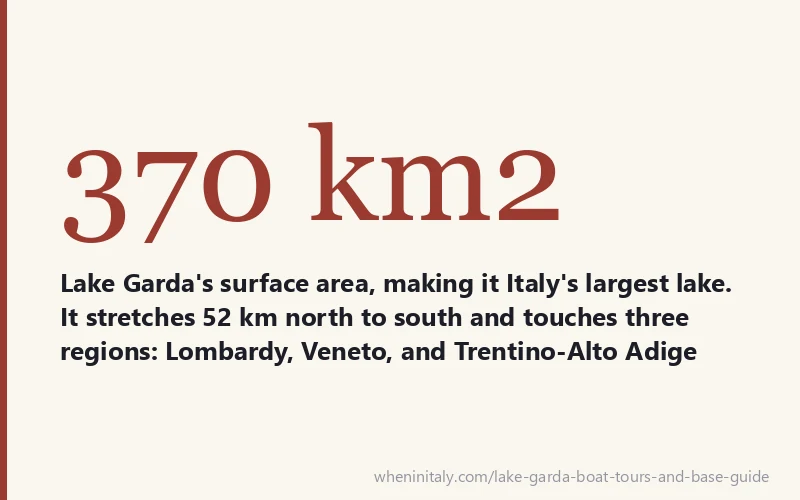
Lake Garda is Italy’s largest lake by surface area, covering roughly 370 km² with a maximum depth of 346 metres. It stretches about 52 km from the wide southern basin (around 17 km across at its broadest) up to the narrow Alpine fjord of Riva del Garda in the north. Three regions touch its shoreline: Lombardy on the west (Brescia province), Veneto on the east (Verona province), and Trentino-Alto Adige at the northern tip (Trento province). The western shore is the Riviera dei Limoni, named for the terraced lemon-houses (limonaie) that once climbed the cliffs above Limone, Tremosine, and Gargnano. The northern fjord enjoys a Mediterranean micro-climate even at Alpine latitude: olive groves, palms, and the famous Limone lemons grow there because steep mountain walls trap warmth and shelter the basin from northern weather. The result is four distinct shores in a single lake. South for resort beach towns and easy train access; west for elegant 19th-century villas and lemon terraces; east for vineyards and the Monte Baldo ridge; north for sailing, climbing, and the Trentino Dolomites’ edge.
Which town should you base in? Sirmione vs Desenzano vs Salò vs Malcesine vs Riva
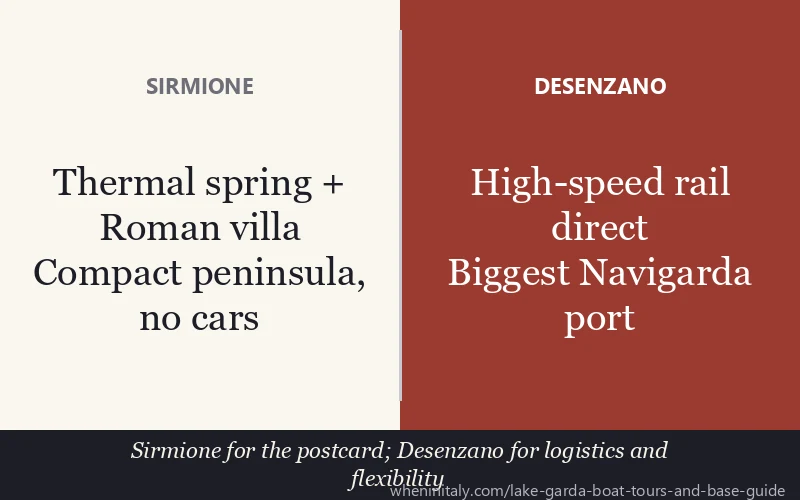
The short answer: Desenzano for first-timers who want easy train access and a real working town; Sirmione for thermal water, Roman ruins, and the most photogenic peninsula; Salò or Gardone Riviera for west-shore elegance and the Vittoriale; Malcesine for the cable car to Monte Baldo and east-shore views; Riva del Garda for sailing, windsurfing, and the dramatic northern cliffs.
Sirmione (Lombardy, Brescia province). Built on a thin three-kilometre peninsula jutting into the southern basin, Sirmione packs three top sights into walking distance: the Castello Scaligero with its rare water-filled moat, the Grottoes of Catullus archaeological park, and the Aquaria thermal complex fed by sulphurous hot springs. The trade-off is crowding. Sirmione’s historic centre is car-restricted and small; in July and August it can feel saturated by mid-morning. Best for travellers who want to combine spa days, walkable history, and lake views in a compact base.
Desenzano del Garda (Lombardy, Brescia). The largest town on the lake (around 25,000 residents) and the practical choice for a first visit. Its train station sits on the Milan-Venice high-speed line, putting Frecciarossa connections to both cities at roughly 30 minutes (Milan) and 60 minutes (Venice). Desenzano hosts the lake’s busiest Navigarda port, a Roman villa with mosaics, and a workaday lakefront with restaurants and bars open year-round. Best for travellers without a car or those planning multiple day-trips off the lake.
Salò and Gardone Riviera (Lombardy, Brescia). The elegant slice of the western shore. Salò is a curve of pastel 19th-century facades and an unusually long lakeside promenade; the town gave its name to the WWII Republic of Salò. Six kilometres north, Gardone Riviera hosts the Vittoriale degli Italiani, Gabriele D’Annunzio’s clifftop estate. Best for travellers who want a quieter base with one major cultural anchor and easy ferry hops to Sirmione, Limone, and Malcesine.
Malcesine (Veneto, Verona province). The east-shore base for active travellers. The Funivia Malcesine-Monte Baldo cable car climbs from lakeside to roughly 1,760 metres in about ten minutes, opening up panoramic ridges, hiking trails, and paragliding launch points. The medieval Castello Scaligero of Malcesine sits above the harbour. Best for travellers who want a smaller historic base and one big alpine excursion built into the trip.
Riva del Garda (Trentino-Alto Adige, Trento province). The northern tip, where the lake narrows into a fjord between sheer cliffs. Riva is the international capital of Lake Garda windsurfing and sailing, thanks to the steady afternoon “Ora” wind that funnels north up the lake. Climbers come for the Sarca Valley walls just inland. Best for sporty travellers who want activity-first and Dolomite proximity over thermal-and-history southern lake culture.
The Navigarda public ferry: how the lake’s hop-on system works
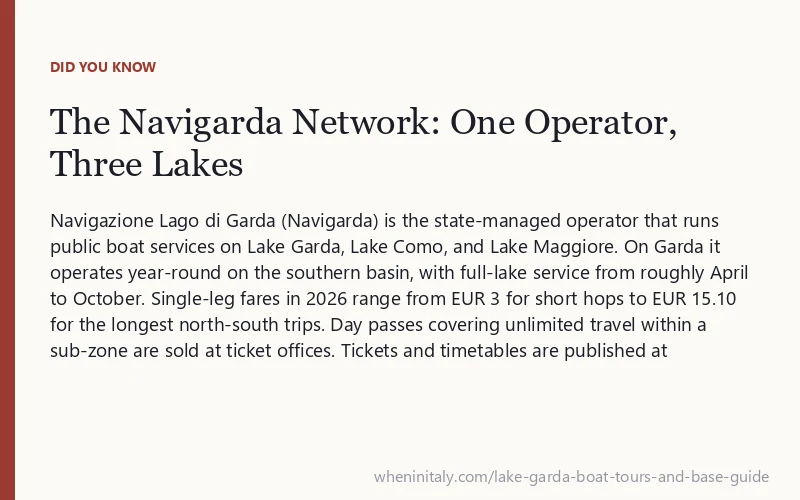
Lake Garda’s public boat network is run by Navigazione Lago di Garda (commonly called Navigarda or Gestione Navigazione Laghi), the state-managed operator that also runs Lake Como and Lake Maggiore services. On Garda the network covers the southern basin year-round and extends to the full lake (south to Riva del Garda) from roughly April to October. Three vessel classes operate: standard slow ferries (battello), faster hydrofoils (aliscafo), and car ferries on the cross-lake Limone-Malcesine route.
Single-leg fares for 2026 range from roughly EUR 3 for the shortest hops up to EUR 15.10 for the longest north-south trips, depending on distance and vessel type (hydrofoils carry a supplement). Practical sample legs: Desenzano to Sirmione runs about 25 minutes by standard ferry; Sirmione to Garda is roughly 50 minutes by ferry or 25 by hydrofoil; Riva to Malcesine takes around 45 minutes by hydrofoil. The cross-lake Limone-Malcesine route is the most useful single hop on the lake: it links the western Riviera dei Limoni directly to the eastern Monte Baldo cable car in about 20 minutes (a faster service runs in roughly 15), and several private operators (Garda Express, Garda Escursioni) supplement the Navigarda schedule with their own boats from EUR 10 return.
Day passes covering unlimited travel within a sub-zone (south basin, mid-lake, or full lake) are sold at the ticket office and are usually cheaper than three or more single legs. Tickets and the seasonal timetable PDFs are published on the Navigazione Laghi official website; phone bookings go through the toll-free line 800-551801 within Italy. Real-time schedule changes are common in shoulder season, so the printed PDF in hand at the ferry pier is the safest reference.
The classic boat tours: guided cruises, Riva motorboats, and license-free dinghies
Beyond the public ferries, three commercial formats dominate. The first is the guided multi-stop cruise, run by dozens of operators from Sirmione, Desenzano, Garda, Bardolino, and Riva. Typical formats are three to six hours, EUR 30 to EUR 90 per person, often with on-board commentary, a swim stop in a quiet bay, and sometimes lunch. These are the easiest option for travellers who want a curated half-day on the water without choosing routes.
The second format is the classic Riva motorboat tour. The Riva Aquarama and similar 1950s-era mahogany speedboats are an Italian icon, and several operators offer private charters in vintage or replica craft, typically EUR 80 to EUR 200 per hour for a small group. These boats are a stylistic choice as much as a transport choice: gleaming wood, low silhouette, the engine note of postwar dolce vita.
The third format is license-free dinghy rental. Italian coastal regulations allow non-licensed drivers to rent boats up to 40 horsepower, and Lake Garda’s many marinas (especially around Bardolino, Garda, Salò, and Sirmione) offer day rentals from roughly EUR 80 to EUR 160 depending on season and engine size. Many operators have moved to electric outboards in the last few years, which fits the lake’s increasingly quiet-engine zoning. License-free dinghies are the right choice for a self-directed half-day exploring coves and lemon-house cliffs at a slow pace.
For sailors and windsurfers, the north-end towns of Riva del Garda and Torbole host world-class schools and rental fleets that take advantage of the steady afternoon Ora wind. Lessons typically run two hours from EUR 60 per person, with boards and sailing dinghies available for half-day or full-day rental.
Sirmione: thermal grottoes, Roman villa ruins, water-moated castle
Sirmione is the densest cluster of headline sights on the lake, all walkable from a single peninsula entrance. The Castello Scaligero, built starting in 1277 by the Della Scala (Scaliger) family of Verona, guards the only land bridge into town. It is one of very few European castles with a fully water-filled moat that survives intact, complete with a fortified dock. The 2026 standard ticket is EUR 6 (reduced EUR 2), and the climb up the 146-step keep delivers a 360-degree view across the southern basin. The castle is open Tuesday to Sunday, 8:30 to 19:30, with last entry 30 minutes before closing.
At the tip of the peninsula, the Grottoes of Catullus (Grotte di Catullo) is the largest Roman residential villa known in northern Italy, with a rectangular footprint of roughly 167 by 105 metres covering about two hectares. The villa was built between the late 1st century BC and the early 1st century AD, and although tradition associated the site with the poet Catullus, the actual residents are unknown. The standard ticket in 2026 is EUR 10 (reduced EUR 2 for EU citizens 18-25, free for under-18s and on the first Sunday of every month). A combined ticket covering Catullus, the Castello Scaligero, and the Roman Villa of Desenzano costs EUR 14 full or EUR 6 reduced, which is the value option for a serious ancient-Sirmione day.
Between the castle and the grottoes, the Aquaria thermal complex (recently rebranded as Spa & Thermal Garden under the Terme di Sirmione group) is fed by the Boiola spring, a sulphurous hot source rising from beneath the lake at around 69°C. Multi-day passes (typical pricing for weekend packages and three-to-five-day stays runs roughly EUR 130 to EUR 260 depending on configuration) are sold direct through the Terme di Sirmione website; same-day single entries shift seasonally and require checking the operator directly. The thermal water is one of the original reasons Sirmione became a resort in the 19th century.
The Vittoriale, the lemon terraces, and the cable car: the rest of the lake’s headline sights
Three sights anchor the rest of the lake. The Vittoriale degli Italiani above Gardone Riviera is Gabriele D’Annunzio’s eccentric villa-museum-mausoleum, built between 1921 and the poet’s death in 1938. The complex includes the Prioria (D’Annunzio’s house, preserved to the inch), an open-air theatre, a war museum, gardens, and the actual prow of the WWI cruiser Puglia embedded in the hillside. Entrance pricing in 2026 splits across three paths: Path A (full estate plus three museums plus guided tour of the house) is EUR 18 full / EUR 14 reduced; Path B (park plus two museums) is EUR 12 full / EUR 10 reduced; Path C (park plus three museums) is EUR 15 full / EUR 12 reduced. Summer hours are daily 9:00 to 20:00; winter hours run weekends and holidays only, 9:30 to 17:30.
Along the western shore between Limone sul Garda and Gargnano, the historic limonaie (lemon-house terraces) are the regional landmark. These stone-and-pillar greenhouses, with retractable wooden roofs and sailcloth side curtains, allowed Garda’s lemon, citron, and orange trees to fruit at the northernmost limit of European citrus cultivation through the 17th to 19th centuries. A few are still in production as living museums; the Limonaia del Castèl in Limone is the most photographed.
On the east shore, the Funivia Malcesine-Monte Baldo cable car is the lake’s signature panorama. Two stages carry passengers from lakeside (around 90 metres) to the Monte Baldo ridge (around 1,760 metres) in roughly ten minutes total, with the upper cabin rotating 360 degrees during ascent. The 2026 round-trip fare is EUR 27 (EUR 25 if booked online), one-way EUR 19 (EUR 17 online), with reduced “junior” pricing of EUR 17 RT. The funivia runs year-round except for maintenance closures in March and November. At the top, hiking trails fan across the ridge (the Pozza-Tratto-Spino loop is a popular two-hour walk), and Monte Baldo is one of Europe’s busiest paragliding launch sites.
Day trip from Verona, Milan, or Venice: which works?
Verona is the easiest by a wide margin. Peschiera del Garda sits 24 km west of Verona on the Milan-Venice rail line; the regional train covers the gap in roughly 18 minutes for around EUR 4 each way. Sirmione is 35 km from central Verona, reachable by direct ATV bus (line 026) in roughly 50 minutes. Many guided day trips bundle Sirmione with a quick Verona stop, lunch, and a Navigarda ferry hop for EUR 60 to EUR 100 per person; self-directed visitors can do the same itinerary on public transport for closer to EUR 25 round-trip plus lake activities.
From Milan, the Frecciarossa high-speed train reaches Desenzano del Garda in about 1 hour 10 minutes (sometimes 1h 25 depending on departure), with returns from EUR 30 to EUR 50 round-trip when booked in advance. That makes Milan a comfortable but tight day trip: viable for a Sirmione or Desenzano ferry loop with lunch, less viable if the goal is to reach the western or northern shores.
From Venice, the Frecciarossa to Peschiera del Garda runs about 1 hour 35 minutes, with round-trip fares typically EUR 40 to EUR 70 in advance. Like Milan, Venice works as a day trip only for the southern basin (Peschiera, Sirmione, Desenzano via short transfers); reaching Riva del Garda from Venice in a single day means seven hours of transit for three on the lake, which is generally not worth it.
For travellers building a multi-stop itinerary, the cleanest pattern is: arrive at Desenzano or Peschiera by Frecciarossa, base on the lake for two or three nights, then continue to Verona, Milan, or Venice afterwards. A day-trip-only approach is best limited to the Sirmione-Peschiera-Desenzano southern triangle.
What does a Lake Garda day cost in 2026, and when to visit?
Budget for a self-directed day on the southern basin runs roughly EUR 30 to EUR 60 per person: a Navigarda day pass (around EUR 18 to EUR 26 depending on zone), one major sight ticket (Castello Scaligero EUR 6, Catullus Grottoes EUR 10, or the EUR 14 combined ticket), a casual lunch, and gelato. A guided day trip from Verona including transport, a Sirmione visit, and a short cruise typically lands at EUR 60 to EUR 100 per person. Adding a Monte Baldo round trip from Malcesine adds EUR 25 to EUR 27. A vintage Riva motorboat charter is the splurge variable, at EUR 80 to EUR 200 per hour for the boat (not per person).
The shoulder seasons are unambiguously the sweet spot. May to mid-June and September deliver lake water warm enough to swim (around 20-23°C in early autumn), full Navigarda schedules, all the major sights open, and visibly fewer crowds than the July-August peak. Italian school holidays drive most of the summer surge; Ferragosto (August 15) and the surrounding fortnight are the most saturated period of the year, with Sirmione and Limone often booked solid two months ahead. October opens with mild weather and quiet ferries, then most lake operators wind down by early November, when the schedule contracts to the southern basin and the cable car closes for maintenance. Winter (December to February) keeps the southern Navigarda routes running and many of the thermal options open year-round, but the lake is essentially a quiet local destination during that window rather than a tourism one.
For a first visit of three to four days, a Desenzano or Sirmione base in late May, early June, or mid-September gives the broadest access without the crowds. For sailors and windsurfers, June and September are also peak conditions for the Ora wind in the north. For the lemon-house terraces and the Vittoriale at their photographic best, late September into early October catches the soft autumn light over the western cliffs.
Sources and References
- Tickets and timetables Lake Garda — Navigazione Laghi (official) — Navigarda fare and timetable structure for 2026, EUR 3-15.10 single-leg range, full operator info.
- Rates — Lake Garda — Navigazione Laghi (official) — Detailed 2026 rate tables.
- How to use Lake Garda Public Ferries 2026 — lakegardaguide.it — Cross-reference on routes, vessel types, day-pass logic.
- Ferries Lake Garda 2026 — Instagarda — Seasonal schedule notes, southern-basin year-round operation.
- Ferry from Limone sul Garda to Malcesine — visitlimonesulgarda.com — Cross-lake duration (~20 min) and frequency.
- Garda Express Malcesine-Limone return ticket — gardaexpress.it — EUR 10 private cross-lake operator alternative.
- Vittoriale degli Italiani Path A/B/C 2026 ticket prices — Trip.com guide — Three-tier ticket structure: EUR 18 / 12 / 15.
- Vittoriale official via Grandi Giardini Italiani — Site overview and ticket-tier confirmation.
- Grotte di Catullo & Sirmione Archaeological Museum — Direzione regionale Musei Lombardia (official) — Italian Ministry of Culture official listing.
- Sirmione & Desenzano combined ticket — Direzione regionale Musei Lombardia — EUR 14 combined Catullus + Castello + Villa Romana.
- Grottoes of Catullus — Wikipedia (size and dating) — Footprint dimensions (167 × 105 m, ~2 hectares) and historical context.
- Castello Scaligero Sirmione — visitsirmione.com (official town) — 1277 founding, water-filled moat, fortified dock.
- Castello Scaligero hours and fares 2026 — gardavisit.it — EUR 6 standard ticket, 8:30-19:30, closed Mondays.
- Funivia Malcesine-Monte Baldo timetables and fares (official) — EUR 27 RT 2026, March/November maintenance closures.
- Funivia Malcesine-Monte Baldo (official) — Operator overview, ridge access, panoramic deck.
- Isola del Garda guided tours (official, Cavazza family) — EUR 39-49 adult range, included DOP olive oil tasting.
- Aquaria / Spa & Thermal Garden — Terme di Sirmione (official) — Rebranded thermal complex, package configurations.
- Lake Garda — Wikipedia — 370 km², 346 m max depth, three regions, 52 km north-south.
- Lake Garda statistics & facts — gardaitaly.com — Cross-reference on geography, micro-climate, town overviews.
- Lake Garda — Britannica — Authoritative geography reference.