TL;DR / Key Takeaways
- The classic three-island day costs EUR 9.50 as a single ticket or EUR 25 for 24 hours of unlimited vaporetto travel; guided cruises run EUR 25 to 50 per person and bundle a glass-blowing demo plus an English-language guide.
- Murano has been the centre of Venetian glass since a Senate decree dated 8 November 1291 moved every furnace off the wood-built city for fire safety; the 12th-century mosaic floor of the Basilica dei Santi Maria e Donato is the island’s quietest masterpiece.
- Burano’s coloured houses are not folklore but a regulated palette: owners must request permission from the Comune, which assigns the colour. The lacemakers’ demonstrations at the Museo del Merletto justify the EUR 5 ticket.
- Torcello has roughly ten residents and the most important Byzantine Last Judgement mosaic in Western Europe inside a cathedral consecrated in 1008. Cruise itineraries that skip Torcello are missing the editorial point.
- The genuine glass mark to look for is Vetro Artistico Murano, managed by the Promovetro consortium since 2001 under a 1994 Veneto Region law. Anything sold simply as “Murano-style” is not regulated.
- Best months are April to May and September to October: the lagoon is calm, the heat is manageable, and the colours of Burano photograph cleanly without August haze.
The Three Lagoon Islands at a Glance
The northern Venetian lagoon strings together three working communities that look from a vaporetto like a single excursion but were, for centuries, three separate worlds. Murano sits roughly 1.5 kilometres from Fondamente Nove and is built on seven smaller islands stitched by bridges; about 5,000 people live there and the economy still revolves around glass furnaces that have been burning, by law, since 1291. Burano is around 6 kilometres further north-east, has roughly 3,000 residents, and is best understood as a fishermen’s village whose coloured house fronts and lace tradition turned it into one of the most photographed places in Italy. Torcello, only ten or fifteen minutes beyond Burano on vaporetto line 12, is almost depopulated (around ten full-time residents in recent years) but holds a Byzantine cathedral that arguably outranks anything on the other two islands.
The full loop, taken at a respectful pace, runs five to six hours from a Fondamente Nove departure: about an hour on Murano, ninety minutes to two hours on Burano (lunch included), and an hour on Torcello before the return. Half-day tours typically cut Torcello, which is the obvious time saving and the worst editorial choice.
Vaporetto vs Guided Cruise: the EUR 9.50 vs EUR 25-50 Decision
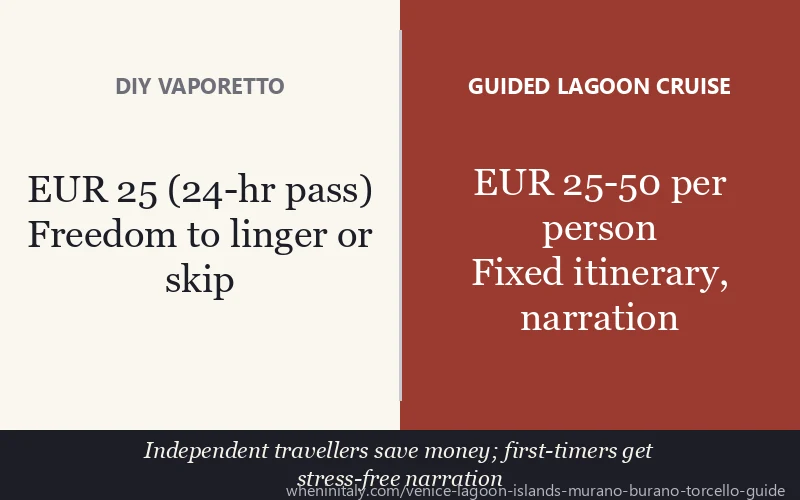
The dominant trip-planning question is whether to travel independently on the public ACTV vaporetto network or to book a guided lagoon cruise. The honest answer turns on three variables: time, comfort with public transport, and whether a glass-blowing demonstration is part of what makes the day feel like a Venice day.
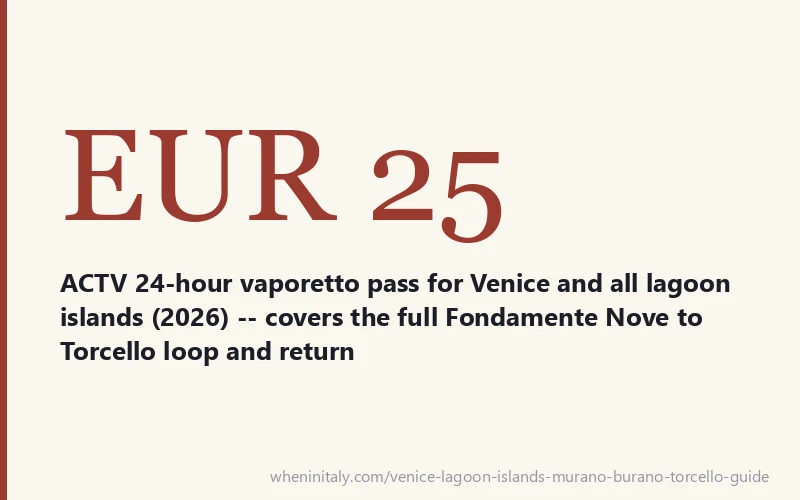
The DIY math. A single vaporetto ride costs EUR 9.50 and is valid for 75 minutes, which is enough to reach Murano but not enough to chain three islands. The time-based passes published by ACTV and Venezia Unica for 2026 are EUR 25 for 24 hours, EUR 35 for 48 hours, EUR 45 for 72 hours, and EUR 65 for seven days; validity counts in hours from first validation, not in calendar days. Travellers aged 6 to 29 can buy the EUR 6 Rolling Venice Card and cut the 72-hour pass to EUR 27, making it the best deal on the lagoon. Vaporetto line 12 runs Fondamente Nove to Murano Faro, then Mazzorbo, Burano, and Torcello. Frequencies are roughly half-hourly in summer and hourly in winter; check the ACTV timetable on the morning of travel because lagoon schedules shift seasonally.
The guided cruise. Half-day lagoon cruises sit between EUR 25 and EUR 50 per person and typically include round-trip transport, an English-speaking guide, commentary on lagoon history, and a stop at a Murano glass furnace for a brief demonstration. Cruises buy two things the vaporetto cannot: a guide who can explain what is on the walls of Torcello cathedral, and a stress-free itinerary for travellers who do not want to read timetables in a second language. They cost the freedom to linger.
The verdict. Independent travellers who already navigate Venice comfortably should buy the 24-hour pass, take the first morning line 12, and use the saved EUR 30 to 40 per person on a sit-down lunch on Burano. First-time visitors, families with young children, and travellers on a single Venice day who want narration baked in are better served by a guided cruise, but the boat that includes Torcello, not the half-day version that drops it.
Murano: Glass Since 1291, a Veneto-Byzantine Basilica, and the “Free Demo” Trap
Murano’s identity is glass, and the date matters. On 8 November 1291 the Venetian Senate ordered every glass furnace in Venice moved to the island, primarily because Venice was still largely wood-built and the furnaces were starting fires that threatened the city. The secondary effect was that concentrating glassmakers on one island let the Republic guard the trade secrets that made Venetian cristallo and lattimo recipes unrivalled in Europe for centuries. Glassmakers were rewarded with privileges (their daughters could marry into the patriciate) and, conversely, were forbidden to leave the Republic on pain of death.
The guidebook stop on Murano is glass: a furnace tour, a vase blown in two minutes, a gallery exit. The editorial stop is the Basilica dei Santi Maria e Donato, founded in the seventh century, with the present church dating from around the 1140s. Entry is free. The mosaic floor, laid around 1140, covers more than 500 square metres of porphyry, serpentine, marble, and glass tesserae arranged into peacocks, eagles, griffins, and geometric figures contemporaneous with the floor of St Mark’s Basilica. The apse mosaic of the Virgin Mary on a gold ground stares back from the half-dome above the altar. Save Venice has been funding restoration cycles since the 1970s, most recently after the November and December 2019 acqua alta events submerged the floor in corrosive seawater.
For the institutional version of Murano’s history, the Museo del Vetro (Glass Museum) on Fondamenta Marco Giustinian is open daily 10:00 to 17:00 and costs EUR 15 for adults, EUR 7.50 reduced. It runs through Roman-era glass through the medieval guilds to twentieth-century studio glass, including pieces by Carlo Scarpa and Vittorio Zecchin.
The “free factory demo” reality. Cruise tours and many independent itineraries route through a glass furnace where a maestro creates a horse, vase, or jellyfish in two to three minutes. Entry is free. The exit runs through a showroom with no obligation to buy and a great deal of social pressure to do so. The demonstrations themselves are real and worth seeing once; the prices in the showrooms tend to be top-of-market. To be sure of buying genuine Murano glass, look for the Vetro Artistico Murano trademark, a mark of origin established by Veneto Region law n. 70/1994 and managed since 2001 by the Promovetro consortium. The mark is a sticker, hologram, or engraved logo applied only to glass made by furnaces inside the Murano Glass District that meet the consortium’s standards. Anything labelled “Murano-style,” “in the manner of Murano,” or simply “Italian glass” is unregulated and routinely manufactured in eastern Europe or China.
Burano: the Coloured-Houses Myth and the Lace Museum Reality
Burano sits in the picture-postcard category because of the colour palette of its house fronts: pinks, blues, lemons, ochres, and reds in tight rows reflecting in the canals between them. The folk explanation, repeated on most signs and most blog posts, is that fishermen painted the houses brightly so they could find their way home through lagoon fog. A more careful reading is municipal: the colours are a property and orientation system that long pre-dates tourism, regulated today by the Comune di Venezia. Owners who want to repaint must apply to the local council, which assigns one of roughly fifty approved colours from a palette mapped to specific blocks so that adjacent houses do not duplicate. Houses are repainted, in practice, every two years.
The other half of Burano’s identity is lace. The island has produced needle lace since at least the sixteenth century, and the Museo del Merletto in Piazza Galuppi is open Tuesday to Sunday 10:00 to 16:00 (with extended hours to 17:00 on Fridays and Saturdays from 1 May to 26 September 2026). Reduced tickets are EUR 3.50; full adult tickets are sold through the Fondazione Musei Civici Venezia ticketing system. What earns the EUR 5 is not the small permanent exhibition but the lacemakers’ demonstrations, where members of the historic Scuola del Merletto, mostly women in their seventies and eighties, work needle and pillow lace at tables in the museum. There are perhaps a dozen of them left who can produce the original Burano point.
For lunch, Trattoria Da Romano on Via Galuppi has been operating since 1947 and serves the canonical Burano dish, risotto di go, made with the small lagoon fish go (goby) cooked into a bisque and stirred through Vialone Nano rice. Reservations are essential in summer. The hidden monument is the leaning Campanile di San Martino, the bell tower of the parish church, which tilts visibly westwards: it is one of the lagoon’s two famous leaning towers, and the obvious photograph that almost every tourist misses.
Torcello: Ten Residents, a 12th-Century Last Judgement, and Locanda Cipriani
Torcello is the editorial highlight of the lagoon and the reason any thoughtful itinerary includes the third stop. In the sixth and seventh centuries, after the Bishop of Altino fled the Lombard advance and resettled here in 639, Torcello became the most populated island in the Venetian lagoon, with population estimates for the tenth century running between 10,000 and 35,000 people. By the time the Republic of Venice consolidated its political and economic life around the Rialto, Torcello was already declining: malaria from the brackish marshes, the silting of its main canal, and the gradual diversion of trade to the new city emptied the island. By 1797 there were about 300 residents. Recent counts put the full-time population at around ten or eleven people.
What remains is the Cattedrale di Santa Maria Assunta, the cathedral founded in 639 and consecrated in its present form in 1008. The basilica is open daily 10:30 to 18:00 from March through October and 10:00 to 17:00 from November through February, with the ticket office closing thirty minutes before. A full ticket is EUR 5; a combined basilica-plus-bell-tower ticket with audio guide is EUR 9. The drawcard is the entire interior west wall: a 12th- and 13th-century Last Judgement mosaic of the Veneto-Byzantine school, layered horizontally from the Crucifixion at the top down through the Anastasis, the resurrection of the dead, and the souls of the damned at the bottom. Above the apse, the Madonna Hodegetria stands isolated against a gold field, perhaps the most quietly powerful Byzantine image in Italy outside Sicily. Photographs do not transmit the scale.
Outside, the so-called Throne of Attila sits in the piazza, a stone seat that local tradition links to Attila the Hun but that art historians read as a fifth-century bishop’s chair from one of Torcello’s earliest parish councils. The Ponte del Diavolo (Devil’s Bridge) crosses the central canal: it is one of only two parapet-less bridges left in Venice and a useful reminder that until the late nineteenth century, every bridge in the city was built without railings.
The final landmark is Locanda Cipriani, opened in 1934 by Giuseppe Cipriani (the same Cipriani behind Harry’s Bar in Venice) as a country inn meant to be the slow counterweight to his Venice operations. Ernest Hemingway spent November 1948 there, dividing the days between duck hunting in the lagoon and writing Across the River and Into the Trees. Queen Elizabeth II visited privately in May 1961 during her Britannia tour, the only restaurant the Queen is recorded to have visited privately during her reign. The inn still operates as restaurant and six-room hotel under Bonifacio Brass, Giuseppe Cipriani’s grandson.
What Does a Venice Islands Day Cost in 2026?
A reasonable answer for an independent traveller, using only published 2026 fares, is about EUR 40 to 65 per person before lunch. The components break down as:
- Vaporetto pass. A 24-hour ACTV pass at EUR 25 covers the full Fondamente Nove to Torcello loop and the return. Travellers under 30 with the EUR 6 Rolling Venice Card pay EUR 27 for the 72-hour pass instead, which often makes more sense if the islands are part of a multi-day stay.
- Murano. Free entry to the Basilica dei Santi Maria e Donato. EUR 15 (EUR 7.50 reduced) for the Museo del Vetro. Free glass demonstrations at the cruise-affiliated furnaces; cost only if buying.
- Burano. EUR 5 (EUR 3.50 reduced) for the Museo del Merletto. Coloured houses are free.
- Torcello. EUR 5 (EUR 4 reduced) for the Cattedrale di Santa Maria Assunta. EUR 9 (EUR 8 reduced) for the combined basilica-plus-campanile-plus-audio-guide ticket.
- Lunch. Burano runs EUR 30 to 60 per person for a sit-down trattoria meal with risotto di go and a glass of wine. Torcello’s Locanda Cipriani is in a different bracket entirely (set menus from EUR 70).
For a guided cruise the all-in figure is normally EUR 25 to 50 per person plus optional museum tickets and lunch. The cheapest tier rarely includes Torcello; the EUR 40-and-up tier usually does.
Best Route, Best Time of Day, with Kids?
The route that consistently works is Fondamente Nove to Murano to Burano to Torcello, returning the same line 12 in reverse. Catch the first morning departure (typically before 09:00); arrive at Murano with the basilica still empty; spend an hour, then continue to Burano for the photographic main event and lunch; ride the short hop to Torcello for the cathedral in early afternoon; return to Venice by late afternoon. The reverse direction (Torcello first) is technically valid but means seeing the most demanding monument first, when concentration is sharpest, and ending the day with the easiest stop.
The best months are April through May and September through October. The lagoon is calm, the air is clear, the photography on Burano is at its best in the long lateral light of those seasons, and the Torcello cathedral interior reads cleanly without the August haze. August combines high heat, full crowds, and the worst vaporetto crowding on line 12. November through February brings shorter daylight, the risk of acqua alta (tides above 80 cm flood St Mark’s Square, and while the lagoon islands themselves rarely flood meaningfully, vaporetto schedules can be disrupted), and the basilica’s reduced winter opening hours.
With kids. The day works for children from about age six upwards. Murano’s glass demonstrations are short, theatrical, and genuinely entertaining for younger visitors; Burano’s coloured streets reward picture-taking and allow a slow gelato break; Torcello’s cathedral is a hard sell for children under nine but the bell tower climb (additional EUR 5) usually saves it. Carry water, accept that the lagoon vaporetti can be rough on smaller stomachs in choppy weather, and budget more rest stops than feel necessary.
Beyond Murano-Burano-Torcello: the Other Lagoon Islands
The classic three are not the only islands worth a vaporetto ticket. Returning visitors and travellers with more than one day in Venice should consider:
- Sant’Erasmo. About 600 residents, eight kilometres of vegetable gardens, and the home of the Carciofo Violetto di Sant’Erasmo, the violet artichoke recognised as a Slow Food Presidium. The first April flowering, called castraùre, is the prized cut. Bicycles can be rented at the vaporetto stop and the island is essentially flat. A useful contrast to the cathedral-and-lace itinerary.
- Lido di Venezia. The eight-kilometre barrier island that hosted the first Venice Film Festival in 1932 and continues to host it every September. The Hotel des Bains (1900), where Thomas Mann wrote Death in Venice, and the Hotel Excelsior anchor the seafront. The Lido has actual beaches.
- San Lazzaro degli Armeni. A small monastery island in the southern lagoon, only visitable on the single guided afternoon vaporetto trip operated by the Mekhitarist congregation. Lord Byron rowed across the lagoon to study Armenian here from November 1816 to February 1817; the room he used is preserved. The monastery library holds one of the most important collections of Armenian manuscripts in the world.
- San Michele. The cemetery island just off Fondamente Nove, walled in red brick. Igor Stravinsky, Sergei Diaghilev, Ezra Pound, and Joseph Brodsky are buried here. Quiet, free to visit, and a useful counterweight to lagoon-day fatigue.
- Pellestrina. A long fishing strip south of the Lido, almost untouched by tourism, with a single cycling-and-bus route end to end. Useful for travellers who want to see a Venetian community that still works at the pace of the lagoon rather than the tourist clock.
The standard three-island day captures the lagoon’s headline narrative. The other islands fill in the rest.
Sources and References
- ACTV/AVM 2026 fares — official tariff page
- Vaporetto pass 2026 prices reference
- Patriarcato di Venezia — Basilica di Santa Maria Assunta di Torcello
- Wikipedia — Torcello (population history)
- Wikipedia — Torcello Cathedral
- Wikipedia — Santi Maria e Donato (Murano)
- Save Venice — Mosaic Floor of the Church of Santa Maria and San Donato
- Wikipedia — Venetian glass and the 1291 Senate decree
- Promovetro — Vetro Artistico Murano trademark history and 2001 management mandate
- Promovetro — The Vetro Artistico Murano trademark
- Museo del Vetro (Murano) — official ticketing
- Museo del Merletto (Burano) — official ticketing
- Museo del Merletto — opening hours
- Locanda Cipriani — history and Hemingway connection
- Wikipedia — San Lazzaro degli Armeni and Byron’s residence
- Slow Food Foundation — Sant’Erasmo Violet Artichoke
- Comune di Venezia / Venezia Unica — island of Sant’Erasmo
- Atlas Obscura — coloured houses of Burano (palette and permission system)