Italy is one of the few European countries where a tourist with no boating background and no license can legally take the wheel of a 5.5-metre dinghy and motor down a UNESCO coastline for the day. The rule has been on the books since 2005, was rewritten in 2017 and October 2025, and applies the same way in Cala Gonone, Positano, Lake Garda, Lipari, and Bellagio. This guide covers how the law works in 2026, where the fleets are, what a day costs, when to hire a skipper, and how to avoid the four-figure fines that catch first-timers off guard.
TL;DR / Key Takeaways
- No license required if the boat is under 24 m, engine at or below 40.8 CV (30 kW), and you stay within 6 nautical miles of shore (Codice della Nautica, Article 39).
- Almost every rental dinghy is built to that limit: a 5.5 to 6 m fiberglass hull with a software-throttled 40 hp outboard.
- 2026 day rates run EUR 130 to 280 for the standard 5.5 m boat in Cala Gonone or Lake Garda, EUR 200 to 400 in Positano and the Amalfi Coast, EUR 280 to 450+ in Costa Smeralda in August.
- You need only a car driver’s license, a passport, and a deposit of EUR 200 to 1,000. Minimum rental age 18; the new D1 patentino lets 16-year-olds operate motors up to 115 hp.
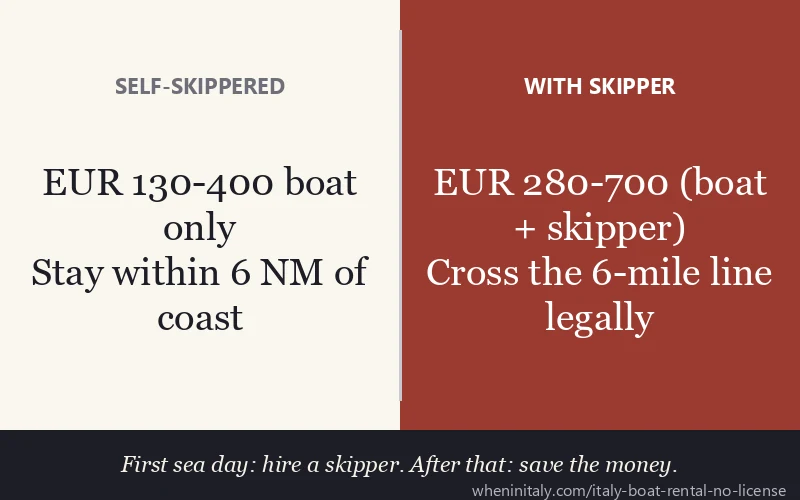
- Hire a skipper (EUR 150 to 300 extra per day) to cross the 6-mile line, take a 7 m+ boat, run Positano-to-Capri, or de-stress a first day.
- Posidonia seagrass anchoring, the 300 m beach belt, and Zone A of marine protected areas are the three rule violations that produce the heaviest fines and no rental briefing fully covers them.
What “Without a License” Actually Means in Italy 2026
The patente nautica is mandatory in exactly four situations defined by Article 39 of the Codice della Nautica da Diporto (Legislative Decree 171 of 18 July 2005, revised by Decree 229/2017 and the new code of October 2025). Outside those four, any adult with a driver’s license and a passport can take command of a boat under 24 metres.
The four trigger conditions:
- More than 6 nautical miles (about 11.1 km) from the nearest coast. Outside the line, license required regardless of engine.
- An engine producing more than 40.8 CV (30 kW). The “40 horsepower rule” on every rental website. Article 39 also lists displacement thresholds, but for almost every rental the operative limit is the 30 kW power cap.
- Operating a jet ski. Always license-required.
- Towing a waterskier or wakeboarder. Always license-required.
The law is not about boat ownership but about the combination of power and distance. The same hull becomes legal or illegal depending on the engine bolted to its transom and the line on the chart you cross.
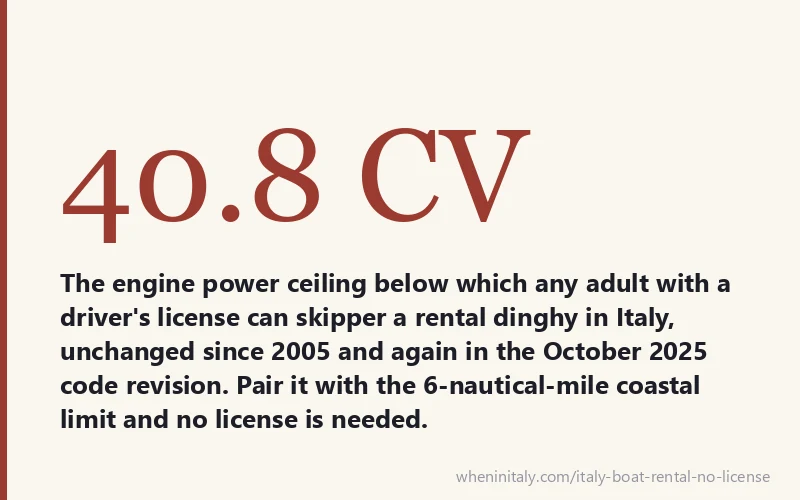
The October 2025 revision added two relevant changes. It introduced the D1 patentino, a junior license from age 16 authorising motors up to 115.6 CV (85 kW) within 6 miles, daytime only, on units up to 10 metres for minors and 12 metres for adults. It also tightened safety gear: life jackets with automatic lights beyond 6 miles, and worn during solo night navigation and on all sailboats. The 6-mile limit and the 40.8 CV threshold did not change.
Who Can Rent? The Driver’s License + Age Rules
Almost every license-free rental operator will ask for four things at the dock.
A valid driver’s license from any country. Italian law does not technically require it (a passport is enough to identify the renter), but operators use a car license as a proxy for road-test competence. Most websites state “patente B (or equivalent) richiesta.” Non-EU renters should bring an International Driving Permit if their license is not in the Latin alphabet.
A passport or government ID for the contract and deposit hold.
A credit card. Pre-authorisation holds run EUR 200 to 1,000 depending on the boat. Cala Gonone’s Dolmen Boat Rental takes EUR 200 on its standard 5 m dinghies. Lake Garda electric operators commonly hold EUR 300. Costa Smeralda fleets and Amalfi 6.5 m hulls hold EUR 500 to 1,000.
Minimum age 18 to rent, with the renter’s name on the contract. At sea, the legal minimum to operate alone is 16 under the new code, provided no license is required for the boat. In practice, every rental puts the contract-holder at or beside the helm; younger family members may take the wheel in clear water under supervision.
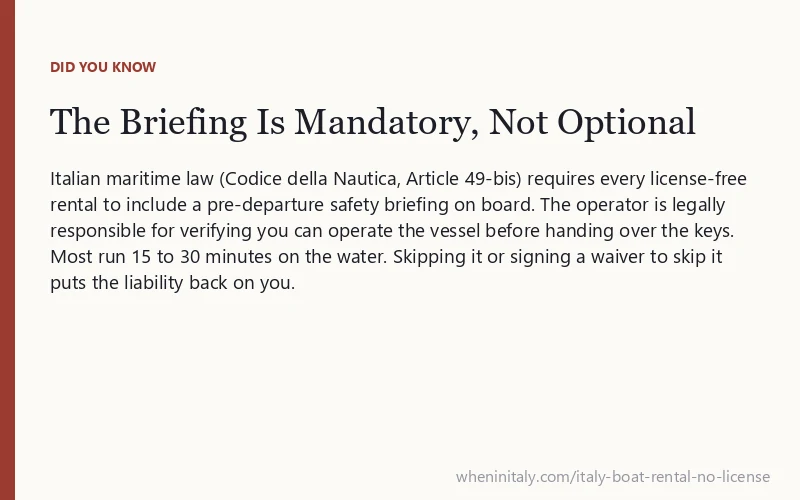
No medical certificate, no swim test, no marine VHF certificate, no logged hours. What is mandatory and free is a 15 to 30-minute on-water briefing: trimming the outboard, reading the depth sounder, basic anchoring, the no-go zones on the chart you are handed. Take notes.
What You Actually Rent: the 5 to 6 Metre Throttle-Limited Dinghy
The standard license-free rental converges on one boat type: a 5.5 to 6 m semi-rigid fiberglass dinghy (in Italian gommone or natante), open cockpit, single outboard, sun cover, basic chartplotter, anchor in a forward locker, small cooler. Common models: Marinello 580, Italmar 580, Selva D.560, Italboat Predator (Lucibello’s flagship in Positano).
The engine is almost always a four-stroke 40 hp Yamaha, Mercury, Honda, or Selva. The throttle is software-limited or mechanically restricted to keep the unit under 30 kW even when the manufacturer plate reads higher. Asking the operator to “uncap” the boat is illegal and voids both rental insurance and your own coverage.
Included almost everywhere:
- Hull, engine, fuel tank, on-water briefing.
- Statutory third-party liability insurance (RC obbligatoria). Covers damage you cause to third parties; does NOT cover damage to the boat itself.
- Safety pack mandated by the maritime code: life jackets for every passenger, two life rings (or one ring plus a horseshoe with a 1-mile rope post October 2025), red distress flares, fire extinguisher, VHF or charged phone in waterproof bag, first-aid kit.
- A printed local chart with recommended route, no-go zones, and return time.
Typically extra:
- Fuel. Either “full to full” or consumption-based. Plan EUR 30 to 80 per day. A full day at 18 to 22 knots on a 40 hp dinghy burns roughly 60 to 90 litres at EUR 1.85 to 2.20 per litre dockside.
- Collision damage waiver (CDW). EUR 15 to 30 per day. Without it, the entire deposit is at risk for any scratch.
- Skipper, if you choose one. EUR 150 to 300 per day, more in peak Costa Smeralda.
Where to Rent It: the Six Destinations That Actually Deliver
Italy has license-free rental fleets in every coastal region, but six pockets concentrate enough operators, enough boats, and enough day-trip cruising ground to warrant the trip.
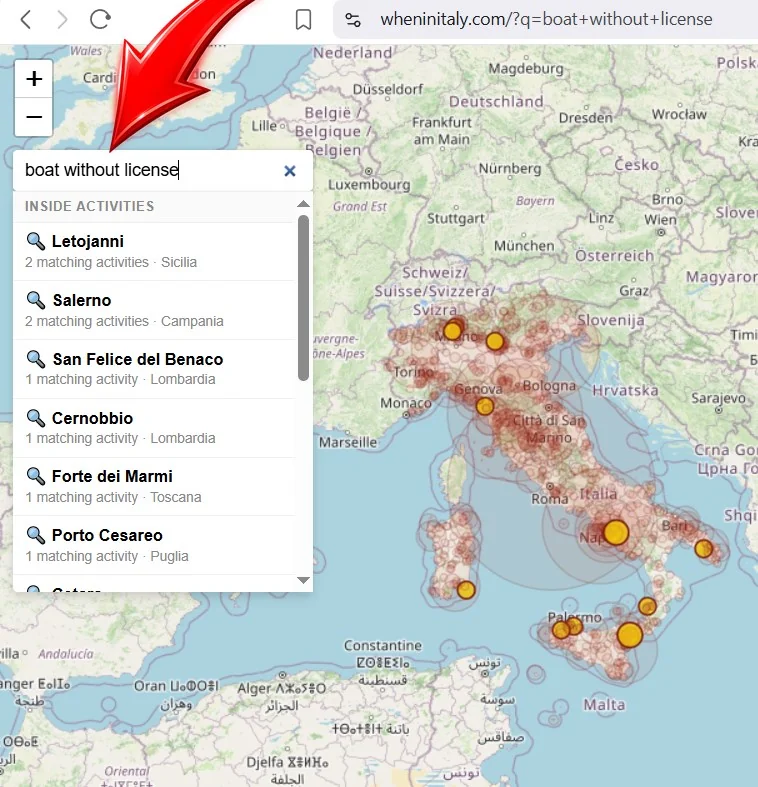
Cala Gonone and the Gulf of Orosei (Sardinia East)
The highest-density license-free scene in Italy and the spiritual home of the Italian dinghy day. From Cala Gonone harbour, 40 km of cliff-walled white-pebble coves open south: Cala Luna, Cala Mariolu, Cala Biriola, Cala Sisine, Cala Goloritzé. All reachable in a single day, most unreachable by road.
Dolmen Boat Rental lists EUR 140 for 08:30-17:30 on the standard 5 m dinghy, EUR 200 deposit, WhatsApp booking. Daymar starts at EUR 140. Gonone Rental and Cala Luna Boat Rental sit in the same band. Across the cluster expect EUR 130 to 280 per day, August roughly 30 percent above June and September.
Sardinia North: La Maddalena, Porto Cervo, Palau
The Costa Smeralda end is the premium pocket. Departures from Porto Cervo, Palau, La Maddalena, Santa Teresa di Gallura, Poltu Quatu, Baja Sardinia, Cannigione. The cruising ground is the Parco Nazionale dell’Arcipelago di La Maddalena: 62 granitic islands, the Spiaggia Rosa on Budelli (no landing since 1994), the anchorages off Spargi and Razzoli.
A 5.5 m dinghy starts around EUR 200 to 300 in shoulder season, EUR 280 to 450+ in August. Operators include La Maddalena Exclusive Boats, Smeralda Boats, and Servizi Nautici Sardegna. The marine park requires a daily access permit (EUR 5 per swimmer, more for boats) and enforces 7 knots within 300 m, 15 knots beyond.
Positano, Amalfi Coast, and Praiano
The highest-revenue license-free market in Italy and the most constrained by the 6-mile rule. Capri sits roughly 16 NM from Positano around the Punta Campanella headland, outside the legal limit for an unlicensed skipper. Positano to Li Galli is 4 NM, fine. Positano to Amalfi is 8 NM along the coast, also fine. The Faraglioni-of-Capri day requires a skipper.
Lucibello (Positano, est. 1953) rents a 5.4 m Italboat Predator with 40 hp for up to 8 people, no license. Cassiopea’s fleet is largely skipper-included. Grassi Junior, Blue Star, and Capri Boat Rental sit in the same cluster. License-free day rates EUR 200 to 400 in 2026; August Saturdays touch EUR 450. Skipper add-on EUR 200 to 300 unlocks the Capri trip.
Lake Garda
Italy’s largest lake and its most accessible license-free scene. 52 km by up to 17 km, sheltered enough that electric boats, which carry no horsepower threshold and require no license at any size, dominate the eastern shore.
Garda Boat (Manerba), Boat Garda (Bardolino), Garda Rent Boat (Sirmione), Easy Boat Rent (Desenzano), and Ora Boats run license-free 40 hp dinghies for EUR 80 to 160 per half-day or EUR 150 to 300 full day. Electric boats run EUR 30 per hour or EUR 200 to 300 full day, with ~7 hours battery life at 4 knots. Deposits EUR 200 to 300.
The classic day: Sirmione to Limone via Salò and Gardone, ~25 NM round trip. The lake enforces a strict 300 m no-engine zone from shore; sail and motor with more than 4 sqm sail must keep 300 m off, crossing perpendicular at 3 knots maximum.
Lake Como
Smaller, busier, well-organised. Bellagio is the base: Boat Hire Bellagio rents license-free dinghies from EUR 75 per hour, fuel and insurance included. The broader Como cluster runs around EUR 95 per hour and EUR 280 to 450 full day. Departure points: the Imbarcadero by Piazza Mazzini in Bellagio and the Molo Riva Grande in Varenna.
Sicily and the Aeolian Islands
The most frontier of the six. Operators are fewer and a meaningful share of inventory is skipper-included. The Aeolian Islands have license-free fleets out of Lipari, Salina, Capo d’Orlando, and Portorosa: 6 to 7 m dinghies with 40 hp engines, EUR 200 to 350 per day. Distances between outer islands (Filicudi, Alicudi) push the 6-mile limit and the afternoon maestrale makes returns uncomfortable for novices. Cefalù, San Vito Lo Capo, and Marzamemi have smaller license-free fleets emerging in 2025-26.
What Does It Cost in 2026?
Four cost components: boat day rate, fuel, optional damage waiver, deposit hold. The ladder below is for a 5.5 m dinghy with 40 hp outboard, full day, shoulder season, from operator websites in spring 2026:
| Destination | Day rate (boat) | Fuel (typical day) | CDW (optional) | Deposit hold |
|---|---|---|---|---|
| Cala Gonone | EUR 130 to 200 | EUR 50 to 80 | EUR 15 to 25 | EUR 200 |
| Costa Smeralda / La Maddalena | EUR 200 to 350 | EUR 60 to 100 | EUR 25 to 35 | EUR 500 to 1,000 |
| Positano / Amalfi Coast | EUR 200 to 400 | EUR 60 to 90 | EUR 25 to 35 | EUR 500 to 1,000 |
| Lake Garda (40 hp dinghy) | EUR 150 to 280 | EUR 30 to 50 | EUR 15 to 25 | EUR 200 to 300 |
| Lake Garda (electric boat) | EUR 150 to 250 | EUR 0 (battery) | EUR 15 | EUR 300 |
| Lake Como | EUR 280 to 450 | EUR 40 to 70 | EUR 20 to 30 | EUR 300 to 500 |
| Aeolian Islands | EUR 200 to 350 | EUR 50 to 90 | EUR 25 to 35 | EUR 300 to 600 |
August premium. Day rates run roughly 25 to 40 percent above June and September across every coastal destination. Costa Smeralda is the steepest curve; Cala Gonone the gentlest.
The hidden cost is the deposit hold. Not money spent, but money frozen on your credit card for 5 to 10 business days after return. A two-week trip with three rental days across Lake Garda, Cala Gonone, and Positano easily runs EUR 1,500 to 2,000 in cumulative holds on a single card. Plan card limits accordingly.
Most operators include third-party liability, safety pack, briefing, and chart. Most do NOT include fuel, CDW, marine park access fees (e.g. La Maddalena), or cleaning fees for food spills.
Skipper or No Skipper: When to Hire Someone to Drive
A skipper adds EUR 150 to 300 per day. On a sheltered destination like Cala Gonone most renters skip one, but five situations make hiring one legally required or operationally smart.
Legally required when:
- You want to go beyond 6 NM from shore. The Capri-from-Positano case, the Filicudi-from-Lipari case. Without a patente nautica you cannot cross the line, and the operator’s insurance does not cover you if you do.
- The boat exceeds 40.8 CV / 30 kW. Larger 7 to 9 m boats with 80 to 150 hp engines are common in Costa Smeralda and Aeolian fleets.
- The operator requires it. In tricky waters (Amalfi summer swell, Stromboli afternoon wind) some operators only rent skipper-included. The Cassiopea fleet in Positano is largely skipper-included for this reason.
Smart when:
- It is your first time at the helm of a motorboat at sea. Sea-state, current, ferry traffic, and the difference between a deep-water and a sea-grass anchorage exceed what a 20-minute briefing transfers. Skipper day one, self-skippered the rest of the week.
- You want to drink wine with lunch. Italy enforces the same 0.5 g/L blood-alcohol limit on the water as on the road. Fines for boating under the influence start at EUR 2,755 and include vessel impoundment.
A skipper is not a guide. They handle the boat and stay at the helm; you bring snorkel gear, choose stops, feed them lunch.
The Rules Nobody Tells You About: Protected Coves, Sea-Grass Fines, Beach Speed Zones
Three rule categories produce nearly all the four-figure fines in Italy’s recreational boating, and none are obvious from the Codice della Nautica itself. They live in regional ordinances, marine-park decrees, and Coast Guard enforcement guidelines.
Posidonia oceanica anchoring. Posidonia is a slow-growing endemic Mediterranean seagrass forming vast meadows along Italy’s sandy bottoms. A single anchor-drag scar takes decades to heal. Anchoring on Posidonia is prohibited inside MPAs and increasingly outside them under regional ordinances; fines start around EUR 200 and exceed EUR 1,500 per incident. The Italian Coast Guard has stepped up enforcement since 2024, deploying drones, naval, air, and underwater assets in protected areas including the new Capo Spartivento MPA in Sardinia. Anchor only on sand, identifiable by the lighter colour visible from the surface. When in doubt use the MPA buoy fields (16 seasonal moorings at Capo Spartivento alone).
Cala Mariolu’s daily visitor cap. The most photographed cove in the Gulf of Orosei runs under a 700-visitor daily cap enforced by the Comune di Baunei. Many July and August days the cap closes by mid-morning. Cala Goloritzé just south is no-landing from the water, period (4 km hike only from Bacu Mudaloru parking, itself capped at 250 cars per day). Cala Biriola caps at 300. Arrive at Mariolu before 10:00 in peak season.
Marine Protected Area zoning. Italy has 32 MPAs. Each has internal zoning: Zone A (integral reserve, no transit, no anchoring), Zone B (no anchoring, low-speed transit only), Zone C (both with restrictions). The 7-knot limit within 300 m of coast in La Maddalena is one of dozens of park-specific ordinances. The chart your operator hands you marks the zones; reading it is the difference between a free day and a EUR 300 to 1,500 fine.
The 300-metre beach belt. A federal rule enforced on coast and lakes alike. Within 300 m of any beach, swimming buoy line, or zona di balneazione, engines must be off or moving at minimum steerage, perpendicular to shore, through a marked landing corridor only. The cap in the broader 1,000 m beach zone is 10 knots. Corridors are usually marked by yellow buoys; if you do not see them, approach under oars only.
Useful catch-all: the Navionics Boating app (about EUR 30 per year for Italy) overlays MPA zones, depth contours, no-anchor areas, and approach corridors on your phone.
A Safe First Day: a Checklist + a 30-Mile Sample Route
What to bring, in order of how often first-timers forget it:
- Waterproof phone case with a lanyard. The phone is your chart, weather radar, VHF backup, and camera.
- Printed copy of the operator’s chart, marked with your route and return time.
- 2 litres of water per person plus electrolytes.
- Reef-safe sunscreen and a wide-brim hat. A 5.5 m dinghy has no shade beyond the bimini.
- Dry bag for cameras, wallets, change of clothes.
- Snorkel, fins, reef shoes. Most operators do not include them; pack from home or buy at the dock for EUR 10 to 25.
- Cash for marina fees, lunch, beach club entry. Card acceptance at remote kiosks is patchy.
Sample day: Cala Gonone to Cala Mariolu and Cala Luna
The canonical Sardinian dinghy day, 25 to 30 NM round trip, inside the 6-mile rule throughout.
- 08:00. Check in at Dolmen, Daymar, or Gonone Rental. Briefing 08:15-08:35. Push off 08:45.
- 09:30. Arrive Cala Luna (7.5 NM south). River-mouth caves are the early-morning highlight before day-tour boats arrive at 10:30. Anchor on sand off the central beach.
- 10:45. Push 3 NM south to Cala Mariolu. Arrive before 11:30 in July or August to beat the 700-cap window.
- 12:30. Slow cruise past Cala Biriola and Cala Sisine, no landing. Cliffs 400 to 500 m vertical.
- 13:30. Lunch at anchor in a sand patch off Cala Sisine or back at Cala Luna. The chiosco sells hot focaccia and cold beer.
- 15:00. Return north. Optional stop at Grotta del Bue Marino (the monk-seal cave).
- 16:30. Refuel at the harbour pump (EUR 1.95 per litre, spring 2026).
- 17:00. Hand back. Deposit released in 5 to 10 days.
The freshwater equivalent is the Sirmione to Limone west-shore loop on Lake Garda: 25 NM round trip, sheltered, with bail-out marinas at Salò, Gardone, and Toscolano-Maderno. A 40 hp dinghy makes it with fuel to spare; on an electric boat, a half-loop to Salò and back is 14 NM, inside one battery cycle.
The pattern across all six destinations holds: take a known route the first day, build the muscle memory of throttle-anchor-radio-chart, and only then start ad-libbing. The Italian coast is one of the most welcoming environments in Europe to learn this skill, and the rule that lets a tourist take the helm has been on the books for two decades. Use it well.
Sources and References
- Italian Ministry of Infrastructure and Transport — Decreto Legislativo 171 del 18/07/2005, Codice della Nautica da Diporto
- Brocardi.it — Article 39 of the Codice della Nautica da Diporto: Patente Nautica
- Mure a Dritta — Rivoluzione in mare: ecco il nuovo Codice della nautica da diporto 2025
- Soleil Scuola Nautica — Patente nautica 2026: guida completa
- Il Messaggero Motori — Nautica, ecco le nuove regole: confermata l’esenzione fino a 40 cv
- Daymar Boat Rental — Boat Rental Cala Gonone, no licence required
- Dolmen Boat Rental — Cala Gonone Tripadvisor reviews and 2026 pricing
- Gonone Rental — Boat Rental Cala Gonone
- Lucibello Positano — Italboat Predator dinghy rental, 5.4 m / 40 hp / 8 pax, no license
- Positano.com — Rent a boat on the Amalfi Coast without a boating license
- Capri.com — Boat rentals without skipper or boating license required on Capri
- Garda Boat — Lake Garda boat rental without a captain, no license
- Ora Boats — Garda Lake boat rental, no license
- Bellagio Boat Rental — Lake Como boat rental, no license required
- SamBoat — Aeolian Islands boat rental without license
- Servizi Nautici Sardegna — Porto Cervo boat rental
- La Maddalena Exclusive Boats — La Maddalena charter and rental fleet
- Navily — La Maddalena Archipelago boating regulations and 7-knot speed limit
- Barche a Motore — Capo Spartivento MPA: anchoring, Posidonia, and buoy fields under the 2026 rules
- Mediterranean Posidonia Network — Regulations and solutions for Posidonia anchoring
- Cala Mariolu official — Visitor cap and access rules, Gulf of Orosei
- Strictly Sardinia — Cala Mariolu access guide: 700-visitor cap, parking quota at Baunei
- Boat Garda — Lake Garda navigation rules, 300 m beach zone
- Europlan — Lake Garda navigation rules and equipment
- Boat the Globe — Italy boating licence requirements summary