TL;DR / Key Takeaways
- The Egadi (Aegadian) Islands sit 7 to 30 km off Trapani on Sicily’s west coast. Three are inhabited: Favignana (19.8 km², the tourist hub), Levanzo (5.6 km², Paleolithic cave art), and Marettimo (12 km², no cars, hiking).
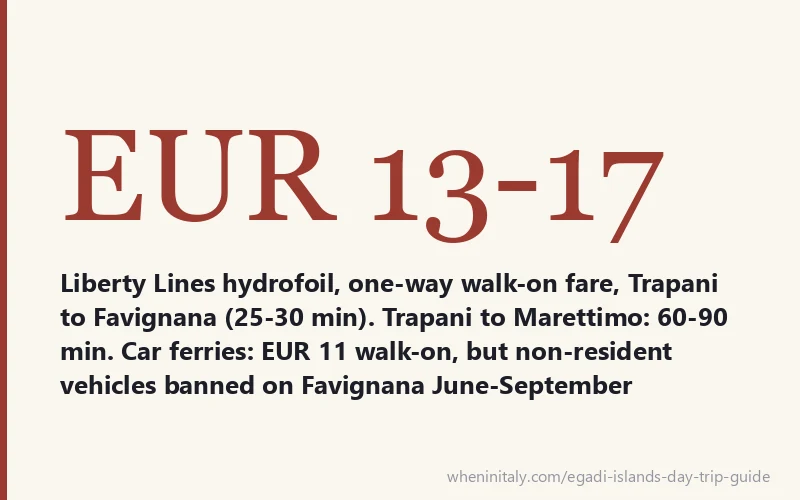
- Liberty Lines hydrofoils run Trapani to Favignana in roughly 25 to 30 minutes from EUR 13 to 17 walk-on. Siremar car ferries take 55 to 80 minutes from EUR 11 walk-on or about EUR 30 with a vehicle, but vehicle traffic is forbidden for non-residents on Favignana from June through September.
- The signature beach, Cala Rossa on Favignana, is named for the red-tinged tuff cliffs left by Roman quarrying, not the water (which is famously milky turquoise).
- The combined Favignana plus Levanzo small-group day cruise from Trapani starts around EUR 115 per person; the DIY hydrofoil-and-bicycle alternative comes in under EUR 40 all-in but takes more planning.
- Marettimo is wasted as a day trip. A round-trip hydrofoil leaves about five hours on the island, which is enough for a single short hike but not for the Punta Troia loop that justifies the visit.
- Best windows: mid-May to mid-June and mid-September to mid-October. July and August are hot, full, and prone to ferry cancellations on scirocco days.
The Egadi at a glance: three islands, three different days
The three inhabited Egadi Islands are not interchangeable. Favignana is the obvious base: 19.8 km², roughly 3,400 year-round residents, a walkable centro storico with no traffic, and the photographed coves (Cala Rossa, Cala Azzurra, Bue Marino) that draw most of the day-trip traffic from Trapani. Levanzo is the smallest at 5.6 km² and 208 residents, a single white-washed port-village, and the only reason most travellers come is the Grotta del Genovese, a cave with Paleolithic engravings and Neolithic paintings that has no real equivalent elsewhere in Italy. Marettimo, the most remote at roughly 30 km west of Trapani, is car-free outside the harbour, dominated by the 686 m Monte Falcone, and structured around four serious hiking trails. Pick the island by the day you want: Favignana for swimming and bicycles, Levanzo for prehistory, Marettimo for trails.
Getting there: hydrofoil vs ferry, Trapani vs Marsala
For a day trip the answer is almost always the Liberty Lines hydrofoil from Trapani.
Two operators run the route. Liberty Lines (the former Ustica Lines) operates fast hydrofoils, aliscafi in Italian, that are walk-on only. Trapani to Favignana takes 25 to 30 minutes; Trapani to Levanzo runs 20 to 25 minutes; Trapani to Marettimo is the longest leg at 60 to 90 minutes. One-way fares sit in the EUR 13 to 17 band depending on date. In high summer the company runs roughly 75 weekly Trapani to Favignana itineraries, which works out to a sailing every 30 to 60 minutes through the day. Siremar runs the slower conventional car ferry, the traghetto: 55 to 80 minutes Trapani to Favignana, about EUR 11 walk-on, around EUR 30 to take a car across, fewer departures (Siremar lists up to three sailings per day on the Favignana run).
Bring a car only if there is a real reason. From June through September the Comune di Favignana bans non-resident vehicle circulation on the island, which neutralises the main argument for the Siremar option in the season most travellers arrive. Outside summer the car ferry makes sense for travellers staying multiple nights with luggage and bikes; for a day trip it does not.
A summer-only Marsala to Favignana service also runs, useful for travellers based in the Marsala wine country, but Trapani has by far the more frequent timetable. Tickets are sold on the Liberty Lines and Siremar websites, on Ferryhopper, or at the port booth on Via Ammiraglio Staiti. Liberty Lines also opened a WhatsApp booking line at +39 342 807 9408 for the 2026 season.
One practical caveat: the scirocco, the southerly wind off Africa, regularly cancels the Marettimo hydrofoil and occasionally clips the Favignana run. Check the next-day forecast on the operator’s site before locking a non-refundable booking.
Favignana: Cala Rossa, the bicycle, and the Tonnara Florio
Favignana is butterfly-shaped (the wing-tips are visible from the air), 19.8 km² of low limestone, and built around a single port. The centro storico is closed to outside cars, and the island’s transport culture is dominated by the bicycle: rental shops cluster at the port, and a flat coast-hugging road circles the eastern wing past every important cove in roughly 90 minutes of easy pedalling.
Cala Rossa is the postcard: a horseshoe of pale tuff cliffs above water that photographs as a cartoon turquoise. The name (literally “red cove”) refers to the rust-coloured stone, soft limestone the locals carved out by hand for centuries to build homes, roads, and churches, not to the colour of the sea. There is no sandy beach. Access is on foot from a clifftop parking area: the eastern path drops via a steep set of cut steps known locally as the scalette; the western path is longer but easier. Either way, bring water, sun protection, and water shoes. The tuff edges are sharp and there is no shade, no kiosk, no lifeguard.
Locals will tell you that Cala Rossa is the postcard, but Bue Marino is the swim. Bue Marino, a former tuff quarry the sea has reclaimed into a deep sheltered pool, is calmer, gentler underfoot, and generally less mobbed by 11 a.m. Cala Azzurra on the south-east tip is the family option: shallow, sandy in patches, easy entry.
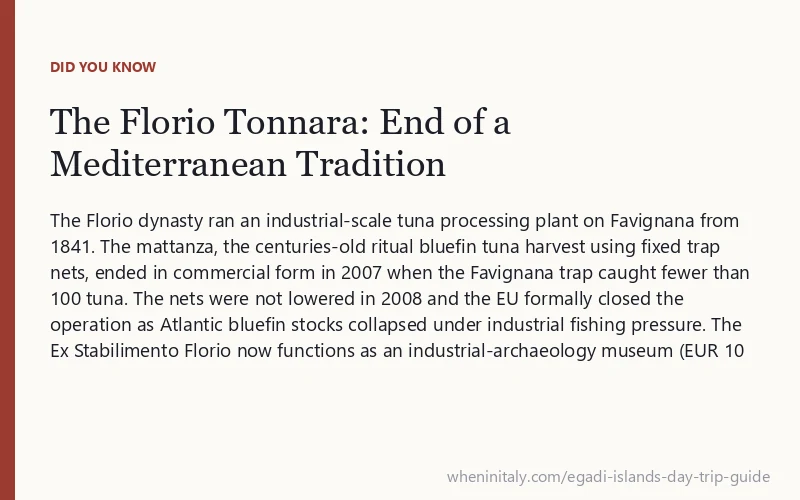
In town, the Ex Stabilimento Florio delle Tonnare di Favignana e Formica is the one indoor stop worth making. The Florio dynasty ran an industrial-scale tuna processing plant on this site from 1841; the building now functions as an industrial-archaeology museum that tells the story of the mattanza, the centuries-old ritual tuna harvest. Standard adult entry runs EUR 10 in 2026, EUR 5 reduced for ages 12 to 18, and free for under-12s; a combined Florio Museum plus Florio Palace ticket is EUR 12. Hours run 09:00 to 17:00 from April to May with a longer split-shift schedule (10:00 to 14:00 and 16:00 to 20:00) in high season. The ticket office closes 30 minutes before the museum.
The mattanza itself ended in commercial form in 2007. That year the Favignana trap caught fewer than 100 tuna; the nets were not lowered in 2008 and the EU formally closed the centuries-old operation as Atlantic bluefin stocks collapsed under industrial fishing pressure. The museum is, in effect, the gravestone of a Mediterranean tradition that ran from the Phoenicians to the Florios.
Levanzo: the Grotta del Genovese cave art
Levanzo is the smallest of the inhabited Egadi (5.6 km², 208 residents) and the only reason most travellers go is the Grotta del Genovese, a sea-cliff cave with prehistoric rock art that has no real parallel in Italy.
The cave holds two distinct layers of work. The deeper layer is Paleolithic: deeply incised animal silhouettes (deer, bovids, fish) cut into the rock roughly 12,000 years ago, when Levanzo was still attached to mainland Sicily by a land bridge. The upper layer is Neolithic: charcoal-and-fat paintings, around 6,000 years old, of stylised human figures, a bull, what appears to be a dance scene. The site was discovered in 1949 by the painter Francesca Minellono (often misattributed in older guides to a French painter). Together the two layers compress the entire transition from late hunter-gatherer to early agricultural Sicily into a single sea-cave wall.
Visits are guided only and must be booked in advance through the official site grottadelgenovese.it. The custodian’s office on Levanzo is on the lane just above the port. Two access options: a short 4WD transfer to a clifftop and a steep 700 m foot descent, or an unguided walk from town that runs roughly 90 minutes each way. The boat option, which lands directly at the cave mouth, depends on sea state and is the first thing the wind cancels. A two-hour all-inclusive tour is the standard format. Cap on group size is small; low-season closures happen; same-day walk-up is unrealistic.
Beyond the cave, Levanzo is a single port-village (one bank, one pharmacy, a handful of trattorias) and a coast of swimmable coves: Cala Fredda and Cala Minnola are the day-cruise standards. A day trip from Trapani that combines a hydrofoil over, a cave tour, and an afternoon swim is one of the cleaner one-day Egadi itineraries on offer.
Marettimo: hiking, no cars, and a castle on a rock
Marettimo is the wild one. Roughly 12 km² with around 300 to 650 residents depending on which census you use (sources diverge between permanent inhabitants and the wider Marettimo frazione count). It sits about 30 km west of Trapani, the most isolated of the three. No cars and no scooters are allowed beyond the port: residents move freely with golf carts and small three-wheelers, but a visitor walks. The local dialect is distinct enough that linguists treat it as a separate variant of Sicilian, a function of centuries of road-free isolation.
The geography is vertical. Monte Falcone, the highest point at 686 m, sits near the centre of the island, and four main trails radiate from the harbour:
- Case Romane, the easiest, about 1.5 hours round trip, ending at the foundations of a Roman-era settlement and a small early-Christian chapel.
- Cala Bianca, the white-pebble cove on the north coast, about 3 hours round trip with a swim at the turn.
- Punta Troia, the headland castle loop, about 4 hours round trip if taken direct.
- The full ridge loop Pizzo Falcone plus Punta Troia for serious hikers: roughly 13 km, 1,000 m of elevation gain, 6 to 6.5 hours, and rated hard on AllTrails.
The Castello di Punta Troia, the keep on a tiny rocky islet at the northern tip of the island, was originally built by the Normans in the 12th century as a watchtower; the Spanish rebuilt it in the 17th century, and the Bourbons used the cisterns as a notoriously brutal political prison. It is now a small museum.
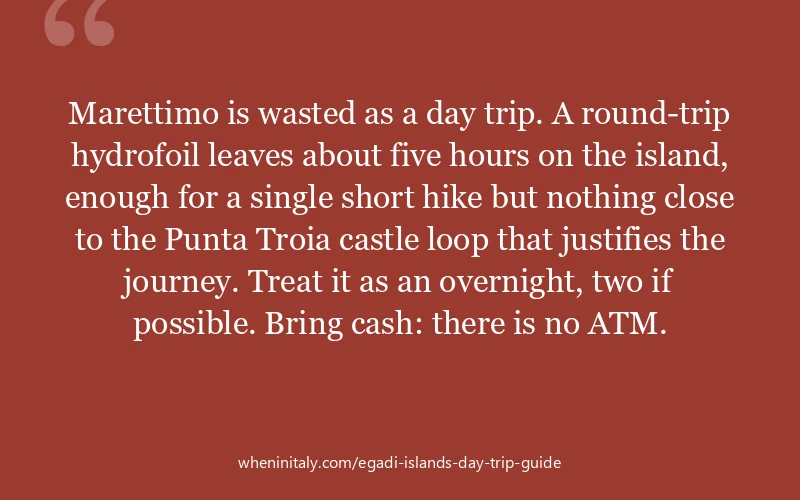
Marettimo is wasted as a day trip. The Trapani hydrofoil takes 60 to 90 minutes each way, and even the earliest sailing leaves only about five hours on the island, enough for the Case Romane trail or a cove swim but nothing close to the castle loop that justifies the journey. Treat it as an overnight, two if possible. Bring cash: there is no ATM.
Day-trip cruise vs DIY: which to pick?
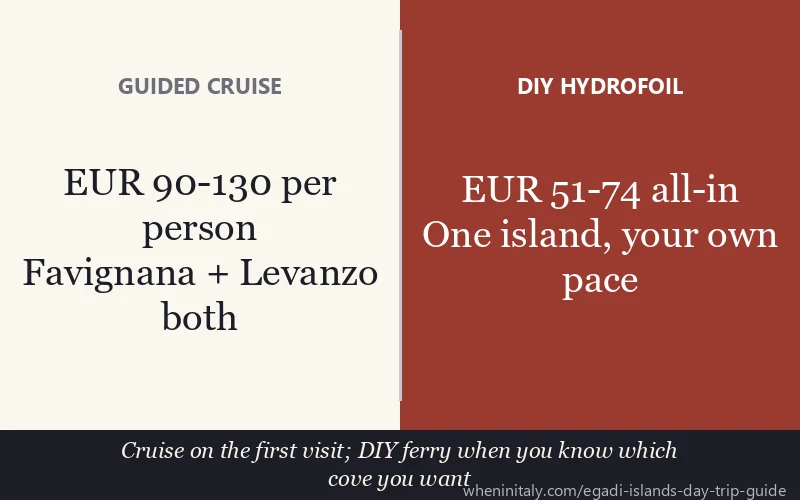
For most travellers the right answer is the cruise on the first visit, the DIY ferry on the second.
The combined Favignana plus Levanzo small-group cruise out of Trapani’s Marina di Levante typically departs at 09:30 to 09:45 and returns around 17:00. Group sizes are capped (the small-boat versions cap at 12; larger boats go higher), the price includes skipper, snorkel stops at Cala Rossa and Bue Marino on the Favignana side and Cala Fredda or Cala Minnola on the Levanzo side, plus an aperitif or light lunch. Pricing for 2026 starts around EUR 115 per person on the small-group products and runs to roughly EUR 60 to 90 on the higher-volume boats. The case for it: zero logistics, you swim in places that are awkward to reach by land, you see both islands in one day, the boat is the activity.
The DIY day flips the maths. EUR 13 to 17 each way on the Liberty Lines hydrofoil to Favignana, around EUR 10 to 15 for a day-rental bicycle, lunch in town for EUR 15 to 25, museum entry EUR 10 if it interests you. Total day budget: EUR 50 to 80 per person, about half the cruise cost, with the freedom to stay until the last hydrofoil and to skip the Levanzo half if you would rather have a slow afternoon at Bue Marino. The case against: you see one island, not two; you do not snorkel at the Cala Rossa cliffs from the water side; you spend roughly an hour of the day on bicycle saddle work.
A useful third option for groups of three to six: a bareboat dinghy rental out of Trapani or Favignana port. Italian regulations permit operation of an under-40 hp, under-10 m vessel without a patente nautica, which means a 5 m motor dinghy is rentable on a passport. Daily rates in summer 2026 sit around EUR 130 to 280 depending on hull size and season. For three or four sharing, the per-person cost matches the DIY day with the cruise’s freedom of route. (More on the licence-free rules on our Italy boat-rental guide.)
What does it cost in 2026?
A realistic per-person Egadi day budget out of Trapani in 2026, in EUR:
| Line item | Low | High |
|---|---|---|
| Liberty Lines round-trip Trapani-Favignana (walk-on) | 26 | 34 |
| Bicycle day rental, Favignana port | 10 | 15 |
| Lunch in centro storico (one course plus drink) | 15 | 25 |
| Tonnara Florio museum entry (adult) | 10 | 12 |
| DIY day, no museum | 51 | 74 |
| DIY day, with museum | 61 | 86 |
For the cruise comparison:
| Line item | Low | High |
|---|---|---|
| Combined Favignana+Levanzo small-group cruise (per person, includes skipper, lunch, drinks) | 90 | 130 |
| Larger-group day boat (less personal, more crowded) | 60 | 90 |
| Private chartered cruise, 6 to 8 pax (per person) | 130 | 180 |
For the Levanzo cave option as a standalone:
| Line item | Low | High |
|---|---|---|
| Liberty Lines round-trip Trapani-Levanzo | 26 | 34 |
| Grotta del Genovese guided tour | 18 | 25 |
| Lunch in port | 15 | 25 |
| Levanzo cave day total | 59 | 84 |
For the Marettimo overnight (because the day trip is not worth it):
| Line item | Low | High |
|---|---|---|
| Liberty Lines round-trip Trapani-Marettimo | 30 | 40 |
| Pensione or B&B per night, shoulder season | 70 | 130 |
| Two meals per day | 35 | 60 |
| Marettimo overnight total | 135 | 230 |
These ranges assume shoulder-season (May to early June, mid-September to October) bookings. July and August add roughly 20 to 40% to accommodation and lunch lines, hold ferry pricing flat, and increase the chance of capacity refusals on the hydrofoil.
Best time, what to bring, with kids
The Egadi shoulder seasons are not subtle. Mid-May to mid-June and mid-September to mid-October are the two windows where the water is warm enough to swim (sea temperatures around 22 to 24 C), the air sits in the high 20s, the hydrofoils run at full schedule, and the islands are quiet enough that Cala Rossa is photographable without other swimmers in the frame. July and August push the daytime air to 30 to 35 C, fill the Favignana hotels at three times shoulder rates, can leave the 09:30 hydrofoil at standby-only capacity, and turn the centro storico evening passeggiata into a slow shuffle. November to March is the off-season proper: the hydrofoil schedule contracts, many restaurants close, the Grotta del Genovese tour runs only on request, and scirocco days cancel runs without much warning.
The wind matters enough to plan around. The scirocco, blowing from Africa, is the one that closes the Marettimo route most often; mistral days from the north occasionally clip the Levanzo run. Liberty Lines posts cancellations on its site and via SMS to ticket-holders.
What to bring for a Favignana day:
- Water shoes, not flip-flops. The tuff at Cala Rossa is sharp; the entries at Bue Marino and Cala Azzurra include rocky stretches.
- Hat, sunscreen, refillable water bottle. The coastal beaches have no shade and no kiosks.
- A light layer for the hydrofoil cabin, which over-air-conditions in summer.
- Cash for small bars and bike rental; ATMs are present on Favignana but unreliable on Levanzo and absent on Marettimo.
With kids: Cala Azzurra and Lido Burrone (the Favignana sandy options) work for any age. Cala Rossa works from roughly age 6 upward, the scalette descent is the limiting factor for younger children. The Tonnara Florio museum is a hit with school-age children for the size of the industrial machinery alone. The Grotta del Genovese tour requires either the foot descent or the boat option, neither comfortable for under-7s. The Marettimo trails are not kid-friendly above the Case Romane loop.
The combined cruise products listed in the catalogue below cover the most-booked Favignana plus Levanzo combinations from Trapani; the standalone Favignana products work for travellers who already know which cove they want.
Sources and References
- Liberty Lines official destinations: Favignana — operator routes, schedule notes, 2026 WhatsApp booking line.
- Liberty Lines fare and timetable page — fare structure for 2026.
- NetFerry: Liberty Lines operator profile — duration and weekly itinerary count for Trapani-Favignana.
- Ferryhopper: Trapani-Favignana route — Siremar duration (55-80 min) and pricing (from EUR 11 walk-on, EUR 30 with car).
- NetFerry: Siremar profile — 2026 timetable and schedule cadence.
- Direct Ferries: Trapani-Marettimo — Marettimo crossing ~60-90 min by hydrofoil.
- Grotta del Genovese official site — booking, tour format, custodian’s office on Levanzo.
- Wikipedia: Grotta del Genovese — discovery date (1949), Paleolithic engravings vs Neolithic paintings, age estimates.
- Lonely Planet: Grotta del Genovese — 4WD plus 700 m descent or 1.5 hr walk from town.
- Ex Stabilimento Florio: VisitFavignana page — 2026 entry tiers (EUR 10 / EUR 5 / EUR 12 combined), seasonal hours.
- Comune di Favignana: Ex Stabilimento Florio — official municipal museum page.
- Wikipedia: Mattanza — last Favignana mattanza in 2007, cessation of nets in 2008, EU closure context.
- Wikipedia: Favignana — area (19.8 km²), 2026-era population (~3,400 residents).
- European Commission Clean Energy for EU Islands: Levanzo — Levanzo at 5.6 km², 208 residents.
- European Commission Clean Energy for EU Islands: Marettimo — Marettimo population data.
- AllTrails: Marettimo Pizzo Falcone-Punta Troia loop — 13 km, ~1,000 m gain, 6-6.5 hr, hard rating; Punta Troia castle Norman 12th c. attribution.
- Egadi Kayak: Cala Rossa updated guide 2026 — tuff geology, access notes, swimmer-shoe recommendation.
- Mare e Vento di Favignana: Cala Rossa — wind protection, swimming conditions.
- GetYourGuide: Trapani-Favignana-Levanzo combined cruise — itinerary, departure time, snorkel stops.
- Viator: Egadi Islands small-boat cruise to Favignana and Levanzo 2026 — small-group pricing benchmark from EUR 115 pp.
- You Know Boat: Hybrid boat tour Favignana-Levanzo from Trapani — alternate small-operator cruise format.
- Wikivoyage: Marettimo — no-cars-beyond-port rule, ATM absence, dialect.