Key takeaways
- Italy has three serious dolphin-watching coasts: Liguria (the Pelagos Sanctuary, the world’s largest Mediterranean cetacean reserve at 87,500 km²), Sardinia (year-round bottlenose pods around Olbia, the Maddalena, and Cala Gonone), and Campania (Naples Bay and the Sorrento peninsula).
- Swimming with wild dolphins in Italian waters is illegal. Boats must stay at least 100 metres from any cetacean under the Pelagos and ACCOBAMS code of conduct, and Italy banned in-water encounters with captive dolphins in 2018.
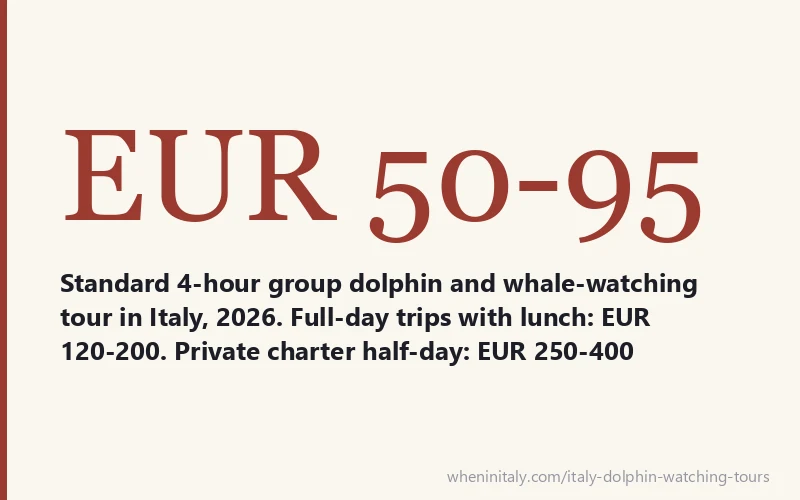
- A standard 4-hour group tour runs EUR 50 to EUR 95 in 2026. A full-day trip with lunch sits around EUR 120 to EUR 200, and a private charter runs EUR 250 to EUR 400.
- Sighting probability with reputable Pelagos Sanctuary operators reaches 70 to 90 percent in summer. Reputable operators offer a free repeat trip if no cetaceans are seen.
- The window that works is April to October, with June to September the calm-sea peak. Bring SPF 50, polarised sunglasses, water, and motion-sickness medication; the trip is solid for kids aged 6 and up.
- Look for the ACCOBAMS High Quality Whale-Watching label (HQWW), implemented in Italy by the CIMA Research Foundation since 2019. Operators that promise “swim with wild dolphins” or “guaranteed sightings” are violating the rules; choose differently.
Italy’s three dolphin-watching coasts at a glance
Italy’s dolphin-watching scene concentrates on three coasts, and they are not interchangeable. Each has a different host species, season profile, and trip style. Knowing which coast matches the trip is the difference between a calm half-day with a near-guaranteed pod sighting and a long offshore expedition chasing fin whales in the open Ligurian Sea.
The Ligurian coast, anchored by Genoa and the ports of Imperia, Sanremo, and Savona, sits inside the Pelagos Sanctuary. Trips here run further offshore than anywhere else in Italy because the sanctuary’s deep canyons attract the largest cetacean diversity in the western Mediterranean: eight species are regularly recorded, including fin whales, sperm whales, and Risso’s dolphins. Trips typically last 4 to 5 hours.
Sardinia’s north and east coasts, especially around Olbia, Golfo Aranci, the Maddalena Archipelago, and Cala Gonone, are bottlenose-dolphin country. A resident pod has lived around Figarolo Island off Golfo Aranci for more than ten years, which is why operators there quote sighting probabilities around 95 percent. Trips are shorter and often pair dolphin watching with snorkelling stops; this is the family-friendly option.
Campania, mostly the Bay of Naples and the Sorrento peninsula, is the underrated third coast. Bottlenose dolphins live here year-round, fin whales pass through offshore in summer, and trips often combine cetacean watching with a Capri or Amalfi loop. The operators are smaller and feel closer to a working research boat than a commercial fleet.
Beyond the big three, smaller cetacean watching operates from the Tuscan Archipelago, the Gulf of Taranto in Apulia (a large bottlenose population, around 6,500 individuals per a 2017 abundance estimate), the eastern Sicily coast around Catania and Taormina, and the Tremiti Islands in the Adriatic.
The Pelagos Sanctuary: the world’s largest Mediterranean cetacean reserve
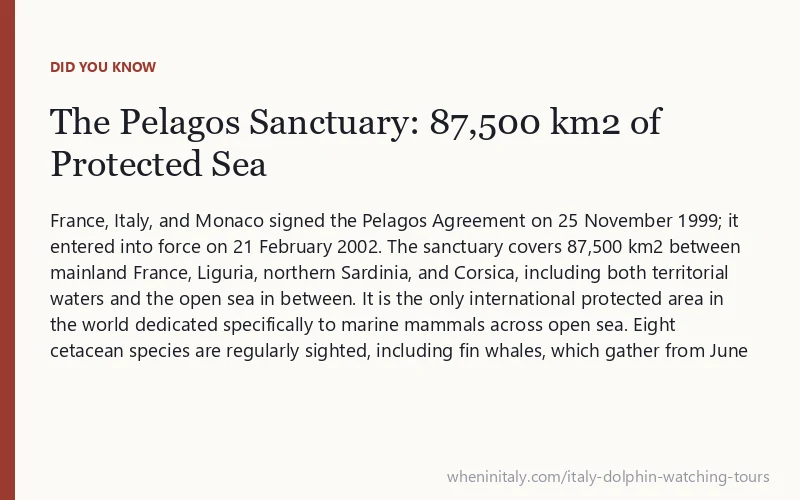
The Pelagos Sanctuary is the only international protected area in the world dedicated specifically to marine mammals across the open sea. France, Italy, and Monaco signed the Pelagos Agreement in Rome on 25 November 1999, and it entered into force on 21 February 2002. The sanctuary covers 87,500 km² of sea between mainland France, Liguria, northern Sardinia, and Corsica, and it includes both territorial waters and the high seas in between.
What makes it special is depth. The Ligurian and Provençal basins drop to more than 2,500 metres within sight of the coast, and the cold, nutrient-rich water that wells up from those canyons feeds dense krill swarms in summer. Krill is what brings the fin whales. The Mediterranean’s resident fin whale population, the only one of its kind outside the Atlantic, gathers in the sanctuary from June through September to feed.
Eight cetacean species are regularly sighted inside Pelagos: fin whale, sperm whale, Cuvier’s beaked whale, long-finned pilot whale, Risso’s dolphin, bottlenose dolphin, common dolphin, and striped dolphin. Striped dolphins account for roughly 70 percent of total sightings in the area, common dolphins around 20 percent, and bottlenose dolphins around 10 percent.
Fin whales are the headline attraction. They are the second-largest animal on Earth after the blue whale, reaching 27 metres in length and weights of around 70 tonnes. The Mediterranean subpopulation is small and threatened: IUCN classifies it as Endangered, with a recent estimate of around 1,700 individuals across the basin and only a few hundred summering inside the Pelagos Sanctuary itself.
Operators inside the sanctuary follow a strict code of conduct enforced under the Pelagos Charter and the ACCOBAMS regional guidelines. The headline rules: no boat closer than 100 metres to a cetacean, maximum approach speed 5 knots, and never approach from in front of or directly behind the animals. Inside the 300-metre observation zone, only one boat at a time is permitted with a group, and engines must be at idle within 100 metres. Swimming with cetaceans is prohibited entirely.
A 2020 study in Frontiers in Marine Science found compliance was inconsistent across sanctuary operators, which is why the High Quality Whale-Watching certification (run in Italy by the CIMA Research Foundation since 2019, with new training rounds in 2026) matters. The label is voluntary, but it is the most reliable signal that a Ligurian operator follows the rules in practice rather than just in marketing copy.
Genoa-area operators (WhaleWatchLiguria from Genova-Pra, Cooperativa Liguria Battello, Costa Victoria Whale Watching) typically run a single 4 to 5 hour morning departure in summer. Sea state matters more here than on Italy’s other coasts because the open Ligurian basin feels conditions from the Gulf of Lion; trips routinely cancel when forecast wave height exceeds about 1.5 metres.
Sardinia: bottlenose dolphins and the Maddalena Archipelago
Sardinia’s dolphin watching is built around resident bottlenose pods rather than seasonal migrants, which changes everything about the experience. Around Olbia, Golfo Aranci, and Figarolo Island, a stable pod has been documented for more than a decade, and operators routinely quote sighting probabilities of around 95 percent in season. That is not a marketing exaggeration; it reflects how predictable the local population is. The Adriatic and northern-Sardinia bottlenose populations are part of the same species (Tursiops truncatus) that an ACCOBAMS-coordinated 2018 to 2019 survey estimated at around 10,350 individuals across Italy’s Adriatic alone.
The standard Sardinia trip is shorter and gentler than the Ligurian one. Boats leave Olbia or Golfo Aranci, head out to Figarolo and Capo Figari (about 30 to 40 minutes offshore), spend an hour or so observing the pod under engine-idle approach rules, then drop anchor in a sheltered cove for snorkelling. A typical itinerary lasts 3 to 4 hours and often includes a Sardinian aperitivo on board.
The Maddalena Archipelago to the north (a national park since 1994) is the more scenic and less dolphin-focused option. Boats from Palau and La Maddalena run combined island-hopping and cetacean-watching itineraries. Bottlenose sightings happen but are not the primary draw; the islands themselves (Spargi, Budelli with its famous pink beach, Santa Maria) carry the trip. This is the better choice for travellers who want a full coastal day with dolphin watching as a bonus rather than the main course.
Cala Gonone on the east coast offers a third Sardinian variation: dolphin watching combined with the Bue Marino caves and the Gulf of Orosei. Striped dolphins appear here alongside bottlenose, and operators occasionally encounter sea turtles (Caretta caretta), which nest on east-coast beaches. Trips run roughly EUR 50 to EUR 90 for a 4-hour group experience.
Sardinia’s season runs from May through October, with June to September the reliable peak. The water stays warm enough for snorkelling stops through late September, which is why Sardinian operators tend to keep running later in the year than their Ligurian counterparts.
Naples Bay and Sorrento: less famous, still reliable
The Bay of Naples and the Sorrento peninsula sit in a marine area less commercialised for cetacean watching than Liguria or Sardinia, which is why the experience feels more personal. Bottlenose dolphins are present year-round around Capri, Procida, and the offshore waters between Naples and Ischia. Striped dolphins appear in summer. Fin whales pass through occasionally on their way to or from the Pelagos Sanctuary feeding grounds.
The Campania trip profile sits between Liguria and Sardinia in length: typically 4 hours, often combined with a Capri or Sorrento coast loop, and frequently run by smaller, family-operated boats. Operators like Genovese Mar Sas in the Sorrento area and Tour Bay of Naples run small-group trips that emphasise observation and marine education rather than volume.
A confronting reminder of why the regulations exist: in 2024 a distressed fin whale calf was filmed repeatedly ramming the seawalls of Sorrento harbour. When divers followed the calf back out to sea, they found its mother dead from a ship strike. The story circulated widely as evidence of why the 100-metre approach limit and the broader vessel-strike-reduction work in the sanctuary matter for a regional population that cannot absorb many losses.
For travellers based on the Amalfi Coast, Naples Bay dolphin watching is the closest serious option, and one of the few Italian coasts where a dolphin-watching trip can plausibly be combined with a coastal city break.
Can I swim with dolphins in Italy? The legal answer
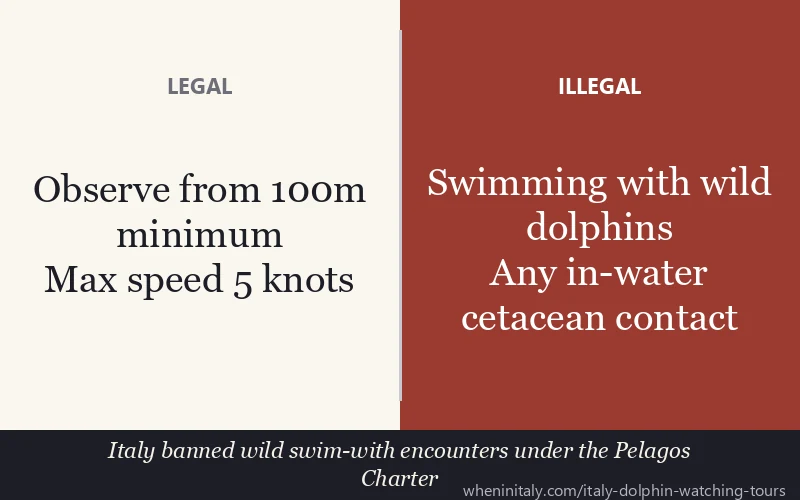
No. Swimming with wild dolphins in Italian waters is prohibited under the Pelagos Sanctuary Charter, the ACCOBAMS regional code of conduct, and Italian implementing regulations. Boats must stay at least 100 metres from any cetacean group, must not approach from in front or directly behind, and must not enter the 300-metre observation zone if another boat is already there. Italy additionally banned swimming with dolphins in captivity in 2018.
The legal framework layers three sources. ACCOBAMS (the Agreement on the Conservation of Cetaceans of the Black Sea, Mediterranean Sea and Contiguous Atlantic Area) sets regional minimum standards adopted by Italy and 24 other parties. The Pelagos Sanctuary trilateral charter (France, Italy, Monaco, in force 2002) adds stricter rules across the 87,500 km² sanctuary, including the no-swim and no-touch provisions and the engine-idle requirement within 100 metres. Italian implementation through ministerial decrees and regional marine-park regulations gives the rules domestic legal force, with violations enforced by the Italian Coast Guard and finable in the EUR 1,200 to EUR 7,200 range.
The rules in plain language: no swimming, no touching, no feeding. Approach speed under 5 knots. No more than one boat at a time within 300 metres of a cetacean group. No approach to mothers with calves, ever. Approach must be parallel to the animals’ direction of travel, never head-on, never from behind.
Operators that advertise “swim with wild dolphins” experiences in Italian waters are operating illegally. There is no permit that allows it; no exception for small groups or for operators claiming a research affiliation. If a tour listing promises in-water contact with wild cetaceans, it is either misleading marketing (the swim happens far from any dolphins) or the operator preparing to break the law on the day. Captive-dolphin facilities like Zoomarine Roma are a separate category under different rules and are not a substitute for a wild encounter.
The legal version is observation from a properly piloted boat at 100 metres or more, watching wild animals in a habitat where many of the species (the Mediterranean fin whale, the common dolphin) are Endangered. That distance is not a compromise. It is the experience.
What to look for in a legitimate operator: the ACCOBAMS High Quality Whale-Watching label (HQWW) is the single most useful filter. Beyond the label, look for a written approach protocol on the booking page, no language about guaranteed sightings, and explicit reference to the 100-metre rule. Operators that contribute observation data to ACCOBAMS or to Tethys Research Institute are typically the most serious about the science.
What you’ll actually see (and your odds of seeing it)
The eight cetacean species regularly recorded inside the Pelagos Sanctuary cover almost the full Mediterranean repertoire: fin whale, sperm whale, Cuvier’s beaked whale, long-finned pilot whale, Risso’s dolphin, bottlenose dolphin, striped dolphin, and common dolphin. Outside the sanctuary, the species mix is narrower but the sighting rates can be higher because the populations are more localised.
Realistic sighting probabilities by coast in season (June to September):
- Pelagos Sanctuary (Liguria): 70 to 90 percent for any cetacean sighting; fin whale specifically around 30 to 50 percent depending on month, with August the peak.
- Sardinia (Olbia, Golfo Aranci, Figarolo): 90 to 95 percent for resident bottlenose pods; striped dolphin and offshore species considerably lower.
- Campania (Naples Bay, Sorrento): 60 to 80 percent for bottlenose; fin whale very rare.
- Adriatic and Apulia: 60 to 75 percent for bottlenose, with the Gulf of Taranto particularly reliable thanks to the large local population (around 6,500 individuals estimated in a 2017 study).
Most reputable Italian operators offer a “free repeat trip” guarantee if no cetacean sighting occurs. The wording matters: a guarantee tied to “any cetacean species” is honest; a guarantee tied specifically to dolphins on a fin-whale itinerary is a hedge. Read the cancellation and re-booking terms before booking.
The species you are statistically most likely to see depends on coast. In the Pelagos Sanctuary, striped dolphin is the most-recorded species at roughly 70 percent of sightings. Common dolphin (despite the name) is now uncommon in the Mediterranean and listed Endangered by IUCN due to historical bycatch in driftnets and ongoing prey decline from overfishing; a confirmed common dolphin sighting is a small event. Risso’s dolphin, the large grey dolphin with extensive scarring from intraspecific tooth rakes, is the most distinctive of the regular species. Cuvier’s beaked whale is the deep-diver of the sanctuary and is rarely seen at the surface for more than a minute or two.
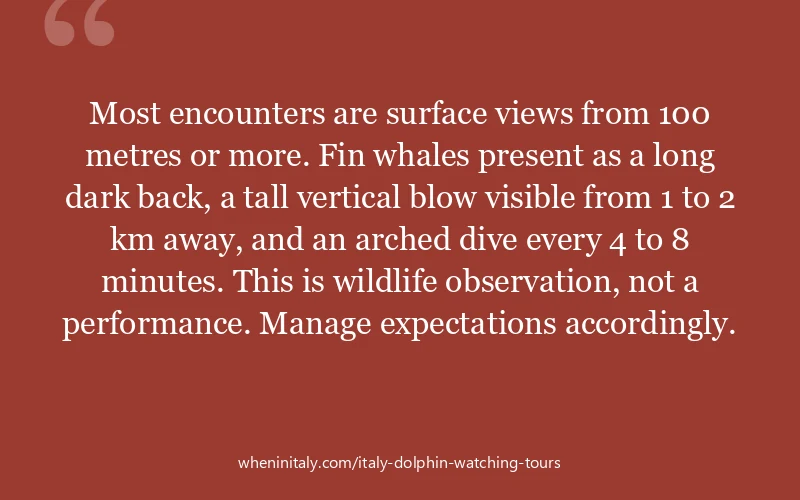
What “seeing” actually looks like: most encounters are surface views from 100 metres or more. Bottlenose pods often approach boats spontaneously and bow-ride, which is permitted under the rules (the prohibition is on the boat approaching the animals, not the reverse). Fin whales typically present as a long dark back, a tall vertical blow visible from 1 to 2 km away, and an arched dive every 4 to 8 minutes. Sperm whale encounters often involve waiting at the surface for 30 to 60 minutes between dives. Manage expectations accordingly: this is wildlife observation, not a performance.
What does it cost in 2026?
A standard 4-hour group dolphin or whale-watching tour in Italy costs EUR 50 to EUR 95 per person in 2026. The price band has moved up roughly 10 to 15 percent since 2022, driven by fuel costs and the gradual professionalisation of the sector under the HQWW programme. The lower end (EUR 50 to EUR 65) covers Sardinia and Campania short trips that stay close to shore. The upper end (EUR 75 to EUR 95) covers Pelagos Sanctuary trips that run further offshore in larger, faster boats.
Full-day trips (7 to 8 hours) with lunch on board run EUR 120 to EUR 200 per person and typically include hydrophone listening, useful for sperm whales (audible at long range) and bottlenose dolphins (whose signature whistles can be identified to individuals). These are concentrated in the Pelagos Sanctuary because that is where the offshore travel time pays back. Private charters for groups of 4 to 8 run EUR 250 to EUR 400 for a half day; the value is flexibility on timing, especially in shoulder season when scheduled departures might cancel for low bookings.
What is usually included: licensed guide or biologist, binoculars, drinking water, sometimes a snack or aperitivo, fuel, and insurance. What is usually not included: hotel transfers, food beyond a snack, and tips for the crew (10 percent is standard if the trip went well).
Pricing red flags: trips below EUR 40 for a 4-hour itinerary are usually compromised (oversold capacity, very short actual sea time, a generic coastal cruise marketed as dolphin watching). Trips above EUR 100 for a standard group itinerary should include something specific (small-group cap, named biologist, full-day with lunch) to justify the premium. Peak summer departures (mid-July to late August) sell out a week or two ahead in Liguria and around Olbia. Shoulder-season trips (May, October) are easier to book late but more vulnerable to weather cancellation; operators typically refund or rebook if they cancel for sea state above 3 (waves above ~1.5 metres).
Best season, with kids, what to bring
The window that works for Italian dolphin watching is April to October, with the reliable peak from June through September. Sea temperatures rise from around 18°C in spring to a stable 24 to 25°C through July and August, the period when plankton blooms support the prey-fish populations that draw cetaceans inshore. Across the Mediterranean, observation success rates in summer reach around 85 percent versus around 45 percent in winter, which is why most commercial operators close from November to March.
By coast: the Pelagos fin whale season concentrates in July and August. Sardinia’s resident bottlenose are active year-round but the comfortable trip window runs May to October. Campania is similar.
For families, dolphin watching works well with kids aged 6 and up. Younger children often struggle with the combination of 4 hours on a boat, sun exposure, and the engine-idle drift periods near a pod (when seasickness peaks). The Sardinian short trips with snorkelling stops are the easiest entry point for younger children: shorter duration, more time at anchor, less open-sea exposure.
What to bring on every trip:
- SPF 50+ sunblock, applied before boarding and reapplied every 90 minutes (sea-surface reflection roughly doubles UV exposure)
- Wide-brimmed hat with a chin strap (Mediterranean afternoon wind takes hats overboard regularly)
- Polarised sunglasses (cuts surface glare and dramatically improves cetacean spotting at distance)
- At least 1.5 litres of water per person (operators usually provide some but rarely enough)
- Light long-sleeved layer or windbreaker (offshore wind chills even in August)
- Motion-sickness medication taken 30 to 60 minutes before departure
- Closed shoes or grip-soled sandals; flip-flops are dangerous on wet decks
- Camera with at least a 200mm equivalent zoom if photographs matter (phone cameras struggle at the 100-metre minimum)
Accessibility: many larger catamaran operators in the Pelagos Sanctuary and around Olbia are wheelchair-accessible at port and on deck, but embarkation varies by harbour. Verify with the operator before booking. Drone photography from a boat to a cetacean is prohibited under the Pelagos rules and most operators will not allow it.
The realistic frame: this is wildlife observation, weather-dependent, and the sea has the final vote. The reward for accepting that frame is one of the few experiences in Italy where the headline animals are wild, the numbers are real, and the rules of engagement actually protect the species being observed.
Sources and references
- Pelagos Sanctuary — official site (sanctuary description, agreement details, code of conduct): https://pelagos-sanctuary.org and https://pelagos-sanctuary.org/pelagos-agreement/
- Pelagos Sanctuary Code of Good Conduct (approach distances, speed limits): https://www.sanctuaire-pelagos.org/en/raising-awareness/code-of-good-conduct
- ACCOBAMS High Quality Whale-Watching Certificate (programme overview): https://accobams.org/main-activites/high-quality-whale-watching-certificate/
- ACCOBAMS Guidelines for the Management of Cetacean-Watching Activities (2023): https://accobams.org/wp-content/uploads/2023/08/GL_Management-of-cetacean-watching-activities-in-the-ACCOBAMS-area.pdf
- CIMA Research Foundation — HQWW Italy training, including 2026 schedule: https://www.cimafoundation.org/en/news/hqww-training-2026-strengthening-the-sustainable-whale-watching-network-in-italy/
- IWC Whale Watching Handbook — Italy country profile: https://wwhandbook.iwc.int/en/country-profiles/italy
- IUCN Red List — Mediterranean fin whale subpopulation (Endangered classification): https://iucn.org/blog/202602/mediterranean-fin-whale-greyhound-seas
- Tethys Research Institute — Pelagos Sanctuary species and research overview: https://tethys.org/activities-overview/conservation/pelagos-sanctuary/
- WWF Mediterranean — Pelagos Sanctuary: https://www.wwfmmi.org/what_we_do/wildlife/the_pelagos_sanctuary/
- Frontiers in Marine Science (2020) — Whale Watching in the Pelagos Sanctuary: Status and Quality Assessment: https://www.frontiersin.org/journals/marine-science/articles/10.3389/fmars.2020.596848/full
- ACCOBAMS bottlenose dolphin Adriatic abundance survey (2018–2019): population context for Tursiops truncatus in Italian waters
- Bearzi et al., Common dolphin (Delphinus delphis) Inner Mediterranean subpopulation IUCN assessment (2021): https://www.researchgate.net/publication/358003856
- Ligurian Sea Cetacean Sanctuary — Wikipedia (background reference): https://en.wikipedia.org/wiki/Ligurian_Sea_Cetacean_Sanctuary
- Italian regulatory framework — captive cetacean swim ban (2018), Italian Coast Guard enforcement of marine protected area regulations