TL;DR
- Cagliari’s walkable historic core fits inside four medieval quarters (Castello, Stampace, Marina, Villanova) and the Castello hilltop is roughly 0.3 km of dense sights you can cover in a half day.
- The defining viewpoint is the Bastione di Saint Remy, a 30-metre neo-classical terrace built into the medieval walls between 1899 and 1902, free to access at any hour and reached either by 170 steps from Piazza Costituzione or by a public elevator (operating intermittently during the ongoing 2025-2026 restoration of the bastion).
- “Underground Cagliari” is not one site but a circuit: the Salesian school WWII tunnel-shelter, the Crypt of Santa Restituta, and the Sant’Eulalia archaeological area below the Marina church. Combined guided walks run about 2 hours and start from EUR 30 per person on the major operator platforms.
- The Roman Amphitheatre remains closed to public visits in 2026, with the EUR 4 million PN Metro Plus restoration project financed but the executive design still under contract; the city’s own published horizon for partial reopening is 2026 to 2029.
- Festa di Sant’Efisio falls on 1 to 4 May 2026 (the 370th edition of a vow first paid in 1657) and pulls roughly 3,000 costumed marchers and 172 horsemen through the streets, so accommodation in the city centre books out months before.
- For cruise passengers stepping off the Marina-side terminal, plan a 6-hour loop: Via Roma to Piazza Yenne, up through Castello for the cathedral and one tower, down via the Bastione, lunch in the Marina, one underground site if time allows. Skip Tuvixeddu and the beach unless you have a full day.
Cagliari at a glance: Castello on the hill, Marina at the sea
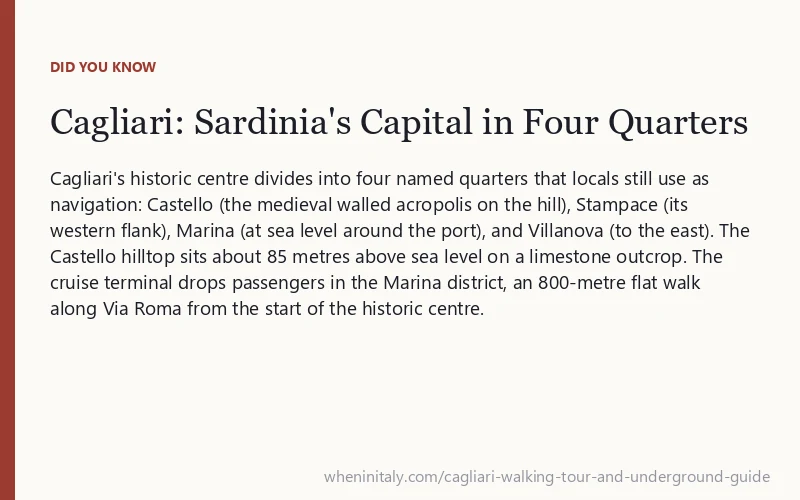
Cagliari is Sardinia’s capital and the island’s largest city, perched on the southern coast around the Gulf of the Angels. Its historic centre is a four-quarter mosaic that locals still navigate by name: Castello is the walled medieval acropolis on the hill, Stampace drops down its western flank, Marina lies at sea level around the port, and Villanova sits to the east. That geography matters for visitors. The cruise terminal lands you in the Marina district, an 800-metre flat walk along Via Roma to Piazza Matteotti, after which the Castello district begins climbing sharply uphill on cobblestones and stairs.
For the cruise passenger with a 6-to-8-hour port stop (Cagliari hosts dozens of Costa, MSC, Royal Caribbean and Norwegian calls each year), the practical loop is Marina to Castello to Bastione to Marina again, with one underground site bolted on. For someone flying in for two or three nights, the city expands outward: the Mercato di San Benedetto for a morning, the 8-kilometre Poetto beach for a late afternoon, the Necropoli di Tuvixeddu for an archaeological half-day, and a day trip south to the Phoenician-Roman ruins at Nora.
The whole historic core is genuinely walkable. The catch is the gradient. Castello sits about 85 metres above sea level on a limestone outcrop, and there is no graceful flat route to the top: you climb, you take the public elevator at the Bastione, or you ride bus #C up the hill.
The Castello quarter: Pisan-Romanesque cathedral, two medieval towers, the archaeological museum
Castello (or “Su Casteddu” in Sardinian) is the medieval walled quarter the Pisans laid out from 1217 onwards and the Aragonese later inherited. It crowns the hill at roughly 85 metres above sea level, and its sights are concentrated in a footprint of about 0.3 square kilometres. Three landmarks anchor any visit.
The Cattedrale di Santa Maria was built in the 13th century in Pisan-Romanesque style and elevated to cathedral rank in 1258. Its history is a stylistic palimpsest: the original Romanesque interior was largely erased by a Baroque overhaul ordered in 1669 and finished by 1704, when architect Pietro Fossati gave it a Baroque facade. That facade was demolished in the early 1900s by superintendent Dionigi Scano in the hope of recovering the medieval church beneath. Nothing usable was found, and the cathedral stood without a facade for roughly twenty years until 1930, when architect Francesco Giarrizzo built the current neo-Romanesque-Pisan facade in pietra forte limestone from the Bonaria quarries. The result is a 13th-century church wearing a 20th-century medieval mask. It works.
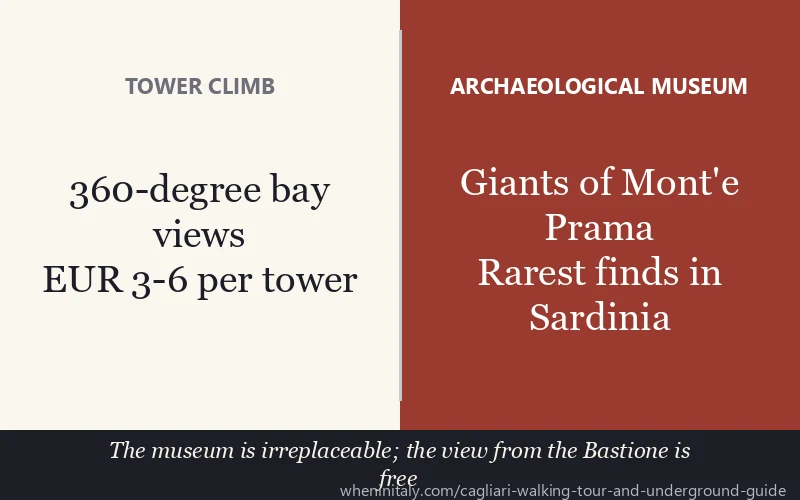
The two medieval towers are the work of one Sardinian architect, Giovanni Capula, commissioned by the Pisan colonial administration. Torre di San Pancrazio (1305) is the older, marked by an entrance epigraph that calls Capula “architector optimus.” Torre dell’Elefante (1307) takes its name from a small carved elephant on its flank. Both are open for climbs and both deliver the standard reward of an old-town tower: a 360-degree view across rooftops, walls, and the bay.
The third anchor is the Museo Archeologico Nazionale, which houses the most comprehensive collection of Sardinian Nuragic civilization artefacts anywhere on the island. Bronze Age figurines, ceramics, and the famous Giants of Mont’e Prama (the colossal stone warriors found near Cabras) are the headline pieces. For visitors who only have a few hours and have to choose between climbing a tower and entering the museum, the museum is the rarer experience: Nuragic Sardinia is unique to this island, and there is no second-best collection.
Walking the rest of Castello takes another hour: Palazzo Reale (the former viceregal seat), Palazzo di Città (the old town hall, now a municipal museum), the Citadel of Museums complex, and the lanes themselves, narrow enough that two pedestrians can barely pass.
Bastione di Saint Remy: the 30-metre terrace built into the medieval walls
The Bastione di Saint Remy is the single image most people carry away from Cagliari. It is a panoramic terrace built between 1899 and 1902 by architects Giuseppe Costa and Fulgenzio Setti in neo-classical style, attached directly to the medieval city walls of Castello and projecting outward as a roughly 30-metre-high platform above Piazza Costituzione. The bastion is free to access at any hour and is the most reliable photo location in the city. Late afternoon and sunset send the light west across the Gulf of Cagliari, lighting up the white limestone of the bastion itself.
There are three ways up. The classical approach is the elegant double staircase of white marble that climbs from Piazza Costituzione, around 170 steps in total. The convenient approach is the public elevator from the same square, which is free but currently subject to the bastion’s ongoing 2025-2026 restoration works (which include the addition of a new elevator for the covered promenade and another between Viale Regina Elena and the upper terrace). Visitors who care about elevator access should check status with the Comune di Cagliari tourism office or the Cagliari Turismo site on the morning of their visit; the queue at the existing single elevator runs long during peak cruise hours regardless. The third option is to walk down through Castello after a museum or tower visit, exiting through the bastion as the route’s grand finale.
The bastion hosts weekend artisan markets, summer jazz and book festivals, and occasional municipal events. Below the terrace sits the WWII air-raid shelter known as the Rifugio antiaereo del Bastione (Don Bosco shelter), a stretch of underground tunnels carved into the rock and opened to guided visits in the mid-2010s. This is why some operators package “Bastione + Underground” as one product: the geography is literally vertical.
The underground complex: Roman cisterns, Cripta di Santa Restituta, WWII shelters
Under “Underground Cagliari” sits a small constellation of separately managed sites (early Christian crypts, Punic and Roman cisterns, 19th-century military galleries, and 20th-century air-raid shelters) that share a city but not a ticket office. Visitors confused by this are not alone; even local guides explain the geography first before pricing.
The main individually-bookable sites are:
- Cripta di Santa Restituta in the Stampace district, an early Christian crypt built into a natural cave that earlier served as a Punic-Roman cistern. Independently ticketed at around EUR 5.
- Roman cisterns under the Bastione, ancient water-storage tanks dating to Punic and Roman times, frequently visited as part of the bastion’s underground tour.
- Rifugio antiaereo del Bastione (Don Bosco WWII shelter), a 200-metre stretch of bomb-shelter tunnels carved beneath Piazza Costituzione, opened to guided visits circa 2015 to 2020. Combined ticket with Galleria Pio IX runs around EUR 5 to EUR 8.
- Galleria Pio IX in Castello, a Bourbon-era 19th-century military gallery that also retained WWII-era equipment. Around EUR 5 standalone.
- Galleria Rifugio dei Salesiani, a 120-metre tunnel under the Salesian school in Stampace, used as a public bomb shelter during the 1943 bombings. Frequently the first stop on combined tours.
- Sant’Eulalia archaeological area, 900 square metres of Roman-era street, walls, and foundations excavated under the church of Sant’Eulalia in the Marina district. The Museum of the Treasury sits above.
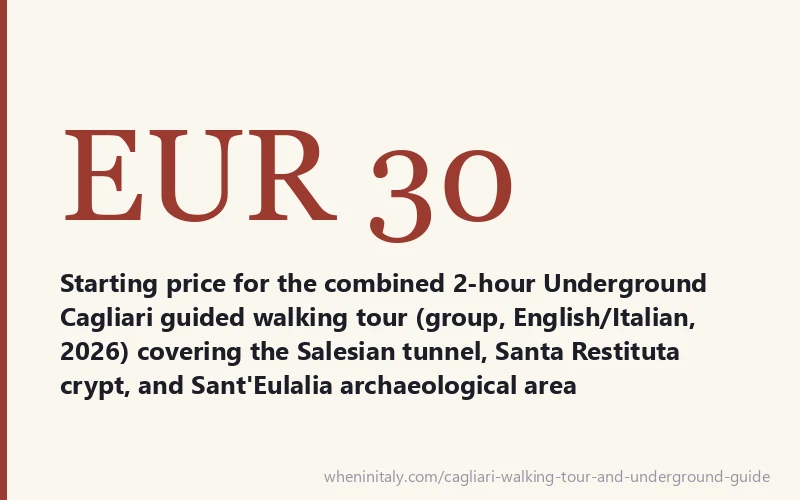
The combined “Underground Cagliari Walking Tour” sold by the major platforms (GetYourGuide, Civitatis, and others) typically takes about 2 hours and visits a curated subset (most often the Salesian tunnel-shelter, the Crypt of Santa Restituta, and the Sant’Eulalia archaeological area) for a starting price of around EUR 30 per person in 2026. Languages are usually English and Italian. Smaller-group or private versions push the price higher; pure self-guided ticketing of two or three sites separately can land closer to EUR 15 to EUR 20 total but loses the historical narration that is the actual product.
The honest opinion: the underground sites are interesting individually but unevenly so, and the guide’s narration is the value. Self-guided visitors will see chambers without the context of who dug them and why, which flattens the experience. For a single visit, the combined guided walk is the sensible choice.
The Marina, the food market, and the cruise-stop reality
Marina is the port-facing district and the first ground a cruise passenger touches. The walk from the cruise terminal to Piazza Matteotti (the natural threshold of the historic centre) runs around 800 metres along Via Roma, flat, paved, lined with palm trees and arcaded shops, and accomplished comfortably in 10 to 15 minutes. From Piazza Matteotti the Castello hill is directly above and to the north; the Marina district itself stretches east along the port behind Via Roma’s first row of buildings.
The Marina’s signature attraction is the Mercato di San Benedetto, the largest covered food market in Sardinia, which spreads over roughly 8,000 square metres on two floors of about 4,000 square metres each and hosts around 300 vendors. The ground floor is the fish hall, where many sellers are themselves the fishermen who landed the morning’s catch from the Gulf of Cagliari. The upper floor has produce, meats, cheeses, breads, and the local sweets. Standard hours are Monday through Saturday, 07:00 to roughly 14:00, closed all day Sunday. (The market has been undergoing structural restoration works since March 2025; visitors should verify the current configuration before walking out of their way.)
The 6-hour cruise-stop itinerary that actually works: off the ship, walk Via Roma to Piazza Yenne (15 minutes); climb to Castello via Stampace (20 minutes uphill); cathedral and one tower (45 minutes); the Museo Archeologico for a fast loop (45 minutes); descend through the Bastione di Saint Remy (30 minutes including photos); one underground site or the food market (60 to 90 minutes); a sit-down lunch in the Marina (75 minutes). That spends six hours and brings you back to the ship with twenty minutes of cushion. What to skip on a port stop: the Necropoli di Tuvixeddu (it is a 30-minute walk from the centre and rewards an unhurried hour), the Roman Amphitheatre exterior (closed and underwhelming from outside in 2026), Poetto beach (the bus is fine, the beach is good, but it costs you the city centre).
What is the Sant’Efisio festival and when is it?
The Festa di Sant’Efisio takes place every year from 1 to 4 May, with the main procession on 1 May. The 2026 edition is the 370th, an unbroken count from 1657. The festival fulfils a public vow made by the city authorities of Cagliari on 11 July 1652, after a plague had killed thousands in the city, promising the saint an annual procession in exchange for protection. The first procession took place in May 1657; the practice has continued every year since, including through war and pandemic.
The procession carries the wooden simulacrum of the saint from the church of Sant’Efisio in Stampace to the small church at Nora (a Phoenician-Roman site about 40 km southwest of Cagliari) and back over four days. The 1 May leg through Cagliari draws roughly 3,000 marchers in traditional costumes representing the historical Sardinian sub-regions of Gallura, Ogliastra, Sulcis, Logudoro, and Barbagia, and 172 horsemen divided into the Campidanesi, Miliziani and Guardiania groups. Crowds in the city run into the tens of thousands. It is one of the largest religious processions in Italy and the single most concentrated display of Sardinian folk costume anywhere.
For visitors, two practical notes. First, accommodation in the historic centre books out months before May for the festival window; arrive earlier or stay outside the centre. Second, the procession route closes streets for hours, so arrival and departure logistics on 1 May should account for that. The reward is a piece of living religious history that has run uninterrupted since the 17th century.
What does a Cagliari walking tour cost in 2026?
Cagliari is small enough to walk for free, and the city signs its main routes well; a self-guided walker with a phone and a half day can hit the four quarters, the Castello cathedral, both towers (climb fees apply), and the Bastione di Saint Remy at no cost beyond museum and tower tickets. The paid guided market in 2026 looks roughly like this:
- Combined Underground Walking Tour (Salesian tunnel + Santa Restituta + Sant’Eulalia or similar selection, 2 hours, group, English/Italian): from EUR 30 per person on the major platforms.
- Standalone underground sites (Cripta di Santa Restituta, Galleria Pio IX, Don Bosco shelter, individually): around EUR 5 to EUR 8 each.
- Bastione + Roman cisterns (often packaged): around EUR 10 to EUR 15 depending on operator.
- Castello walking tour (city centre, 2 hours, no underground): around EUR 20 to EUR 30 group, EUR 60 to EUR 90 small-group.
- Food and market tour (Mercato di San Benedetto with tastings, 2.5 to 3 hours): around EUR 50 to EUR 90 depending on inclusions.
- Half-day private guided tour (city centre + underground, custom): around EUR 100 to EUR 200 total for the guide, regardless of group size up to typical limits.
- Full-day private with driver and Nora day trip: from around EUR 250 upward.
Tower climbs (Torre dell’Elefante, Torre di San Pancrazio) and the Museo Archeologico Nazionale carry separate admission, in the EUR 3 to EUR 9 range each. Confirm site-by-site with the Comune di Cagliari cultural sites office or the Cagliari Turismo portal before relying on a price for budgeting.
Best time, with kids, beyond the city walls
The sweet spot for visiting Cagliari is April to early June and September to October, when daytime highs sit in the 20s Celsius, sea temperatures are swimmable from May, and the worst summer crowds and heat are avoided. August in Cagliari touches 35 C with regularity and turns the city centre into a slow-motion endurance test; cruise passengers will manage but independent travellers should not pick August unless the itinerary demands it. Winter (November to March) is mild by Italian standards (highs typically 14 to 17 C) and quiet, with the trade-off that some cultural sites trim hours.
With kids, Cagliari does well. The Castello walk has natural reward stops: the cathedral interior is a quick win, the tower climbs are a physical challenge older children enjoy, and the Bastione delivers the photo and the ice cream at the top. The Mercato di San Benedetto is a pure spectacle for kids who like watching unfamiliar food (octopus, sea urchin, whole fish on ice). The underground tours can be either hit or miss depending on temperament: cool, narrow, dim spaces work for some children and not others. Poetto beach is the universal kid-fix: 8 km of white sand, public sections free, beach clubs with chairs and umbrellas at standard Italian summer rates, and bus PF from Piazza Matteotti runs every 20 minutes for EUR 1.30 one way, taking 15 to 20 minutes.
Beyond the city walls, three options reward an extra day:
- Necropoli di Tuvixeddu, the largest Punic necropolis in the Mediterranean, with around a thousand shaft-and-chamber tombs cut into limestone across roughly 18 hectares of one of Cagliari’s seven hills. Used from the 6th to the 3rd century BCE. Open year-round since 2014 as an archaeological park, and free.
- Poetto beach, 8 km long from the Sella del Diavolo headland east into the Quartu Sant’Elena municipality. Bus PF from Piazza Matteotti, 15 to 20 minutes, EUR 1.30.
- Nora, a Phoenician-Roman archaeological site about 40 km southwest along the coast, with a Roman theatre, mosaics, and a tied-in beach. The destination of the Sant’Efisio procession on 2 May. A drive or a guided day trip from Cagliari.
The Roman Amphitheatre of Cagliari (Anfiteatro Romano), originally a 1st-to-2nd-century structure cut into the rock at the western edge of the historic centre, remains closed to the public in 2026. A EUR 4 million PN Metro Plus 2021-2027 restoration project is funded but as of early 2026 the executive design contract was still being finalised, with the city’s own published horizon for partial reopening set between 2026 and 2029. Promises of a 2025 partial reopening were not met. For now, the amphitheatre is a perimeter-only sight, visible from the Viale Sant’Ignazio side. Travellers attached to seeing it should keep expectations modest and prioritise the rest of the city.
Sources
- Comune di Cagliari, official site for Anfiteatro Romano: https://www.comune.cagliari.it/portale/page/it/anfiteatro_romano
- Comune di Cagliari, Mercato civico San Benedetto: https://www.comune.cagliari.it/portale/page/it/mercato_civico_san_benedetto
- Comune di Cagliari, Torre di San Pancrazio: https://www.comune.cagliari.it/portale/page/it/torre_di_san_pancrazio
- Comune di Cagliari, Torre dell’Elefante: https://www.comune.cagliari.it/portale/page/it/torre_dellelefante
- Comune di Cagliari, Parco di Tuvixeddu: https://www.comune.cagliari.it/portale/page/it/parco_di_tuvixeddu
- Cagliari Turismo, Bastione di Saint Remy: https://cagliariturismo.comune.cagliari.it/en/vivicagliari/saint-remy-bastion
- Cagliari Turismo, Underground Cagliari: https://cagliariturismo.comune.cagliari.it/en/percorsi/underground-cagliari
- Cagliari Turismo, Saint Mary Cathedral and Bell Tower: https://cagliariturismo.comune.cagliari.it/en/vivicagliari/saint-mary-cathedral-and-bell-tower
- Cagliari Turismo, 370th Feast of Saint Efisio: https://cagliariturismo.comune.cagliari.it/en/events/370th-feast-saint-efisio
- Festa di Sant’Efisio, official site: https://www.festadisantefisio.it/
- Sant’Efisio Martire 2026 program: https://santefisiomartire.it/en
- SardegnaTurismo, Bastione Saint Remy: https://www.sardegnaturismo.it/it/esplora/bastione-saint-remy
- SardegnaTurismo, Torri di San Pancrazio e dell’Elefante: https://www.sardegnaturismo.it/it/esplora/torri-di-san-pancrazio-e-dellelefante
- SardegnaTurismo, Necropoli di Tuvixeddu: https://www.sardegnaturismo.it/it/esplora/necropoli-di-tuvixeddu
- SardegnaTurismo, Duomo di Cagliari: https://www.sardegnaturismo.it/it/esplora/duomo-di-cagliari
- Soprintendenza ABAP Cagliari, Torre dell’Elefante: https://www.sabapca.beniculturali.it/it/337/siti-e-monumenti/4860/cagliari-torre-dell-elefante
- Ministero della Cultura, Anfiteatro Romano di Cagliari: https://cultura.gov.it/luogo/anfiteatro-romano-di-cagliari
- CagliariToday, 2026 status of the Roman Amphitheatre restoration: https://www.cagliaritoday.it/cronaca/anfiteatro-romano-polemica-apertura-visite-2026.html
- ANSA, Anfiteatro Romano future timeline (December 2024): https://www.ansa.it/sardegna/notizie/2024/12/16/tra-due-anni-gli-spettacoli-allanfiteatro-romano-di-cagliari_f9ceba7d-b6a8-486b-8c12-7a0b84a5c7bb.html
- Wikipedia, Cattedrale di Santa Maria (Cagliari): https://it.wikipedia.org/wiki/Cattedrale_di_Santa_Maria_(Cagliari)
- Wikipedia, Festa di sant’Efisio: https://it.wikipedia.org/wiki/Festa_di_sant’Efisio
- Wikipedia, Necropoli di Tuvixeddu: https://it.wikipedia.org/wiki/Necropoli_di_Tuvixeddu
- Wikipedia, Bastione San Remy: https://it.wikipedia.org/wiki/Bastione_San_Remy
- Treccani, Giovanni Capula entry: https://www.treccani.it/enciclopedia/giovanni-capula_(Enciclopedia-dell’-Arte-Medievale)/
- Cagliari Cruise Port, San Benedetto Market: https://cagliaricruiseport.com/top-attractions/san-benedetto-market/
- GetYourGuide, Cagliari Underground Walking Tour listing: https://www.getyourguide.com/cagliari-l820/cagliari-underground-cagliari-walking-tour-t213225/
- Civitatis, Cagliari Underground Tour: https://www.civitatis.com/en/cagliari/underground-tour/