Key Takeaways
- La Scala is two visits in one. The Museo Teatrale alla Scala daytime ticket runs EUR 12 to 15 and includes a peek into the auditorium from a box; an evening opera, ballet, or concert is a separate ticketed performance running from EUR 13 in standing room to EUR 3,000 for a Sant’Ambrogio premiere seat.
- The cheapest legitimate way into a La Scala performance is the posto in piedi (standing ticket) at EUR 13, sold day-of-performance at the box office on Via Filodrammatici. Bring photo ID, queue before 13:00, and prepare to stand for three to four hours.
- The official season opens every year on 7 December (Sant’Ambrogio Day). The 2025 opener was Shostakovich’s Lady Macbeth of the Mtsensk District under Riccardo Chailly. The 2026/2027 opener will be announced in late summer 2026.
- Dress code was re-enforced in July 2025: tank tops, shorts, and flip-flops will get you turned away with no refund. Black tie is expected only for the 7 December premiere; “elegant” attire (dark suit, cocktail dress) is the norm for regular evenings.
- Museum hours are 09:30 to 17:30 daily with last entry at 17:00, closed on 1 January, Easter, 1 May, 15 August, and 7, 25, and 26 December. The auditorium-box view is closed when the orchestra is rehearsing, so weekday mornings are the safer slot.
- Last-minute tickets are released two hours before each performance online (one hour before at the box office) at up to 25 percent off; under-26 students, under-18s, and over-65s qualify for a separate “GSA” tariff of up to 20 percent off Monday through Thursday.
The two ways to visit La Scala: museum vs opera night
There are two completely different La Scala visits, and most travellers conflate them until they reach the box office. The daytime visit is the Museo Teatrale alla Scala: a EUR 12 fixed-date ticket (EUR 15 for the open, fast-track version), about 75 to 90 minutes inside the museum rooms with a view down into the auditorium from a box when no rehearsal is running. No dress code. Children 6 and under enter free. The evening visit is an actual performance: opera, ballet, or symphonic concert, three to four hours long, requiring an advance ticket from EUR 13 standing all the way up to several thousand euro for the December premiere, with a dress code that the theatre re-tightened in 2025.
Pick by the trip you are running. A morning museum stop slots cleanly between the Duomo and an aperitivo in Brera and costs about the same as a museum elsewhere in Milan. An evening performance is a planned event, normally booked weeks ahead, and dominates the rest of your day, since most curtains rise at 19:30 or 20:00 and Milan’s metro stops running around 00:30.
If your itinerary cannot accommodate the evening, the museum visit is not a consolation prize. It is the standard way most Milan visitors experience the building, and the auditorium-box view, when available, is the photograph people come for.
The museum visit: what’s actually inside the Museo Teatrale
The Museo Teatrale alla Scala was founded in 1913 inside the Casino Ricordi, the building immediately adjacent to the theatre. It traces 240 years of opera, ballet, and orchestral music through paintings, sculptures, costumes, set sketches, and personal objects. The collection is denser than its compact footprint suggests. Plan 60 to 90 minutes if you read labels.
Highlights to look for:
- Franz Liszt’s Steinway piano, on permanent display. (Verdi-related artefacts are present too, but the piano in the famous photograph is Liszt’s, not Verdi’s. A common confusion in English-language travel writing.)
- Conductor batons used by Toscanini, alongside batons of Victor de Sabata and other twentieth-century maestros. Toscanini’s annotated scores and conducting photographs are some of the museum’s most-visited cases.
- Maria Callas costumes, photographs, and personal items. Callas occupies an outsized share of the modern collection; the set built around her career is the museum’s pop-culture anchor.
- Verdi and Puccini portraits, busts, and personal effects, including manuscripts and letters.
- Historic set sketches and stage models from premieres of works that defined the canon.
The room most visitors are actually here for is the box overlooking the auditorium. This is normally one of the side boxes (the Palco Reale and adjacent boxes rotate availability). It is where you get the gilded-and-red horseshoe view that has been photographed millions of times. The catch: when the company is mid-rehearsal in the auditorium, the box view is closed to the museum to avoid disturbing the musicians. Weekday mornings, especially Mondays and Tuesdays, statistically have the best odds. Saturday afternoons and pre-premiere weeks have the worst. The museum staff at the entrance will tell you on the day whether the box is open.
Photography in the museum is allowed without flash. Photography during a performance is forbidden, including during intervals once the lights go down. Museum hours are 09:30 to 17:30 daily, last entry 17:00, closed 1 January, Easter, 1 May, 15 August, and 7, 25, and 26 December. On 24 and 31 December last entry moves up to 14:30.
Opera tickets in 2026: the official site, the lottery, and the EUR 13 standing-room secret
There is exactly one safe place to buy La Scala performance tickets: teatroallascala.org, the official site. Anything else, including the high-volume reseller sites that rank above the official one in Google for premiere dates, charges a markup that runs from 30 percent to several hundred percent. The Teatro alla Scala Box Office is at 1 Largo Ghiringhelli, open Monday to Saturday 12:00 to 18:00 (collection and same-day sales open two hours before each performance).
Season shape. The official season runs December through July on the opera-and-ballet side, with the symphonic and concert programme stretching the calendar into autumn. The 2025/2026 season runs ten opera titles plus two complete cycles of Wagner’s Ring, seven ballet productions, and the full concert series. Highlights still ahead in 2026 include Wagner’s Das Rheingold on 1 and 10 March, Puccini’s Turandot, Lucia di Lammermoor (26 June to 17 July), La traviata (19 September to 15 October), and Giselle (1 to 23 October).
When tickets go on sale. Single tickets typically open about two months before each performance date. The most desirable evenings (premieres, gala nights, big-name conductors) are also distributed via subscriptions and carnets that sell first, so by the time singles open, the best Platea seats are often gone. Setting a calendar reminder for the public sale day pays off.
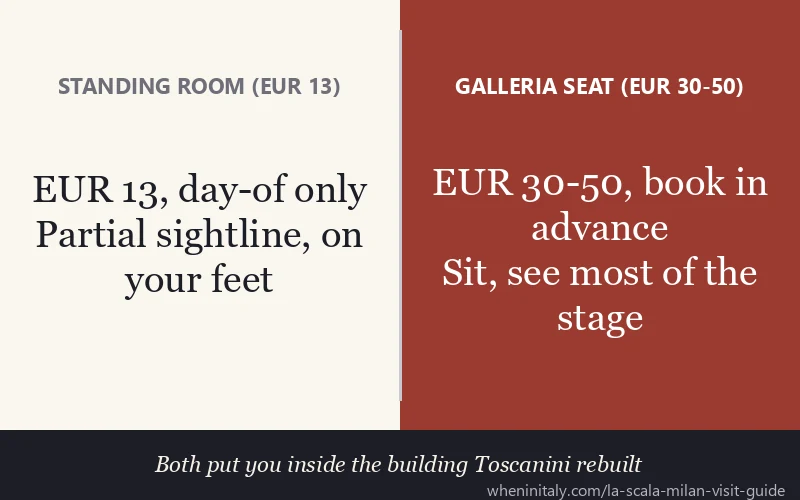
Price ranges. Outside of Sant’Ambrogio, a typical opera evening runs roughly EUR 30 to 50 for upper galleries, EUR 80 to 150 for mid-tier, and EUR 200 to 350 for Platea (orchestra) seats. Ballet skews 20 to 30 percent cheaper than opera. Concerts cheaper still. The sweet spot for first-time visitors is a Galleria seat (top tier): you sit, you see most of the stage, and you spend less than dinner across the road in the Galleria Vittorio Emanuele.
The EUR 13 posto in piedi. This is the locals’ answer and, frankly, the right answer for most first-time opera-goers. La Scala sells a fixed allocation of standing-room gallery tickets (around 140) on the day of each performance, EUR 13, at the box office on Via Filodrammatici. You must show photo ID and you must be there in person. Queue forms in the late morning; arriving by 11:00 is safe for ordinary weekday performances, earlier for Saturdays and any premiere or star-billing date. You stand for three to four hours and the sightline is partial, but you are inside the building hearing the orchestra Toscanini conducted, and you have spent less than a Negroni at Camparino.
Last-minute discounts. Online from two hours before curtain (one hour before at the box office), unsold seats discount up to 25 percent. Separately, the GSA tariff (Giovani, Studenti, Anziani) offers up to 20 percent off all categories except gallery standing for under-18s, students under 26, and over-65s, valid Monday through Thursday and excluding the Prima, A, B, P, and R subscription series and special projects. The Under30/35 Pass costs EUR 10 and unlocks subscription discounts up to 65 percent, dedicated preview shows, and rehearsal invitations. If anyone in your party is under 35, the pass usually pays for itself on a single evening.
Sant’Ambrogio and “La Prima”: the world’s most prestigious opera premiere
7 December is the feast day of Sant’Ambrogio, Milan’s patron saint, and it is also the night the city stops working. La Prima della Scala (the first night of La Scala) is the season’s opening performance and, by reputation, the most prestigious opera evening on the planet. Italian state TV broadcasts it live. Heads of state, the Italian president, fashion-house principals, and the city’s industrial families all attend. Outside the theatre, demonstrators and well-wishers gather around the cordon. Inside, the auditorium has been polished for months.
The 2025 opener was Shostakovich’s Lady Macbeth of the Mtsensk District, conducted by music director Riccardo Chailly with staging by Vasily Barkhatov. Recent openers have included Verdi’s La forza del destino (2024), Verdi’s Don Carlo (2023), and Boris Godunov (2022). The 2026/2027 season opener is announced by the theatre in late summer 2026.
Getting in is genuinely hard. A significant share of the auditorium is allocated to invitations, diplomatic protocol, sponsor seats, and standing subscriptions. What does reach public sale clears in minutes once it opens, with top-tier seats reaching close to EUR 3,000 face value. The standing-room EUR 13 tickets exist for La Prima too, but the queue starts the previous evening and locals camp out. If you want to attend on first attempt, a regular performance later in the season is a vastly better target. If you simply want to be in Milan for the social event, sit at Bar Camparino in the Galleria Vittorio Emanuele from late afternoon, watch the cars and gowns arrive, and have dinner at a restaurant whose terrace faces Piazza della Scala.
What is the dress code for La Scala?
For the daytime museum, there is no dress code. Wear what you would wear to any other museum.
For an evening performance, the dress code is “elegant,” which the theatre formalised in July 2025 after years of looser enforcement. Specifically banned: tank tops, shorts, flip-flops, and any beachwear. Spectators arriving dressed inappropriately are turned away at the door with no refund. A “rules of conduct” sign now sits at the entrance, and the warning is printed on every ticket.
What works on a regular weekday opera night:
- Men. Dark suit with tie is the safe baseline for Platea and Palchi (boxes). Jacket plus collared shirt without tie is acceptable in the Galleria (top tier). Shoes must be closed; sneakers technically pass for standing-room but draw looks in the boxes.
- Women. Cocktail dress, smart separates, or a tailored suit. Heels not required but common. Sleeveless blouses and sleeveless dresses are fine; spaghetti-strap tops crossing into tank-top territory are not. Wraps and pashminas double as both temperature insurance and shoulder coverage if a top is borderline.
- Standing-room. More relaxed in practice. Smart casual passes. T-shirts and shorts still do not.
For the 7 December premiere, black tie is expected. Long evening gowns are standard for women in the Platea and boxes; men in the same areas wear black tie or a dark formal suit. Standing-room dresses up too, but with more variation.
The official theatre line, repeated in every press statement: “Choose clothing in keeping with the decorum of the theatre.” When in doubt on a normal evening, dark colours and a jacket carry you into any tier of the building.
A brief history: Piermarini, the WWII bombing, and the controversial Botta renovation
La Scala exists because its predecessor burned. The Teatro Regio Ducale, Milan’s previous court theatre, was destroyed by fire on 25 February 1776. Empress Maria Theresa accepted a replacement design later that year by the neoclassical architect Giuseppe Piermarini, on the site of the demolished church of Santa Maria della Scala (which itself was named after Beatrice della Scala, wife of fourteenth-century Milan ruler Bernabò Visconti). The new theatre opened on 3 August 1778 with Antonio Salieri’s now-rarely-performed Europa riconosciuta.
For 165 years the building grew into the symbolic centre of Italian opera. Verdi premiered Nabucco, Otello, and Falstaff here. Puccini premiered Madama Butterfly (which famously flopped on opening night before becoming canonical). Toscanini conducted his first Italian tenure here at the turn of the twentieth century.
Then on the night of 15 to 16 August 1943, RAF bombs hit central Milan. The auditorium roof was destroyed, the stage burned, water from the firefighting effort wrecked decorative work. The building was a husk for almost three years. Reconstruction completed in 1946, and on 11 May 1946 Toscanini returned from his American exile to conduct the reopening concert, with soprano Renata Tebaldi making her name in the soloist spot. The concert is one of the foundational events of postwar Italian cultural recovery.
The most recent major intervention was the 2002 to 2004 renovation by architect Mario Botta. The project closed the theatre for nearly three years and reopened on 7 December 2004. Botta’s most visible addition is a 38-metre elliptical backstage tower beside the historic shell, housing dressing rooms, offices, and modernised technical infrastructure. The project was savaged in advance: press, politicians, and preservationists predicted ruined acoustics, visual disfigurement, and procedural illegality. On opening night the music director declared the acoustics excellent, the mayor was happy, and the controversy collapsed almost overnight. A second Botta-designed tower was inaugurated in 2023, completing a multi-decade backstage upgrade.
The acoustic everyone protects is famously warm and voice-first. La Scala was designed for the unamplified human voice in a horseshoe auditorium of about 2,000 seats; it is not a concert hall in the symphonic sense, and conductors who programme heavy orchestral repertoire here are working against the room. This is part of what makes opera nights at La Scala feel different from opera anywhere else.
Combining La Scala with the rest of central Milan
La Scala sits on Piazza della Scala, two minutes’ walk from Galleria Vittorio Emanuele II and the Duomo. The walking-distance map essentially writes itself.
- Galleria Vittorio Emanuele II. Connect Piazza della Scala to Piazza del Duomo through the iron-and-glass shopping arcade. Two minutes’ walk through the Galleria; longer if you stop for a Campari at Camparino or a sandwich at Luini. Most visitors do this segment without realising they have walked through one of the world’s first shopping malls (1877).
- Duomo di Milano. The cathedral and its rooftop terraces are five minutes from the theatre. Buy a Duomo ticket in advance for any visit between April and October.
- Pinacoteca di Brera. Ten minutes north on foot, through the boutique-and-courtyard streets of the Brera district. The Pinacoteca holds Raphael’s Marriage of the Virgin and Mantegna’s Dead Christ; pair it with a museum-morning at La Scala for an exceptionally art-dense day.
- Quadrilatero della Moda. Five minutes east. Via Montenapoleone, Via della Spiga, Via Sant’Andrea, Via Manzoni: the four-street fashion district. Window-shop or aperitivo at one of the hotel terraces.
- Casa Museo Boschi-Di Stefano and Museo Bagatti Valsecchi. Smaller house-museums for art-day pairings. Both walkable, both excellent, both quieter than the headline museums.
- Other Milan opera venues. La Scala is the prestige but not the only show. Teatro Dal Verme (concerts and chamber programmes) and Teatro Strehler / Piccolo Teatro (mostly drama, occasional musical theatre) round out the city’s classical-performance scene at lower price points.
Nearest metro stops are Duomo (M1, M3) and Cordusio (M1), both about a five-minute walk from the theatre’s main entrance on Piazza della Scala. The box-office entrance on Via Filodrammatici is 30 seconds further along the same block.
Best time to visit, with kids, with limited time
For the museum. Weekday mornings (Monday or Tuesday, 09:30 opening) maximise the chance the auditorium box is open. Avoid the week before any major premiere, when the company runs full dress rehearsals and the box closes for safety. Avoid Saturday afternoons unless you do not mind missing the box view. The museum is generally not crowded by central-Milan standards; you do not need to book days in advance, but the open-ticket EUR 15 fast-track version saves 15 to 30 minutes of queueing in summer.
For an opera evening. Anchor your trip on a specific performance. Book the moment the public sale opens (typically two months before the date), or plan for the EUR 13 posto in piedi if you are flexible on standing for three hours. Avoid the week of 7 December unless you are specifically targeting La Prima or its surrounding gala atmosphere, in which case book accommodation by July of the prior year. The summer pause runs through August; symphonic and concert programming fills September to November.
With kids. The museum is fine for ages 6 and up. Younger children get bored in the painting rooms but the auditorium-box view holds them. An evening opera is genuinely difficult for under-10s: the building is hot, the seats are upright, the works run three to four hours including intervals, and the language is rarely English. Wagner’s Ring operas can run five-plus hours. Take older children to a ballet (visual, shorter, higher tolerance) or to one of the children’s concert programmes the theatre runs through the season.
With limited time. A 90-minute museum visit is achievable between 10:00 and 11:30, leaving the afternoon free for the Duomo and Brera. A full operatic evening will absorb 19:00 to 23:30 minimum; if you have only one Milan evening, decide whether you would rather hear an opera in the building Toscanini rebuilt or eat a long dinner in the Galleria. Both are correct answers; they just are not the same evening.
Under-30 angle. If you are travelling with anyone under 35, the EUR 10 La Scala Under30/35 Pass plus a subscription to a small Under30/35 ticket bundle is genuinely the best ratio of money to opera in Italy. Single discounted tickets in the under-30 programme have come in below EUR 30 for performances that sell at EUR 200-plus to the general public.
For the rest of the trip, the catalogue below collects every La Scala-tagged guided experience currently bookable through GetYourGuide. Combined museum-and-Duomo passes and small-group opera-history tours are usually better value than a stand-alone museum entry once you factor in the Duomo line at peak season.