Italy is the world’s largest wine producer (since reclaiming the title from France in 2023) and the only country where every one of its twenty regions makes commercial wine. That fact is why generic “best Italian wines” lists are useless to a traveler. The real planning question is not which bottle to drink, it is which appellation to drive into, which season to time it for, and which base city to sleep in. This guide walks you through the eight regions that account for the vast majority of bookable wine experiences, then closes with the practical handbook for actually visiting a cantina in 2026: prices, lead times, glossary, the spitting and tipping etiquette nobody tells foreign visitors, and the drink-driving limit you will violate after one and a half glasses.
Italian wine, in eight regions
Picture Italy as a vertical wine map, north to south. The northwest is Piedmont, where Nebbiolo makes Barolo and Barbaresco in the Langhe hills around Alba. Move east and you hit Lombardy and the Franciacorta sparkling-wine zone south of Lake Iseo, then Veneto, where Verona anchors Valpolicella and Amarone country and Treviso sits at the foot of the Conegliano-Valdobbiadene Prosecco hills. South into the centre is Tuscany, the country’s most-visited wine region: Chianti Classico fills the space between Florence and Siena, Brunello waits an hour further south at Montalcino, and the Super Tuscans hug the Tyrrhenian coast at Bolgheri. Below that is Campania (the Avellino hills behind Naples) and then the deep south: Puglia at the heel, with Primitivo around Manduria, and the islands. Sicily has Etna’s volcanic vineyards in the northeast and Marsala’s fortified-wine tradition on the west coast. Sardinia owns Cannonau (red) and Vermentino di Gallura (white). That is the orientation. Everything else is detail.
The regions split into two booking realities. North of Rome, English is widespread, cellar doors run on a tour-and-tasting model familiar to anyone who has done Napa or Sonoma, and online booking through GetYourGuide or directly with the producer is reliable. South of Naples, the model gets more agricultural. Many cantinas are family-run with no permanent tasting room. You email, you wait, you arrive at a working farm, and the tasting happens at the kitchen table with whoever is around. Prices are roughly half of the north and the wines are often better value. Knowing which model you want is half the planning.
Tuscany: Chianti, Brunello, and the Super-Tuscan question
Tuscany is the default Italian wine destination because Florence is the airport and Sangiovese is the grape that bankrolls everything. Three appellations matter, and they are not interchangeable.
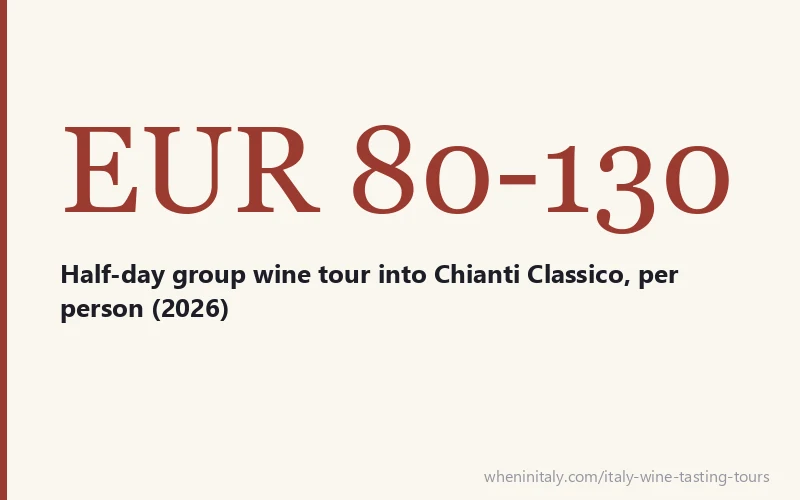
Chianti Classico DOCG is the historic heart, the strip of hills between Florence and Siena around the four old League of Chianti villages: Greve in Chianti, Castellina in Chianti, Radda in Chianti, and Gaiole in Chianti. It earned DOCG status in 1984 and the production zone was first defined by Grand Duke Cosimo III in 1716, which makes it one of the oldest officially demarcated wine regions on earth. The seal to look for on the bottle and on the cellar gate is the Gallo Nero, the black rooster on a white background with a Bordeaux-coloured frame (redesigned in 2013, but the rooster has been the symbol since the 14th-century military league). Chianti without “Classico” on the label is a much wider, less prestigious DOCG covering most of central Tuscany, often a perfectly good weeknight bottle but not the experience travelers come for. From Florence, half-day tours into Greve and Castellina run EUR 80-130 per person; full-day with two or three cantina visits and lunch at an estate runs EUR 150-220.
Brunello di Montalcino DOCG is the patience appellation. 100% Sangiovese (the local clone is called Sangiovese Grosso or Brunello), grown only within the commune of Montalcino itself, then aged a minimum of five years before release: at least two years in oak, at least four months in bottle, with the calendar starting January 1st of the year after harvest. The Riserva pushes that to six years. Around 250 producers crowd into the small commune. The town is genuinely tiny and walkable, and it makes a much better base than Florence if Brunello is the priority: stay one or two nights and you can visit four cantinas without driving more than 20 minutes. From Florence as a day trip, expect EUR 180-280 per person for a small-group tour with two estate visits and lunch.
Vino Nobile di Montepulciano DOCG is the third Sangiovese DOCG, made in the hill town of Montepulciano (do not confuse with the Montepulciano d’Abruzzo grape, which is unrelated). Less famous than Brunello, often a better price-quality ratio, and Montepulciano itself is a stunning town to walk in the late afternoon.
The fourth Tuscan reality is Bolgheri on the coast south of Livorno. This is Super Tuscan country: Sassicaia, Ornellaia, Tignanello, Solaia, the Bordeaux-blend wines that ignored the Chianti rules in the 1970s and forced the entire DOC system to adapt. They are not Sangiovese. They are Cabernet Sauvignon, Merlot, Cabernet Franc, sometimes Petit Verdot. Bolgheri is a 2.5-hour drive from Florence and not a casual day trip, but it is the right detour for visitors who care more about international varieties than indigenous ones. Tenuta San Guido (Sassicaia) does not run public tastings. Ornellaia and Antinori’s Guado al Tasso do, by appointment, at the EUR 80-150 tier.
If you only do one Tuscan wine day, base in Florence and book a small-group tour into Greve or Panzano in Chianti. If you do two, add Montalcino. If you do three, the third should be Bolgheri or a Super Tuscan tasting in Florence rather than a third Chianti day, because diminishing returns set in fast in the same valley.
Piedmont: Barolo, Barbaresco, and Nebbiolo’s mountain wines
Piedmont is for the wine traveler who wants to take it seriously. Nebbiolo is a slow grape (it is the latest-ripening major Italian variety, often picked in mid-October) and the wines it makes in the Langhe hills around Alba are among the most age-worthy in the world. Barolo DOCG is the headline: 100% Nebbiolo, 11 communes (Barolo village, La Morra, Castiglione Falletto, Serralunga d’Alba, Monforte d’Alba are the five most respected), aged a minimum of 38 months including 18 in oak before release. Since 2010, the zone has been mapped into 170 single-vineyard MGAs (Menzioni Geografiche Aggiuntive), the Italian answer to Burgundy’s premier-cru system. A serious producer’s lineup will include three or four single-MGA bottlings and reading the label in Barolo is a skill that takes a weekend to acquire and a lifetime to perfect.
Barbaresco DOCG sits a few kilometres east of Alba, also 100% Nebbiolo, slightly shorter aging requirement, generally lighter and more elegant than Barolo. Cult producer Gaja built his global reputation here. Serious tasters often say Barbaresco is what you drink while waiting for the Barolo to mature.
The cult names matter for booking strategy. Giacomo Conterno, Bartolo Mascarello, Giuseppe Mascarello, Roagna, Vietti, Bruno Giacosa, and Aldo Conterno receive far more visit requests than they can fulfill. Months of advance contact is normal, polite refusal is common, and a confirmed slot is a meaningful achievement. The good news: the next tier down (Brovia, Massolino, Cavallotto, G.D. Vajra, Trediberri, Burlotto, Oddero) makes wine that is competitive with the cult names and welcomes visitors with two weeks’ notice at EUR 25-60 per tasting flight.
The base-city decision is real. Alba is the right answer if you want to walk to dinner and not drive after tasting; the town is small, full of bistros, and it sits in the gap between Barolo and Barbaresco zones. La Morra and Barolo village itself are quieter villages with vineyard-view inns. Turin is a one-hour drive away and fine for a single day trip, but doing two days from Turin means spending too much time in the car. Milan stretches it: 2.5 hours each way, viable but tiring.
The killer reason to visit in autumn is the Fiera Internazionale del Tartufo Bianco d’Alba, the white truffle fair, running from October 10 to December 6, 2026, with the main market open on weekends. Truffle and Nebbiolo is one of the few food-and-wine pairings that lives up to its hype, and Alba is built around the experience for those eight weeks. Hotels need to be booked four to six months ahead for fair weekends.
Veneto: Amarone, Prosecco, and the Conegliano UNESCO hills
Veneto is two completely different wine trips that share a region. East from Verona, you have the Valpolicella zone and Italy’s most idiosyncratic red wine. Amarone della Valpolicella DOCG is made by the appassimento method: the Corvina, Rondinella, and Molinara grapes are picked normally in September, then laid out on bamboo or plastic racks in well-ventilated lofts for 100 to 120 days. They lose roughly half their water weight, the sugars concentrate, and the resulting wine ferments to a minimum 14% alcohol with most bottlings landing at 15-16%. The wine that comes out is dark, dense, often divisive, and expensive (EUR 50-200 per bottle is the normal retail range, with cult producers like Quintarelli and Dal Forno running into four figures). The same grapes done without drying make regular Valpolicella DOC. The same grapes refermented on Amarone leftovers make Ripasso. Sweet appassimento wine is Recioto, Amarone’s older sibling. A serious Valpolicella visit explains all four bottles in one tasting and is one of the most educational two hours in Italian wine.
Soave DOC sits east of Verona, makes white wines from Garganega, and is the region’s quiet success story (basic Soave is forgettable, Soave Classico from the volcanic hills is excellent and undervalued).
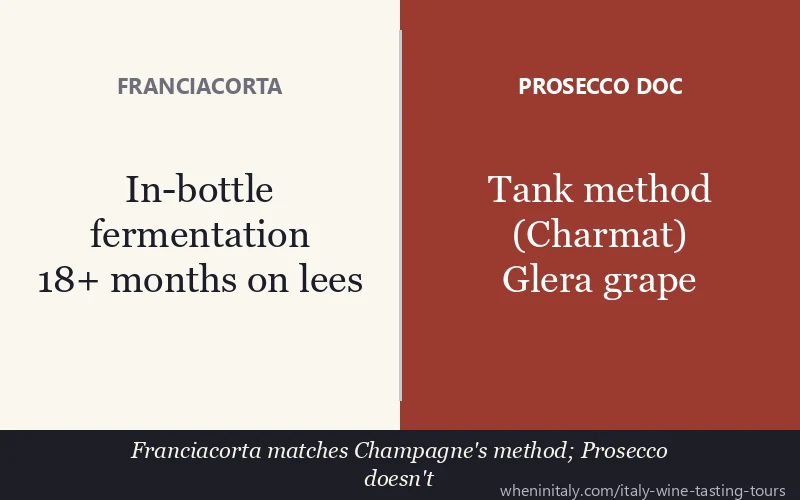
A 90-minute drive east of Verona, the wine country changes entirely. Conegliano-Valdobbiadene Prosecco Superiore DOCG is the prestige zone of Prosecco, the steep hills between Conegliano and Valdobbiadene that received UNESCO World Heritage status on July 7, 2019. This is the Prosecco worth flying for: tank-method sparkling from the Glera grape, made on slopes too steep for tractors (the work is mostly by hand, and the local term “viticoltura eroica”, heroic viticulture, is not marketing). Within the DOCG, the Cartizze subzone is the steepest 107 hectares and the most expensive wine. The much wider, much cheaper Prosecco DOC covers nine provinces across Veneto and Friuli, makes most of the supermarket Prosecco the world drinks, and is not what you come to Italy to taste.
The base-city choice is Verona for Amarone (and you can fold in a Lake Garda half-day), or Treviso/Conegliano/Valdobbiadene for Prosecco. Trying to do both from one base means a 90-minute transfer day and is worth it only if you have four nights.
Sparkling Italy: Franciacorta, Trento DOC, and Asti
Italy’s serious sparkling-wine answer to Champagne is not Prosecco. It is the metodo classico triangle: Franciacorta in Lombardy, Trento DOC in Trentino, and Alta Langa in Piedmont. All three use the second-fermentation-in-bottle method that defines Champagne. All three are made primarily from Chardonnay and Pinot Nero. All three are, on a price-per-quality basis, often better value than entry-level Champagne.
Franciacorta DOCG is the largest and most visitor-ready of the three. The zone surrounds the southern shore of Lake Iseo, an hour east of Milan. Permitted grapes are Chardonnay, Pinot Nero, Pinot Bianco, and Erbamat (a recently rehabilitated local variety). Aging requirements run longer than Champagne: 18 months minimum on the lees for non-vintage, 30 months for Millesimato (vintage), 60 months for Riserva. Compare with Champagne’s 15 months minimum for non-vintage. The major producer names are Berlucchi (the historic pioneer, started in 1961), Ca’ del Bosco (the prestige modernist), Bellavista (the elegant traditionalist), Mosnel, Bersi Serlini, and Contadi Castaldi. From Milan, day-trip groups visit two or three cellars with lunch for EUR 150-250. The atmosphere is lower-key than Champagne, the cellars are usually smaller, and tastings frequently happen with the family or winemaker rather than a designated hospitality team.
Trento DOC is the mountain version, made in the Adige valley around Trento and Rovereto using only Chardonnay, Pinot Nero, Pinot Bianco, and Meunier. The flagship producer is Ferrari, founded in 1902 by Giulio Ferrari and now Italy’s leading metodo classico house. At the 2024 Champagne and Sparkling Wine World Championships, Trentodoc collected 73 medals, more than any other Italian region. The Trento style tends to be more taut and mineral than Franciacorta, which makes sense given the altitude and the cooler Alpine climate.
Asti in Piedmont covers two very different wines that share the name. Asti DOCG (formerly Asti Spumante) is the sweet, low-alcohol, frothy sparkling Moscato that is a food wine, not a serious-tasting wine. Moscato d’Asti DOCG is its lighter, slightly less fizzy cousin: 5 to 6.5% alcohol, dessert-friendly, and one of the best wines in the world to drink with peach. Asti as a region is a 30-minute drive from Alba, so it folds easily into a Piedmont trip even if it is not the main reason to be there.
The south: Etna, Primitivo, Cerasuolo, and Cannonau
The south is where Italian wine in 2026 offers the best price-quality ratio and the most unspoiled cantina visits. Four appellations stand out.
Etna DOC on Sicily’s eastern flank is the volcano-wine story we cover in depth in our Mount Etna tours guide. The headline facts: vineyards run from 400 to 1,000 metres up the volcano’s slopes, the soils are layered lava flows of different ages and mineralogy, the indigenous reds (Nerello Mascalese, Nerello Cappuccio) and whites (Carricante, Catarratto) are unlike anything else in Italy, and many of the vines are pre-phylloxera and ungrafted (Etna’s volcanic sand is hostile to the louse). The region adopted a 142-contrade cru system in 2011, modeled loosely on Burgundy’s climats. Tenuta delle Terre Nere, Benanti, Pietradolce, Frank Cornelissen (the cult biodynamicist), Passopisciaro, and Graci are the names to know. Bases: Catania, Taormina, Linguaglossa, or one of the small wine-village inns on the volcano itself.
Primitivo di Manduria DOC in southern Puglia is genetically identical to California’s Zinfandel, a fact established by Carole Meredith’s UC Davis lab in 1994 (and traced back to a Croatian grape called Crljenak Kaštelanski in 2001). The wine is jammy, alcohol-forward (often 14.5% and up), affordable, and impossible to mistake for Tuscan Sangiovese. Manduria is the demarcated centre, but the broader Salento peninsula around Lecce is also Primitivo and Negroamaro country. Visits often pair with masseria stays: the fortified farmhouses converted into agriturismi, which give you tasting, lunch, pool, and bedroom in one stop. Bases: Lecce, Ostuni, Manduria itself.
Cerasuolo di Vittoria DOCG in southeastern Sicily is the only DOCG in Sicily (Etna, despite its prestige, is still DOC). It blends Nero d’Avola (50-70%) with Frappato (the remainder) and was elevated to DOCG in 2005, the island’s first. The wines are bright, cherry-red (cerasuolo means cherry-coloured), and food-friendly in a way Etna reds rarely are.
Cannonau di Sardegna DOC is Sardinia’s signature red. The grape is genetically Grenache (Spanish Garnacha, French Grenache), although Sardinia argues with reasonable evidence that the variety is older on the island than on the Iberian peninsula. What makes Cannonau distinctive is the polyphenol content: thicker grape skins under intense Sardinian sun produce two to three times the polyphenols of average red wine, which is the basis for the Blue Zone longevity link that Sardinia is famous for. Vermentino di Gallura DOCG in the granite-soiled north of the island is Sardinia’s only DOCG (since 1996) and one of Italy’s best mineral, saline whites. Bases: Olbia and the Gallura coast for north Sardinia, Cagliari for south.
A short list of regions worth knowing about even if they are not the main trip:
- Friuli-Venezia Giulia in the northeast: world-class whites (Friulano, Ribolla Gialla, Pinot Bianco), the modern home of orange wine.
- Trentino-Alto Adige: properly made Pinot Grigio (the version that disabused the world of the supermarket-bottle stereotype), Lagrein, Schiava, and Gewurztraminer.
- Campania: Greco di Tufo and Fiano di Avellino as serious whites, and Aglianico del Taurasi as the south’s most age-worthy red, sometimes called the “Barolo of the south.”
- Emilia-Romagna: Lambrusco taken seriously is genuinely delicious. Skip the supermarket version. Bottle-fermented Lambrusco from a producer like Cleto Chiarli is a revelation.
- Marche: Verdicchio dei Castelli di Jesi, the Adriatic’s quiet white-wine success story.
What a cantina visit actually looks like in 2026
Italian cellar-door culture is its own thing. It is more like visiting somebody’s working farm than walking into a Napa hospitality centre, and the etiquette differs in ways that catch first-time visitors out.
Price tiers (per person, 2026): - Walk-in tasting at a small producer: EUR 10-25, sometimes free if you buy a bottle. - Booked tasting at an established cellar (4-6 wine flight, 30-45 minutes): EUR 25-50. - Tasting plus cellar tour (90 minutes): EUR 40-80. - Tasting plus light food (cheese, salumi, bruschetta): EUR 60-120. - Tasting plus full multi-course estate lunch: EUR 100-180. - Full-day private wine tour with driver, two or three cellars, lunch: EUR 250-500 per person depending on group size and producer prestige.
Booking lead time: - Small family producers in the south: 2-3 days, often via WhatsApp. - Established cellars in Tuscany, Piedmont, Veneto: 1-2 weeks. - Top tier (Antinori, Frescobaldi, Ca’ del Bosco, Berlucchi, Pieropan): 3-4 weeks. - Cult names (Conterno, Roagna, Quintarelli, Soldera, Cornelissen): 8-12 weeks of polite email back-and-forth, with a real chance of refusal.
Glossary you will see on cellar gates: - Cantina: the cellar itself, often used as shorthand for “the place that makes and sells the wine.” - Tenuta: estate, larger property holding, often implies multiple vineyard parcels. - Azienda Agricola: agricultural business. Legally distinct from a regular wine company; means the producer farms their own grapes (as opposed to buying fruit). A reliable indicator of quality control. - Fattoria: similar to azienda agricola, more common in Tuscany, often historical estate with multiple buildings. - Castello: castle, usually a converted medieval property now making wine.
The visit format. A typical 90-minute visit at an azienda agricola opens with a vineyard walk or a vineyard view, moves into the cellar to see fermentation tanks and aging barrels, then sits down at a tasting room or kitchen table for a flight of four to six wines, frequently with a small plate of pecorino, bread, and salumi to keep the alcohol absorbing properly. The host (who is often the owner or winemaker, not a hired guide) will pour generously and watch what you do.
The spitting question. Italian wine country provides spittoons and water and expects you to use them, especially across multiple cellars. Drinking everything you are poured at three estates in a day is genuinely irresponsible: you will be at 15 standard drinks before lunch, and the host knows it. Spitting is not seen as rude. Foreign visitors who refuse to spit and visibly get drunk are a recognised category of cellar-door problem and you do not want to be one.
Tipping. Not expected at cantinas. Unlike American wineries, where 15-20% on the tasting fee is standard, Italian tasting fees are inclusive. Buying a bottle or two on the way out is the appropriate “tip.”
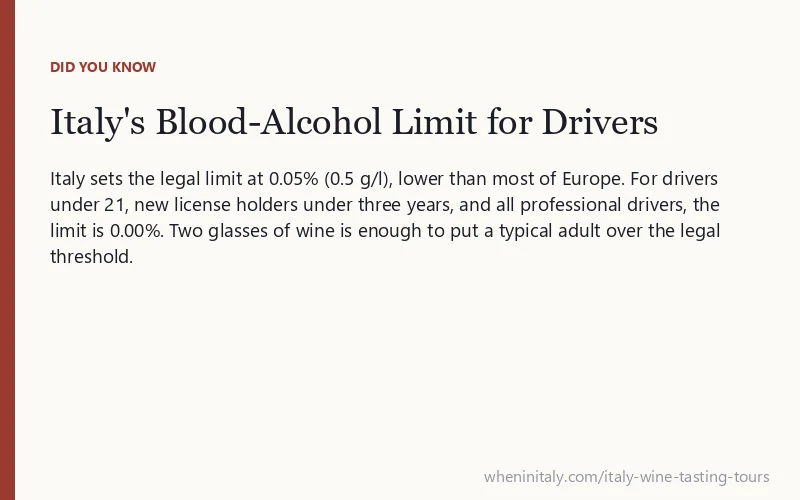
Drink-driving. Italy’s blood-alcohol limit for drivers is 0.05% (0.5 g/l). For drivers under 21, drivers with less than three years of license, and professional drivers, the limit is 0.00%. Two glasses of wine is enough to put a typical adult over 0.05%. Penalties at 0.08-0.15% start at EUR 800 and 6-12 months license suspension. The simple rule: if you are visiting more than one cellar in a day, you need a driver. Either book a wine tour with transport included, hire a private driver (EUR 200-350 for a full day in Tuscany or Piedmont), or stay walking-distance to your cellars and use taxis.
Self-drive trade-offs. Self-driving works for one-cellar visits with a designated driver in the group. It does not work for serious tasting days. Italian rural roads in wine country are narrow, winding, often unmarked, and frequently shared with farm equipment. Cycling and e-bike wine tours are increasingly common in Chianti, Franciacorta, and the Prosecco hills, and they solve the alcohol problem elegantly: you cannot ride a bicycle drunk either, but the speeds are forgiving. Vintage Vespa wine tours out of Florence and Siena are a niche option that combines the two activities in one experience. Cross-reference our Italy Vespa tours guide for routes that pair Vespa with Chianti tastings.
Strade dei Vini (wine roads). Italy operates around 140 official wine routes through the Federazione Italiana Strade del Vino, dell’Olio e dei Sapori. Each route is a signposted driving itinerary linking participating producers, restaurants, and accommodations. Free maps are available at regional tourist offices and at most participating cellars. The Strada del Vino del Chianti Classico, the Strada del Prosecco e Vini dei Colli Conegliano Valdobbiadene, and the Strada del Barolo are the three most developed for English-speaking visitors.
The classification short version. DOCG (Denominazione di Origine Controllata e Garantita) is the top tier, around 80 wines have it, with strict yield, aging, and tasting-panel requirements. DOC is the next tier, looser rules, around 330 designations. IGT (Indicazione Geografica Tipica) is broader still and is where many Super Tuscans intentionally live, because they refused to follow the Chianti rules. Quality does not strictly correlate with tier: a serious IGT Super Tuscan outranks most DOCG wine in price and reputation. The classification tells you what is in the bottle and where it came from, not whether the wine is good.
Choosing your wine trip: by interest, by season, by base city
The matrix that helps most travelers decide:
If you are new to wine and want the easiest, most-supported version: Tuscany from Florence. Chianti Classico into Greve or Panzano, half-day or full-day group tour, EUR 100-200 per person. English fluent everywhere. Photogenic.
If you care about sparkling wine and want better value than Champagne: Franciacorta from Milan, 60 minutes by car or train. Visit Berlucchi for the history, Ca’ del Bosco for the architecture, Bellavista for the elegance. One full day is enough.
If you are a serious red-wine person and want one trip that defines your year: Piedmont in October. Base in Alba. Book Barolo and Barbaresco visits two months ahead. Time it for the truffle fair (October 10 to December 6, 2026). Three nights minimum.
If you want value, sun, and uncrowded cellars: Puglia in May or September. Lecce or Ostuni base, Primitivo and Negroamaro country, masseria stays. Pair with the beach. Half the cost of Tuscany.
If you want the most distinctive wines in Italy and an active landscape: Etna in May or September. See our Mount Etna article for the full breakdown. Catania or Taormina base, mostly small ungrafted-vine producers, lunar volcanic landscape.
If you want food-and-wine pairing as the main event: Alba in October-November for white truffle and Nebbiolo. Bologna or Modena for balsamic, Parmigiano, and Lambrusco. Naples for pizza and Aglianico. Italy’s regional cuisine still maps tightly to its regional wine, and the closer you stay to the geography of both, the better the meal.
If you are traveling with kids: Tuscany works because the estates are scaled for hospitality and many have pools, animals, and history-of-the-villa tours that engage children for the 45 minutes the adults are tasting. Ask specifically for “family-friendly” tours when booking. Avoid the cult-Barolo style of visit, which is built around tasting-room intensity and works poorly with bored eight-year-olds.
By season: - March-May: vines waking up, weather mild, prices low, harvest still six months away. Excellent visiting season. - June-August: hot in the south, crowded in Tuscany, harvest happening early in Sicily and Puglia. Many producers prefer not to take visitors during the picking weeks. - September-October: harvest in the centre and north. The most atmospheric time to visit if you can tolerate that the producer is busy. Book three months ahead. - November-February: quieter, often lower rates, easier to get cult-producer slots, cellars are working on next year’s wine. Tuscany and Piedmont are cold and beautiful.
On what to wear. Cellar visits are casual but not beach-casual. Closed-toe shoes are required in working cellars (you walk on wet floors and around forklifts). Linen, jeans, sundresses, blazers, all fine. The “outfit” question that gets asked online for Tuscany wine tours mostly resolves to: dress how you would for a nice lunch at a friend’s countryside house. No heels for vineyard walks. Bring a light layer, cellars are 12-15 degrees Celsius even in August.
The single most useful planning rule: pick the wine you actually want to drink and base your trip on that, not the other way around. Travelers who plan a Tuscan villa week and then ask which wineries they should visit usually have a less interesting trip than travelers who decide they want to understand Barolo and then book a Piedmont week around Alba. The wine map of Italy rewards specificity. Start with what is in your glass, end up where it came from.