TL;DR / Key Takeaways
- Bologna is the only Italian city with two officially deposited pasta recipes: ragù alla bolognese (Accademia Italiana della Cucina, 17 October 1982, revised 20 April 2023) and tortellini in brodo (Dotta Confraternita del Tortellino + Accademia, 7 December 1974). A serious cooking class will reference at least one.
- Class formats split four ways: Cesarine in-home (EUR 80 to 120 per person, 3 to 4 hours), commercial classroom schools like La Vecchia Scuola Bolognese (EUR 60 to 95, 2 to 3 hours), market-tour-plus-class add-ons (an extra EUR 15 to 30), and full-day Modena-and-Parma food tours like Italian Days Food Experience (EUR 250 to 350, 6 to 8 hours).
- Cesarine was founded in Bologna in 2004 by University of Bologna sociologist Egeria Di Nallo. The network now hosts more than 50,000 travellers a year across roughly 1,500 home cooks Italy-wide. The original Bologna chapter still runs the largest concentration of Cesarine in-home classes in Italy.
- The Quadrilatero, a tight grid of medieval food-market streets behind Piazza Maggiore, is where most market-tour-plus-class operators start. Anchor stops include Tamburini (since 1932 on Via Caprarie), Paolo Atti & Figli (founded 1880, Palazzo Atti on Via Caprarie), and Mercato delle Erbe on Via Ugo Bassi.
- “Spaghetti bolognese” does not exist as a Bologna dish. In 2019 then-mayor Virginio Merola told Italian public radio RAI that the dish is “fake news” and asked citizens to send him photos of the offending plates from abroad. Bologna’s ragù is for tagliatelle, lasagne, or polenta, never spaghetti.
- Bologna is a comfortable half-day class trip from Florence (Frecciarossa in 33 to 37 minutes, fares from around EUR 9.70 if booked early) or Milan (around 1 hour 5 minutes, fares from around EUR 12).
Why Bologna is the cooking-class capital of Italy
Bologna carries three medieval nicknames that still describe it in 2026: La Dotta (the learned, for the University of Bologna founded in 1088, the oldest continuously operating university in the Western world), La Rossa (the red, for terracotta rooftops and a long left-wing political tradition), and La Grassa, the fat one, for its trattorias and dense culinary heritage. The third nickname drives the cooking-class economy. In a country where every region claims its own kitchen, Bologna is the city most often described, inside and outside Italy, as the gastronomic capital.
Four signature dishes anchor a Bologna class: tagliatelle al ragù alla bolognese, tortellini in brodo, lasagne verdi alla bolognese, and a rotating supporting act (crescentine, tigelle, tagliatelle in bianco con tartufo in white-truffle season from October through December). All four are pasta-or-flour-led, all four are emblematic of the wider Emilia-Romagna kitchen, and all four are technically demanding enough to fill a half-day class but simple enough to reproduce at home.
The geography helps. The Quadrilatero, a tight grid of five or six streets behind Piazza Maggiore, is a working medieval food market of century-old salumerie, fresh-pasta shops, and fishmongers. Most market-tour-plus-class operators meet groups in Piazza Maggiore, walk them through the Quadrilatero, then head to a nearby kitchen. The walk is 200 metres. No other Italian city packs a UNESCO-listed historic centre, a working food market, and a cluster of named cooking schools into so small a footprint.
The institutional backdrop matters too. Bologna is the birthplace of Cesarine, Italy’s first nationwide network of home-cook hosts, founded in 2004 by University of Bologna sociology professor Egeria Di Nallo with the Ministry of Agriculture and the Association for the Guardianship of Italy’s Culinary Heritage. The network started as an Emilia-Romagna project and now spans every Italian region with about 1,500 active home cooks hosting more than 50,000 travellers a year. Bologna remains the densest chapter.
The four dishes you will actually cook
A first-time Bologna class almost always teaches tagliatelle al ragù. The pasta is the star: roughly 8mm wide ribbons of fresh egg dough, cut from a hand-rolled sheet (sfoglia) that a sfoglina (a specialist woman pasta-roller) demonstrates with a long wooden mattarello. The ragù is the slow-cooked meat sauce that takes most of the prep time. The Accademia Italiana della Cucina recipe, deposited at the Bologna Chamber of Commerce on 17 October 1982 and revised on 20 April 2023, builds on beef, pancetta, soffritto (carrot, celery, onion), white wine, milk, and a small quantity of tomato passata or concentrate. The 2023 revision relaxed the cut requirement (cartella di manzo, beef skirt, was previously mandatory; the updated text accepts shoulder, chuck, brisket, plate, or flank) and allows browning the meat and vegetables separately. Pairing it with anything other than tagliatelle, lasagne, or polenta is a category error in Bologna.
Tortellini in brodo is the second pillar. The pasta is small, navel-shaped, hand-folded around a filling whose recipe was deposited in a notarial deed on 7 December 1974 by the Dotta Confraternita del Tortellino with the Accademia, signed by then-mayor Renato Zangheri. The filling combines pork loin, prosciutto crudo, mortadella, Parmigiano Reggiano, eggs, and nutmeg. The deposited text specifies a finished pasta thickness of 6 to 10 hundredths of a millimetre and a target weight per filled tortellino of 5 grams; the broth must be made from a farmyard capon. Christmas morning in Bolognese homes is traditionally tortellini in brodo. Class versions skip the capon and serve vegetable or chicken broth, but the folding lesson is the point.
Lasagne verdi alla bolognese is the third. The pasta sheets are coloured green with cooked spinach folded into the dough, then layered with the same ragù from the tagliatelle lesson, besciamella (butter, flour, milk), and grated Parmigiano, and baked. Longer half-day classes make one batch of ragù and use it for both the tagliatelle and lasagne lessons.
The fourth slot rotates. Crescentine and tigelle (small fried or grilled flatbreads served with cured-meat platters) appear in classes leaning towards Apennine-foothills cuisine. Tagliatelle in bianco con tartufo (butter, Parmigiano, white truffle shavings) features October through December when local white truffle is in season. Tortelloni di ricotta sometimes substitutes for tortellini when groups want a larger, easier-to-fold shape.
Class formats: Cesarine in-home, commercial school, market-tour-plus-class, food-tour day
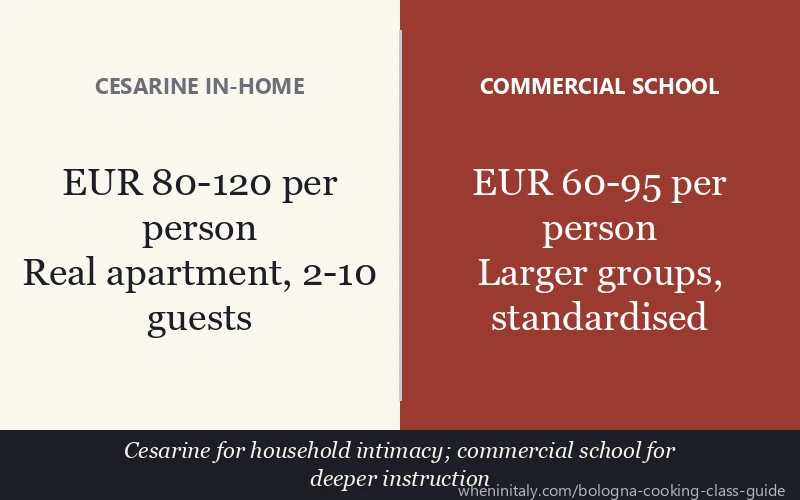
The Bologna class market splits cleanly into four formats. Choose by what matters most: intimacy, instruction depth, market context, or geographic breadth.
Cesarine in-home is the right answer for first-time cooking-class travellers. A Cesarina (the verified home-cook member of the network) hosts one to ten guests in her own apartment for 3 to 4 hours; the class ends with a sit-down meal of what was just cooked. Bologna pricing is EUR 80 to 120 per person. Booking is on cesarine.com; lead times reach 4 to 6 weeks for popular hosts in May through October. The format trades some pedagogical depth (a Cesarina is a great cook, not necessarily a chef-instructor) for household intimacy no commercial school can match.
Commercial classroom schools suit travellers who want a working professional kitchen, larger groups, standardised instruction, and slightly lower prices. La Vecchia Scuola Bolognese, founded by Alessandra Spisni in 1993, is the most-mentioned named operator in search autocomplete and the only school in the world formally training sfogline. Spisni is a television personality whose recipe book is a household reference. Bologna Cooking School on Via dell’Inferno runs English-led group classes (EUR 80 to 110) and private classes (EUR 200 and up). Il Salotto di Penelope is a smaller boutique operator. Duration runs 2 to 3 hours. Lead time is 1 to 3 days in low season, 1 to 2 weeks for peak slots.
Market-tour-plus-class suits travellers who want Quadrilatero context. The format starts with a 30 to 45 minute walking tour of the Quadrilatero (and sometimes Mercato delle Erbe on Via Ugo Bassi), then moves to the kitchen. Cesarine, Italian Days Food Experience, and several Quadrilatero-adjacent commercial schools run this version. The market portion adds EUR 15 to 30 and roughly an hour to total time. For groups who have not wandered the Quadrilatero independently, this is the format that lands the cooking in context.
Full-day food tours like Italian Days Food Experience (Alessandro Martini) suit travellers who want to see how Bologna’s pantry is sourced. An 8am Bologna pickup, a Modena Parmigiano-Reggiano dairy at production hour, a traditional balsamic acetaia (the wood-cask aging lofts where 12-year and 25-year IGP balsamico matures), and a Parma-area prosciutto producer. Lunch included. EUR 250 to 350 per person, 4 to 6 weeks lead time in peak season. Technically not a cooking class, but the most efficient single-day way to understand every cooking-class ingredient.
The Quadrilatero market integration
The Quadrilatero is four streets in a tight grid behind Piazza Maggiore: Via Drapperie, Via Pescherie Vecchie, Via degli Orefici, and Via Caprarie. It has been a food market continuously since the late Middle Ages, when guilds named after each trade (drapers, fishmongers, goldsmiths, butchers) clustered on the streets that still carry their names. By 9am on any weekday the Quadrilatero is producers laying out fresh fish, pasta shops folding the day’s tortellini in window-front kitchens, and salumerie stacking mortadella. By midday the same streets fill with locals taking aperitivo at counter-front bars.
Three named producers anchor a market walk. Antica Salsamenteria Tamburini opened on Via Caprarie in 1932, when brothers Angelo and Ferdinando Tamburini took over the older Benni shop, and remains the largest salumeria in the Quadrilatero, with a tavola calda at the back where shoppers can sit for a plate of tortellini between purchases. Paolo Atti & Figli, founded in 1880, is the other end of the spectrum: an artisan fresh-pasta and bakery firm whose Via Caprarie palazzo (Palazzo Atti) and Via Drapperie shop have stayed in the Atti family for five generations. Antica Pescheria Pasquini on Via Pescherie Vecchie is the most prominent of the Quadrilatero fishmongers and supplies many of the city’s fish-led trattorias. Mercato delle Erbe, a covered produce market five minutes’ walk away on Via Ugo Bassi, fills out fruit, vegetables, and herbs.
Most market-tour add-ons walk a 30 to 45 minute loop through the Quadrilatero, stop at two or three named producers for tastings (a slice of mortadella at Tamburini, a piece of fresh sfoglia at Atti, a glass of Pignoletto at a counter bar), then continue to the school’s kitchen with a small bag of ingredients. The point is part logistical (the school does need Parmigiano and pasta flour) and part editorial: a good market portion teaches who runs the Quadrilatero and why every ingredient is local. The add-on costs EUR 15 to 30 on top of the base class fee. For travellers in Bologna only 24 to 48 hours, it is the most efficient way to compress two activities into one morning.
Ragù vs bolognese: what is the international misunderstanding the class will fix?
The first 60 seconds of many Bologna classes are spent dismantling “spaghetti bolognese.” It is the misunderstanding international visitors most often arrive with, and it is the editorial moment the class is built around for many guests. The dish does not exist in Bologna’s culinary tradition. In late February 2019, then-mayor Virginio Merola complained on Italian public radio RAI that the world had imposed a fake dish on the city, branded the spaghetti version “fake news,” and asked citizens to tweet him photos of the offending plates from abroad. The mayor’s complaint went international and was covered by CBC, The Local, Euronews, and others. Eight years on, the clarification is still part of the curriculum.
What the official ragù actually is: the recipe deposited by the Accademia Italiana della Cucina on 17 October 1982 (revised 20 April 2023) calls for collagen-rich beef (the 1982 text specified cartella, beef skirt; the 2023 update accepts shoulder, chuck, brisket, plate, or flank), pancetta, a soffritto of carrot-celery-onion, white wine, milk, broth, and a small amount of tomato passata or concentrate. No garlic. No Mediterranean herbs (no oregano, no basil). Tomato is restrained, present to balance acidity, not to build flavour. Cooking time is several hours of low simmer.
What the official ragù is paired with: tagliatelle (fresh egg pasta hand-cut at roughly 8mm wide), lasagne verdi (the green spinach-pasta baked dish), or in some traditional households polenta. Not spaghetti. Spaghetti is a southern Italian shape suited to oil-and-tomato sauces; the cling profile is wrong for a thick meat ragù. In Bologna restaurants in 2026, asking for “spaghetti bolognese” will at best earn a polite redirect to tagliatelle al ragù and at worst a small lecture. Many class teachers lead with this clarification on purpose: the “you’ve been making bolognese wrong” moment converts a cooking session into a memory.
What does it cost in 2026?
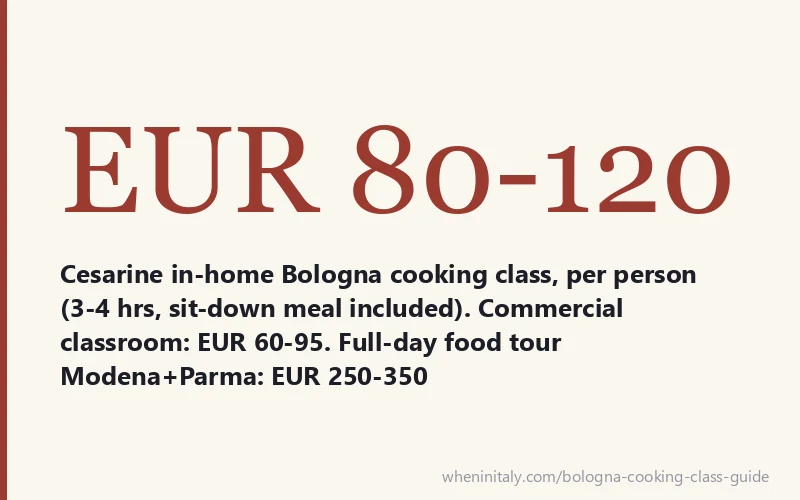
Pricing in Bologna splits cleanly by format. The numbers below are typical per-person fees; on-platform GetYourGuide prices may run 5 to 15 percent higher.
Cesarine in-home (3 to 4 hours, meal included): EUR 80 to 120 per person in a small-group class with one Cesarina hosting two to ten guests. Private bookings run EUR 150 to 220 per person depending on group size. Includes ingredients and the sit-down meal.
Commercial classroom school (2 to 3 hours): EUR 60 to 95 per person at La Vecchia Scuola Bolognese, Bologna Cooking School, or Il Salotto di Penelope. Private and specialty classes (truffle, multi-course) start at EUR 120 and reach EUR 250.
Market-tour-plus-class add-on: EUR 15 to 30 above base for a 30 to 45 minute Quadrilatero walk with two or three producer stops. Adds roughly an hour. Worth it for first-time visitors; skippable for those who have walked the Quadrilatero independently.
Italian Days Food Experience (full-day, 6 to 8 hours): EUR 250 to 350 per person for Bologna pickup, Modena Parmigiano-Reggiano dairy, traditional balsamic acetaia, Parma prosciutto producer, lunch included. The most expensive Bologna day-experience and consistently among the highest-rated.
FICO Eataly World (1.5 to 3 hours): EUR 60 to 95 per person at the food-and-wine theme park five minutes from Bologna Centrale by metro. Classes cover pasta, pizza, gelato, and chocolate. Theme-park setting rather than artisan kitchen, which suits some travellers and disappoints others. Open daily 10am to midnight.
Lead times scale with format. Walk-in to commercial schools is realistic 1 to 3 days out in low season (November to March, excluding Christmas week). For peak season (May through October) and Christmas market season, allow 1 to 2 weeks for commercial schools and 4 to 6 weeks for popular Cesarine hosts and Italian Days. Specialty classes (truffle, private, English-only) sell through earlier.
With kids, with limited time, vegetarian
With kids: Tortellini-folding is the kid-engaging activity in Bologna. Most schools welcome ages 6 and up; some take ages 4 and up with a parent’s help. The fold is mechanically satisfying (a small disk of pasta folded around a fingernail of filling, twisted into a navel shape), the result is small and edible, and a child of seven or eight will produce 20 to 30 passable tortellini in a half-hour. Cesarine hosts are usually best for family groups: the in-home setting tolerates kid energy better than a commercial classroom. Ask for a Cesarina whose profile lists family experiences. La Vecchia Scuola Bolognese also runs family sessions on request.
With limited time: A 2-hour commercial classroom class is the minimum viable Bologna cooking experience. Frecciarossa-from-Florence travellers can make this a half-day round trip: 9am train from Florence Santa Maria Novella, 9:40am arrival at Bologna Centrale, 11am class, 1:30pm wrap, 2pm late lunch in the Quadrilatero, 4pm or 5pm train back. The Cesarine in-home format is harder to compress under 3 hours because the meal is part of the experience. For travellers with only 90 minutes, FICO Eataly World runs short pasta and pizza classes inside the food park, 5 minutes by metro from Bologna Centrale.
Vegetarian and dietary: Standard at Cesarine and most commercial schools, but confirm at booking. Bologna’s signatures are meat-and-pasta led (ragù, tortellini filling, mortadella platters), so a vegetarian menu typically substitutes tagliatelle in bianco with butter and Parmigiano, tortelloni di ricotta in place of tortellini in brodo, and vegetable lasagne. Vegan classes are rarer; search for “plant-based” or “vegan” and confirm with the operator. Gluten-free is a meaningful constraint for any pasta class; some schools accept gluten-free flour substitution, but the resulting sfoglia is mechanically different and the sfoglina lesson loses some of its point.
Combining with Bologna sights and day-trip access
A cooking class slots into a Bologna day with room left over. A two-hour commercial class wraps around a meal, leaving morning or afternoon for the main sights, all within a 15-minute walk of the Quadrilatero.
The Two Towers (Le Due Torri): The Asinelli Tower (97 metres) and the leaning Garisenda Tower (48 metres), both built in the early 12th century, frame the eastern entrance to the historic centre. As of 2026 Garisenda is closed for stabilisation work; Asinelli is open for paid climbs (498 steps, panoramic view of terracotta rooftops). Confirm access at bolognawelcome.com before queuing.
The porticoes: Bologna’s covered walkways extend roughly 62 km city-wide, of which 42 km lie inside the historic centre. UNESCO inscribed the porticoes on 28 July 2021, recognising 12 representative ensembles. The longest single stretch is the 3.8 km Portico di San Luca climbing the hill west of the centre to the Sanctuary of San Luca.
Piazza Maggiore and Basilica di San Petronio: The medieval main square anchors the historic centre. San Petronio, the unfinished brick basilica on its southern flank, is the largest brick church in the world and houses the longest indoor sundial in the world (66.8 metres, traced into the floor in 1655 by Giovanni Cassini).
FICO Eataly World: Five minutes by metro from Bologna Centrale, a 100,000-square-metre food-and-wine theme park of producer pavilions, restaurants, and 6 cooking classrooms. Open daily roughly 10am to midnight. Best for travellers with a half-day to spare and interest in food production at scale (live curing rooms, pasta extrusion lines, gelato demonstrations).
Day-trip from Florence: Frecciarossa runs 70 daily services Bologna to Florence on weekdays, fastest trains 33 to 37 minutes. Advance fares from around EUR 9.70 in second class; standard fares EUR 25 to 50. Bologna Centrale to the Quadrilatero is a 10-minute taxi or 20-minute walk.
Day-trip from Milan: Frecciarossa Milan Centrale to Bologna Centrale averages 1 hour 5 minutes and as fast as 54 minutes on the express services. Advance fares from around EUR 12; standard fares EUR 30 to 60. The Milan day-trip is workable but tighter than the Florence one; Florence is the natural overnight pairing.
Pair with Modena and Parma: The Italian Days Food Experience (or a self-driven version of the same loop) covers Modena (Parmigiano-Reggiano dairies, traditional balsamic acetaie, the Ferrari museum if there is time) and Parma (prosciutto producers, the historic centre). Modena is 30 minutes from Bologna by regional train; Parma is 50 minutes. For travellers with two full days in Bologna, a one-day cooking class plus a one-day Modena-Parma food tour is the high-confidence itinerary.
Sources and References
- Italian Academy of Cuisine registers updated recipe for true ragù alla bolognese — official 20 April 2023 announcement of the revised deposit.
- Ragù alla bolognese — Bologna Welcome — the city tourism board’s reference text.
- The Classic Bolognese Ragù according to the Accademia Italiana della Cucina — full English text of the 1982 deposit.
- The registered recipe — Dotta Confraternita del Tortellino — the 7 December 1974 notarial deed.
- Tortellini in brodo — Bologna Welcome
- Mayor of Bologna, Italy, on crusade to expose fake spaghetti Bolognese — CBC News — February 2019 coverage of Mayor Merola’s RAI statement.
- Italian mayor rails against spaghetti bolognese: ‘It’s fake news’ — The Local Italy
- Spaghetti Bolognese Doesn’t Exist — Italy Segreta
- Cesarine boom: 50,000 guests a year for Italy’s largest team of “home cooks”
- Introducing Cesarine — cesarine.com press area — founder background and 2004 origin at the University of Bologna.
- VSB Bologna — La Vecchia Scuola Bolognese, Alessandra Spisni — official site of the 1993-founded school.
- Alessandra Spisni and La Vecchia Scuola Bolognese — The Foodie Bugle
- Antica Salsamenteria Tamburini dal 1932 — official Tamburini history page.
- Paolo Atti & Figli — official site and Paolo Atti pasta factory — Storia e Memoria di Bologna for the 1880 founding date.
- The Porticoes of Bologna — UNESCO World Heritage Centre — 28 July 2021 inscription.
- La Dotta, La Grassa, La Rossa — Italy Segreta — context on the three nicknames.
- Bologna to Florence by Train — Trainline — current Frecciarossa times and fares.
- Train from Milan to Bologna — ItaliaRail
- FICO Eataly World — Italia.it — current operating status and cooking-class schedule.
- Bologna Welcome — La Vecchia Scuola Bolognese — city tourism board listing.