Key Takeaways
- Only about five destinations earn a real day from Florence in 2026: Siena, the Siena+San Gimignano+Chianti combo, Pisa+Lucca paired together, Chianti on its own, and Bologna for a long lunch. Everything else is either a bonus or a guilt trip.
- Florence Santa Maria Novella (SMN) is the rail hub; the adjacent Firenze Autostazione at Piazza della Stazione 60R is where Autolinee Toscane regional buses leave for Siena, San Gimignano (via a Poggibonsi change), and Volterra.
- Cheapest direct combo by public transport: Florence to Pisa Centrale on a Trenitalia Regionale, about 57 minutes for roughly 9.90 EUR one-way, then a regional onward to Lucca in another 30 minutes for 3 to 5 EUR.
- The classic full-day guided product (Siena + San Gimignano + a Chianti winery with lunch) runs roughly 100 to 180 EUR per person and lifts every logistic headache off your plate; self-driving the same route saves about 60 EUR per couple but loses the wine pours.
- Cinque Terre and Venice are technically possible as Florence day trips but punish you with five hours of travel for six on the ground. Both reward an overnight; both disappoint as same-day round-trips.
- Two full days for Florence itself plus one or two day-trip days is the planning sweet spot. Three to four nights in Florence covers the city well and leaves room for the Tuscan countryside without overpaying for an under-used base.
The honest day-trip rule for Florence
Florence is the best Tuscan base by a wide margin, and that fact has produced a problem: travel blogs treat almost every walled hill town within 200 km as a viable day trip, which is how readers end up spending eight hours on regional trains to spend ninety minutes inside Volterra’s Etruscan museum. The honest count is shorter. About five destinations are worth the round-trip from Florence in a single day: Siena, the Siena and San Gimignano and Chianti combination, the Pisa and Lucca pairing, Chianti as a standalone half or full day, and Bologna for a serious meal. Beyond that the math turns against the day-tripper. Cinque Terre, Venice, Volterra by public transport, Cortona, Pienza, Montepulciano: each is a fine destination, and each is better served by an overnight than by a sprint. This guide treats the same as Florence’s “Italy day trips from Rome” framing: the goal is to identify the ones that actually earn a day, then say plainly which to skip.
Siena: the dedicated deep-dive
Siena is the single highest-yield Tuscan day trip from Florence and deserves its own pass. The Autolinee Toscane bus 131R from Firenze Autostazione covers the route in about 1 hour 15 minutes for 8.40 EUR one-way; the train requires a change and ends up slower at roughly 1 hour 30 minutes for similar money. Most travelers underestimate how much there is to do once they reach the Piazza del Campo, then discover the Duomo, the Scrovegni-rivaling pavement floor, the Pinacoteca Nazionale, and the Torre del Mangia each ask for an hour or more in their own right.
When in Italy publishes a dedicated Siena guide that handles itinerary timing, ticket-stacking strategy, and the question of whether to add the Opa Si Pass. See /siena-day-trip-guide/ for the full breakdown. Two practical points worth flagging here: Siena’s bus station deposits you at Piazza Gramsci, a five-minute downhill walk to the Campo, and the last 131R back to Florence typically leaves Siena around 21:05, which means a real dinner inside the walls is part of the option set rather than an aspiration.
The classic combo: Siena + San Gimignano + Chianti vineyard
This is the most-booked full-day Tuscany product from Florence and the one that survives every “what should I do in Tuscany” thread: a coach or minivan leaves Florence around 09:00, stops at a Chianti winery for a tasting and tour, has lunch on-site or in San Gimignano, walks the medieval-towers town for ninety minutes, then closes at Siena for two and a half hours before returning to Florence around 19:00 or 20:00. Group prices in 2026 run roughly 100 to 180 EUR per person depending on lunch inclusions and winery prestige; private tours for two to four people land in the 350 to 700 EUR range for the vehicle and guide.
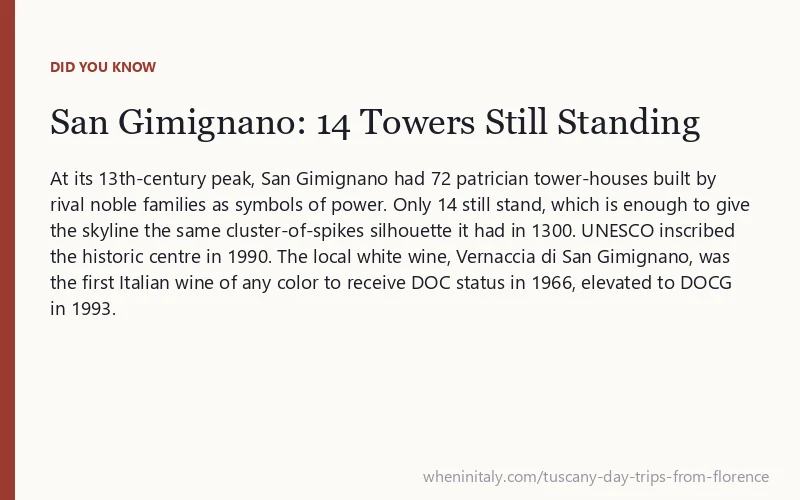
Each stop earns its slot for a different reason. San Gimignano was named “Medieval Manhattan” because at its 13th-century peak it had 72 patrician tower-houses; 14 still stand, which is enough to give the skyline the same cluster-of-spikes silhouette it had in 1300. UNESCO inscribed the historic centre in 1990. Vernaccia di San Gimignano, the local white, was the first Italian wine of any color to receive DOC status in 1966 and was elevated to DOCG in 1993; the Vernaccia consortium documents references to the grape as far back as 1276. Chianti delivers the wine and the landscape rather than monuments, which is why it makes more sense as a guided visit than a self-walked one. Siena, finally, gives the day a proper civic and architectural anchor: the Campo, the Duomo, the contrada culture, the post-tour aperitivo on the slope of the shell-shaped piazza.
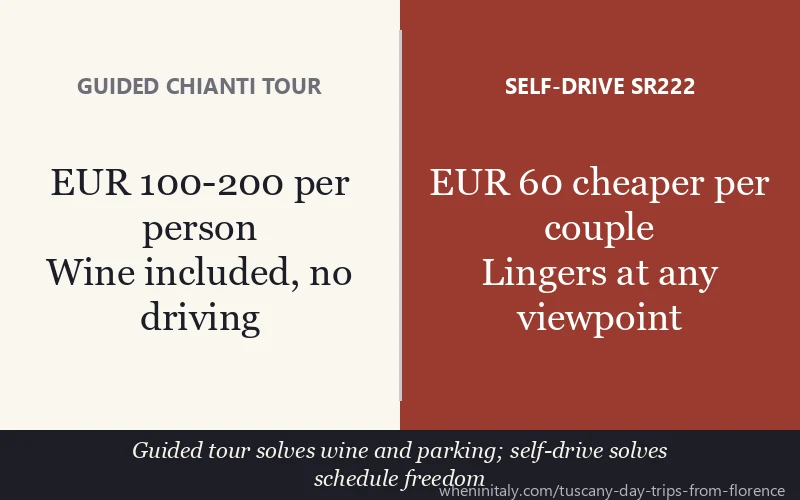
The case for the guided coach over self-driving is straightforward. Self-driving the same loop on the SR222 Chiantigiana costs about 60 EUR per couple in fuel, tolls, and parking, but you cannot taste at the wineries while driving and you must navigate the ZTL (limited-traffic zone) edges of San Gimignano and Siena, both of which fine non-residents aggressively. The guided tour solves the wine problem and the parking problem at once; the self-drive solves the schedule problem and lets you linger at the lookouts on SR222 between Greve and Castellina.
Pisa, Lucca, and the half-day options
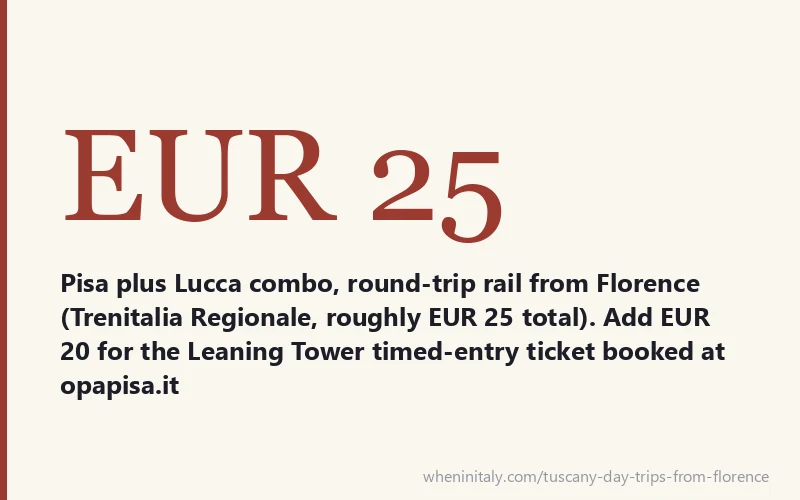
Pisa is the Florence day trip people most often overrate as a full day and most often underrate as a half-day combo. The Trenitalia Regionale to Pisa Centrale runs roughly 57 minutes for about 9.90 EUR one-way; trains leave SMN multiple times an hour and there is no booking advantage to buying in advance because Regionale fares are fixed. Once on the ground, the entire Piazza dei Miracoli walking route (Cathedral, Baptistery, Camposanto Monumentale, Leaning Tower) compresses into three to four hours including a tower climb. The Tower itself costs 20 EUR with a timed slot every 30 minutes; Opera della Primaziale Pisana, the lay-ecclesiastical body that has managed the complex since its founding in 1063, releases tickets up to 90 days in advance through opapisa.it, and June-through-August slots disappear within hours of release.
The full-day move is to pair Pisa with Lucca. From Pisa Centrale a regional train reaches Lucca in about 30 minutes for 3.60 EUR; from Florence direct, Lucca is roughly 1 hour 20 minutes by Regionale for about 9 EUR one-way. Lucca’s draw is not a single monument but the 4.2 km Renaissance city walls (1545 to 1650 build), which were converted into a tree-shaded public promenade in the 19th century instead of being demolished, as happened to most European urban fortifications. The walls are wide and flat enough to walk or bike the entire circuit; bike rentals at Cicli Bizzarri near Porta Santa Maria or at Tourist Center Lucca outside the train station run roughly 5 EUR per hour. Inside the walls, the Piazza dell’Anfiteatro (an oval medieval square built directly into the Roman amphitheatre footprint) and the Casa Natale Puccini both deserve a stop.
The honest verdict: Pisa as a full day is one museum and one tower repeated for six hours, and most travelers feel the diminishing returns by the second hour. Pisa plus Lucca as a single day, leaving Florence by 09:00 and returning by 19:00, gives the day shape and lets the Pisa visit stay tight and triumphant rather than padded.
Chianti wine country: a half-day or full-day on its own
Chianti as a standalone trip lets the wine, not the towns, run the day. Half-day tours from Florence depart around 13:30, drive the SR222 to a single winery in Greve in Chianti or Panzano for a ninety-minute tasting and cellar walk, and return by 18:00 or 19:00 for 70 to 130 EUR per person. Full-day tours add a second producer, a long Tuscan lunch with paired pours, and often a stop in Castellina or Radda for a town walk. Group full-day prices run 100 to 200 EUR per person; private experiences for two to four travelers are typically 350 to 700 EUR for the vehicle.
Self-driving the SR222 is one of the most rewarding short drives in Italy, but only as a non-tasting day. The road threads from Strada in Chianti south through Greve, Panzano, Castellina, Radda, and Gaiole; the views earn every kilometer; the wineries reward direct visits with cellar discounts unavailable through tour operators. Designated drivers should book one tasting at a time and resist the second pour. Travelers who want both the road and the wine should book the guided tour and accept the 100 EUR premium as the price of finishing the day with the same designated driver they started it with.
Three villages anchor the region for visitors. Greve in Chianti has the central Piazza Matteotti and Antica Macelleria Falorni, the historic butcher whose porchetta sandwiches are the region’s unofficial road snack. Castellina in Chianti is smaller, walled, and quieter; its medieval Via delle Volte is a covered defensive walkway worth the ten-minute detour. Radda in Chianti is the highest of the three, with a tightly-packed centro storico around the 15th-century Palazzo del Podestà and panoramic terraces facing south toward Siena.
Volterra and the slower Tuscany picks
Volterra is the connoisseur’s pick: it requires effort to reach, rewards travelers who already have a Tuscan day or two banked, and has none of the bus-tour churn that defines San Gimignano in July. Public transport from Florence is genuinely awkward. There is no direct line; the workable route changes at Cecina (Florence to Cecina by Trenitalia Regionale, then bus 790 from Cecina FS or train to Saline-Pomerance, then bus 780 to Volterra), with total journey times around 2 hours 30 minutes one-way. The alternative is the Autolinee Toscane bus 131 to Colle Val d’Elsa with a change to a Volterra-bound onward, also roughly 2 hours 30 minutes. By car the trip is closer to 1 hour 30 minutes via the SS429 and SR68.
What makes the trip pay off: Etruscan walls dating to the 4th century BCE, a 1st-century BCE Roman theatre that ranks among the best-preserved in Italy, the Museo Etrusco Guarnacci with its collection of more than 600 funerary urns, and the alabaster-carving workshops that have continued the local craft uninterrupted for 2,500 years. The Piazza dei Priori, with the Palazzo dei Priori (1208), is the oldest civic palace still in use in Tuscany. None of this rewards the half-day, all of it rewards the slow visit, and the Twilight tourism boom of the mid-2010s has thoroughly receded so the town is back to its quiet Etruscan self.
For travelers who already have Florence and Siena banked, the slower Tuscan picks worth a longer day or an overnight from Florence are: Arezzo (90 minutes by train) for the Piero della Francesca fresco cycle in the Basilica di San Francesco, Cortona (1 hour 45 minutes by train plus shuttle) for the Val di Chiana hill town views and the Etruscan museum, Pienza (no direct rail; a guided wine-and-cheese tour is the practical access) for the Renaissance “ideal city” plan commissioned by Pope Pius II in 1459, and Montepulciano (similar access constraints) for Vino Nobile and the Tempio di San Biagio. All four are stronger as overnights from Florence than as same-day round-trips.
Beyond Tuscany: when Bologna, Venice, and Cinque Terre earn a day
Three popular “from Florence” day trips technically lie outside Tuscany. Each has a different verdict.
Bologna is the strongest of the three and the easiest. Frecciarossa from SMN to Bologna Centrale runs 35 to 40 minutes; advance fares start around 19.90 EUR in second class and rise to 29.90 EUR in first; walk-up fares often land in the 25 to 50 EUR range. The trip is built around a long lunch: ragu alla bolognese in its actual home, mortadella from the Quadrilatero market, and a cooking class or pasta-making workshop in the early afternoon. See /bologna-cooking-class-guide/ for the food-led itinerary. Bologna also rewards a walk through the Portici (the 38 km of arcaded walkways inscribed by UNESCO in 2021) and a climb of the Asinelli Tower if it is reopened to visitors after recent stabilization work.
Venice is doable but tight. Frecciarossa from SMN to Venezia Santa Lucia runs about 2 hours 14 minutes on the fastest direct services, with second-class fares from roughly 19 EUR booked in advance and 60 to 90 EUR on walk-up. A 09:00 departure puts you on the Grand Canal by 11:30 and gives you about six hours before the practical last train back. That is enough for the Rialto, San Marco, a vaporetto loop, and one museum, but not enough for the Accademia, Murano, or Burano. Most Florence-based visitors who do Venice as a day trip return wishing they had given it a night. The honest version of this advice: if Venice is on the trip, build a one-night Venice into the itinerary and use Florence as the longer base.
Cinque Terre as a day trip from Florence is punishment, not travel. The fastest direct service is the Frecciargento to La Spezia at roughly 1 hour 30 minutes; most options route via Pisa for a total of about 2 hours 10 minutes. From La Spezia you board the Cinque Terre Express, which hops the five villages (Riomaggiore, Manarola, Corniglia, Vernazza, Monterosso) in 30 minutes end-to-end during the high season at 15-to-30-minute intervals. The arithmetic: five hours of moving for six hours of villages, with no margin if any train is late. The strong recommendation is to overnight in Monterosso or La Spezia for one or two nights and let Cinque Terre breathe. Florence to Cinque Terre as a same-day round-trip should be reserved for travelers on a one-week trip who genuinely cannot find another night.
What does it cost in 2026, and how many days do you need in Florence?
The honest 2026 cost ladder for a single Florence day-tripper, public transport, no guided tour:
- Pisa: about 20 EUR round-trip rail plus 20 EUR for the Tower if climbed, total 40 to 60 EUR with a meal.
- Lucca: about 18 EUR round-trip rail plus 5 EUR per hour for a bike, total 30 to 50 EUR with a meal.
- Pisa plus Lucca combo: about 25 EUR round-trip rail (ticket through Pisa to Lucca), total 60 to 90 EUR with the Tower and a meal.
- Siena by 131R bus: about 17 EUR round-trip plus monument tickets at 15 to 30 EUR, total 50 to 80 EUR with a meal.
- San Gimignano via Poggibonsi: about 22 EUR round-trip with the bus change, total 50 to 80 EUR with a meal and a Vernaccia tasting.
- Bologna: about 40 to 100 EUR round-trip Frecciarossa (booked early vs walk-up), total 90 to 180 EUR with a serious lunch.
- Volterra by public transport: about 30 EUR round-trip with the changes, total 60 to 90 EUR; by guided tour with lunch, 130 to 200 EUR.
- Venice: about 40 to 180 EUR round-trip Frecciarossa, total 100 to 250 EUR for a tight day.
- Cinque Terre: about 35 to 70 EUR round-trip rail plus the 19 EUR Cinque Terre Card, total 90 to 150 EUR for a punishing one.
Guided full-day combo tours from Florence (Siena + San Gimignano + Chianti winery with lunch) compress all the logistics into a single 100 to 180 EUR per-person line item and remove the train-ticketing and ZTL-fining downside. For two to four travelers, private tours at 350 to 700 EUR per vehicle become competitive once you split the cost.
How many days do you need in Florence? The planning answer: two full days for the city itself (Uffizi, Accademia, Duomo complex, Oltrarno, the Boboli or Bardini gardens, a proper aperitivo evening) plus one or two day-trip days, which translates to three or four nights in Florence as the sweet spot. Booking five or more nights only pays off if you intend to use Florence as a Tuscan base for four or more day trips, in which case the math works because Florence’s hotel inventory and dining options are deeper and cheaper than anywhere smaller in Tuscany. Booking only one or two nights in Florence is the most common mistake: the Uffizi alone deserves three hours, and a one-night stay reduces the city to a checklist of facades.
A defensible two-week Italy itinerary using Florence as the Tuscan anchor: three nights Rome, four nights Florence (with a Pisa+Lucca day and a Siena+San Gimignano+Chianti day), two nights Cinque Terre, three nights Venice, two nights Bologna. For a one-week trip, drop Cinque Terre to a half-day Pisa visit, hold Florence at three nights, and accept that Venice gets one tight night.
Sources and References
- Autolinee Toscane lines and timetables (Tiemme regional bus authority) — operator of routes 131R, 131, 130, 133, 780, 790 used in this article.
- Autolinee Toscane San Gimignano-Firenze fares page — current single-ticket pricing for the Poggibonsi-change route.
- Visit Tuscany on Piazza dei Miracoli — Pisa monument complex overview.
- UNESCO World Heritage Centre — Piazza del Duomo, Pisa (inscribed 1987) — official 1987 inscription record.
- Opera della Primaziale Pisana (official ticketing for Pisa monuments) — 90-day-ahead booking window and 20 EUR Tower price.
- Trenitalia (Italian state rail) — Frecciarossa and Regionale fare and timetable authority.
- Decanter on Vernaccia di San Gimignano DOCG history — historical references back to 1276.
- Comune di San Gimignano UNESCO heritage walk — official source for the 1990 inscription and tower count.
- Hidden Lucca cycling guide — bike rental shops and 4.2 km wall circumference.
- Italy Beyond the Obvious on biking the Lucca walls — Renaissance build context (1545-1650).
- Cinque Terre Express (Trenitalia) — high-season frequency and village-hopping intervals.
- DiscoverTuscany on getting to Volterra — Cecina/Saline change route and Colle Val d’Elsa alternative.
- VolterraTur (official tourism office) — official access guidance for Volterra.
- Trips From Florence on Florence-Venice train (2026) — Frecciarossa fare and duration verification.
- SeatGuru/Seat61 on Italy rail (2026 guide) — Regionale ticketing and Frecciarossa overview.
Related guides on When in Italy
/siena-day-trip-guide/— the dedicated Siena deep-dive (timing, ticket stack, Opa Si Pass, 131R timetables)./italy-day-trips-from-rome/— the parallel honest-day-trip framing for Rome travelers./bologna-cooking-class-guide/— the food-led half-day Bologna itinerary that pairs with this guide./italy-wine-tasting-tours/— broader wine-region context for travelers extending beyond Chianti./amalfi-coast-tours/— the southern counterweight when planning an Italy itinerary that splits north and south.