Key Takeaways
- An agriturismo is a legally defined working farm under Italian Law 96/2006 (Disciplina dell’agriturismo), where hospitality must remain ancillary to genuine agricultural production. The label is not a marketing term; a property using it should be growing wine, olives, grain, or raising livestock as its primary business.
- The classic Florence agriturismo day runs roughly 09:30 to 16:00, with pickup near Santa Maria Novella station, a 45 to 60 minute drive into Chianti or Val d’Orcia, and a single rural property hosting the whole day: vineyard walk, olive oil tasting, pasta-from-scratch class, and a long lunch with wine pairings.
- Expected price band for 2026: roughly EUR 100 to 160 per person for a small-group full-day with round-trip transfer, EUR 250 to 400 per person for a private version, and EUR 70 to 95 if booking direct with the farmhouse on a self-drive basis.
- The October to mid-November frantoio (olive mill) season is the year’s high point. New oil (olio nuovo) is at its most peppery and green, the harvest is visible, and tastings often include cold-pressing demonstrations.
- Chianti Classico DOCG wine must be at least 80% Sangiovese and is the only Tuscan red allowed to display the Gallo Nero (black rooster) seal of its consortium. Many agriturismi in the Chianti zone pour their own-label bottlings at lunch.
- Tuscany produces only about 3% of Italy’s total olive oil yet holds four Protected Designations of Origin (Chianti Classico DOP, Terre di Siena DOP, Lucca DOP, Seggiano DOP) plus the regional Toscano IGP. Tasting at an agriturismo is one of the few ways visitors get to compare them side by side at source.
What an agriturismo day actually is
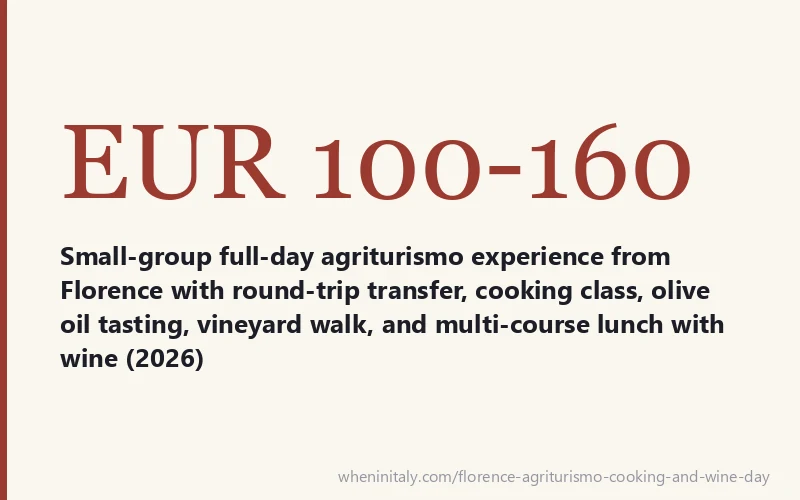
An agriturismo is a working agricultural property registered under Italian Law 96/2006 (Disciplina dell’agriturismo), which permits Italian farms to host paying guests for meals, lessons, lodging, and farm activities only as a secondary business. The agricultural production (wine, olive oil, grain, livestock, vegetables, cheese) must remain the primary economic activity of the holding, and regional implementing laws set caps on how many guests a property can host. The legal frame matters because the term is used loosely in tourism marketing; a hotel in the countryside with a vegetable patch is not an agriturismo, while a 450-hectare organic estate like Diacceroni near Volterra, registered with the Pisa province register, is. From a Florence base, the typical day-experience product follows a now-standard rhythm: pickup near Santa Maria Novella station around 09:30, a 45 to 60 minute transfer into Chianti or the Val d’Orcia, and arrival at a single property where the whole day unfolds. The rest of the schedule varies by farm, but the structure is consistent: vineyard walk (15 to 30 minutes), olive oil tasting (4 to 6 oils with bread), hands-on pasta class (60 to 90 minutes), lunch with wine pairings (90 to 120 minutes), and return to Florence by 16:00 to 17:00. Half-day versions (lunch only) exist but are rare; the format is built for full-day immersion at one place.
The day’s three pillars: olive oil, pasta from scratch, vineyard wine
The agriturismo day works because it stitches together three distinct Tuscan crafts on a single estate, so the visitor sees the same farm’s grapes, olives, and grain transformed in real time. The vineyard walk usually opens the day, with the host explaining the rows by varietal (Sangiovese, Canaiolo, sometimes Merlot or Cabernet for blending), the soil (galestro and alberese in Chianti Classico, the chalk-and-clay crete senesi further south), and the harvest calendar. Olive oil tasting then comes before lunch on an empty palate, when the senses are sharpest. A serious tasting pours four to six estate oils into the cobalt-blue glasses specified by ISO 16657:2006, warmed to 28 degrees Celsius (the temperature set by the International Olive Council in COI/T.20/Doc. No 5/Rev. 2/2020), with bread and water as palate cleansers between samples. The pasta class itself is hands-on and almost always uses the local format: pici (a thick hand-rolled spaghetti from southern Tuscany), pappardelle (wide ribbons for game ragu), or tagliatelle, plus often gnocchi or ravioli depending on the host’s specialty. Lunch is the long Tuscan finale, three to four courses with three to five wine pours, almost always including a Chianti Classico DOCG or in Val d’Orcia a Brunello di Montalcino or Vino Nobile di Montepulciano. The whole day is structured as a meal that takes six hours.
Where to go: the four regions of Tuscan agriturismo
A Florence-based traveler picking an agriturismo for the day is really picking a corner of Tuscany, and the four candidate areas have different signatures. Chianti Classico is the most accessible: roughly 30 to 60 minutes south of Florence, between Greve, Castellina, Radda, and Gaiole. It is the Sangiovese heartland and the only zone whose wineries can display the Gallo Nero seal. Many of the cooking-class day experiences book here because it is closest to the city. Val d’Orcia, south of Siena and a UNESCO World Heritage Site since 2004, is the area of cypress avenues, golden hills, and the towns of Pienza, San Quirico d’Orcia, and Montalcino. From Florence it is a 90-minute to 2-hour drive each way, so day-trips here run longer; the food culture leans toward pici, pecorino di Pienza, and Brunello. Volterra and the western Pisa province, around Peccioli and the Val di Cecina, sit between Chianti and the coast. The landscape is wilder, less manicured, and prices on the farms tend to run lower; this is where Diacceroni operates, and where Volterra itself is worth combining as a half-day stop. Mugello, the green valley north of Florence toward the Apennines, is the quietest and least touristed of the four. Its food is mountain-Tuscan: tortelli di patate (potato-stuffed ravioli), chestnut flour, roasted game. Mugello does not have Chianti’s wine prestige, so day-experiences here are rarer, but for visitors who want a working farmhouse with no other tourists on the property, it is the choice.
Named operators worth knowing
Booking direct (rather than through a tour aggregator) gives more flexibility on group size, dietary requirements, and pacing, but it requires self-drive or a private transfer. Three named agriturismi recur in 2026 search and are worth knowing.
Agriturismo Diacceroni (Peccioli and Volterra area, Pisa province) is a 450-hectare certified organic estate that hosts cooking classes, horseback riding, olive grove walks, and lake activities, all on a working farm with its own restaurant. The cooking school runs structured weekly programs from April to October and has separate tracks for beginners, more experienced cooks, and children. Diacceroni is the operator most often surfaced under “agriturismo cooking class Tuscany” autocompletes precisely because its scale lets it run multiple parallel activities on the same day.
Agriturismo Il Rigo in San Quirico d’Orcia, Val d’Orcia, is the opposite end of the spectrum: a small family-run organic ranch in a five-century-old stone farmhouse. Vittorio Cipolla founded the holding in 1974 after the end of the crop-sharing system, and the farm has been certified organic since 1990, one of the first in the Val d’Orcia. Cooking classes are led by his wife Lorenza in the historic Casa dell’Abate Naldi (the morning meeting point is 10:45). The farm produces stone-ground flour, olive oil, sourdough, and seasonal vegetables, and the cooking is built around what is harvested that week.
Agriturismo Cognanello, on the outskirts of Montepulciano in Siena province, is a 12-hectare working farm that the Giorgi family has run for six generations. The agriturismo offering centers on its own estate-grown ingredients: extra virgin olive oil from hand-harvested olives, hand-rolled pici, Chianina beef from the farm’s livestock, and almond cantucci. It is closer to a homestead than a venue, which is the reason to choose it.
For visitors booking solo, the markers of a serious agriturismo are: registered membership in a regional agriturismo register, on-site primary production (not just a kitchen serving outside ingredients), a price that includes wine and food rather than billing them separately, and English communication confirmed before booking rather than assumed.
Olive oil tasting: how it actually works
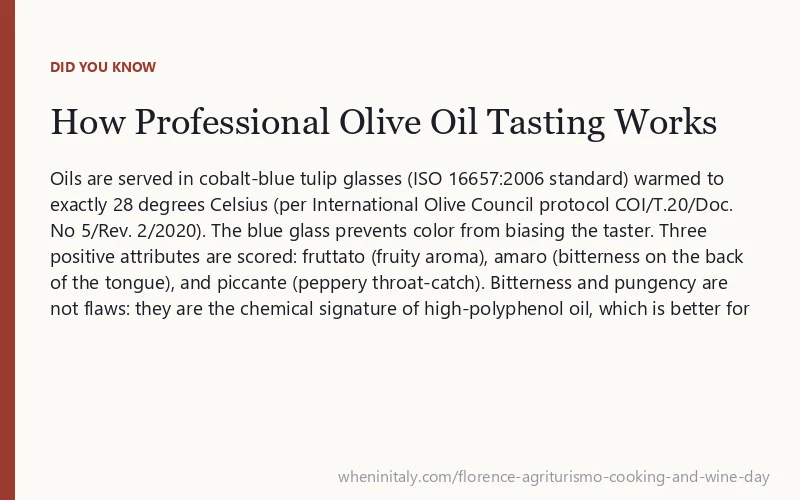
A proper olive oil tasting at an agriturismo follows the same protocol used by professional tasting panels around the world, scaled down for guests. Oils are served in cobalt-blue tulip glasses (the standard set out by ISO 16657:2006), which prevent the taster from being influenced by the oil’s color (color is not an indicator of quality). The glasses are warmed to 28 degrees Celsius (the temperature specified by the International Olive Council in COI/T.20/Doc. No 5/Rev. 2/2020), which releases volatile aromatics without altering the oil’s chemistry. The taster covers the glass, swirls, lifts the cover, and inhales briefly for no more than 30 seconds, then sips a small amount and pulls air across the palate (the slurping technique) to volatilize compounds across the tongue and into the soft palate. Three positive attributes are scored on a 0 to 10 scale: fruttato (fruity, the green-olive aroma signaling healthy fruit harvested at the right ripeness), amaro (bitter, perceived on the back of the tongue and indicating polyphenolic antioxidants), and piccante (peppery, the throat-catch felt when swallowing, also a polyphenol marker). Bitterness and pungency are not flaws; they are the chemical signature of oil that will protect the heart and last on the shelf. Defective oils show rancidity, mustiness, or fermentation off-notes, which the protocol is designed to detect. Tasting is best done before lunch, when the palate is clean. The October to mid-November frantoio (mill) season is when this all comes alive: olives must be pressed within 24 hours of harvest to qualify as extra virgin, the mills run continuously, and visitors can taste olio nuovo straight from the press, vivid green and at peak peppery intensity. This is the real secret of the Tuscan agriturismo year.
Versus an in-cantina wine tasting OR an urban Florence cooking class: when does agriturismo win?
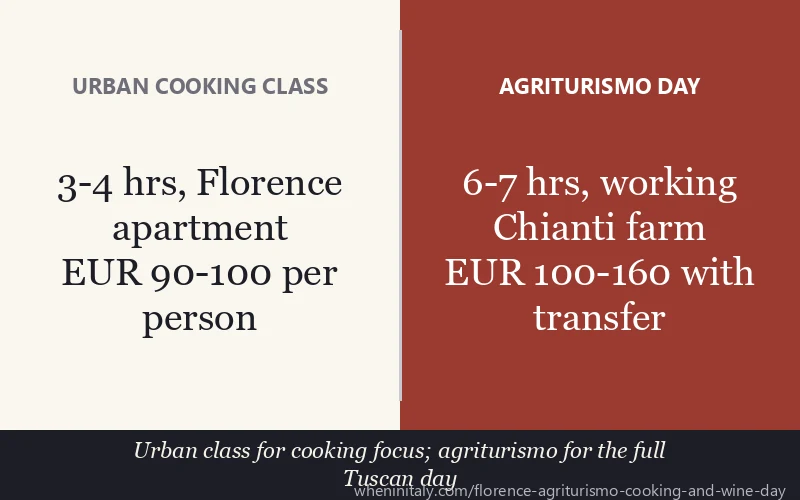
Agriturismo wins when the goal is to combine wine, olive oil, cooking, and landscape into one immersive day at a single working property, rather than running between specialist venues. A standalone in-cantina wine tasting in Chianti runs roughly 90 minutes to 2 hours and pours four to six wines paired with bread, cheese, and salumi; the cost is typically EUR 30 to 60 per person. An urban cooking class in Florence (the Sara Cagle apartment-style format is a clean example at EUR 90 to 100 per person) is a focused 3 to 4 hour hands-on session on pasta, sauce, and tiramisu, with no transfer time and the option of a market-tour add-on. Both are excellent at what they do. The agriturismo day combines the wine pour, the olive oil tasting, the cooking class, the vineyard walk, and a multi-course lunch into roughly six to seven hours at one property, for EUR 100 to 160 per person small-group with transfer included. The trade-off matrix: agriturismo gives more breadth and atmosphere per euro and per hour but loses the urban convenience and the deeper specialization of a focused class. The standard Tuscany day-trip combo (Siena plus San Gimignano plus a brief vineyard stop) is the genuine alternative, and it is a different product: more sightseeing, less depth, more total kilometers in the van. The agriturismo day is the right choice when the priority is slowing down at a single place. The two-stop sightseeing day is the right choice when the priority is seeing as much of Tuscany as possible. Trying to combine the two in one day produces neither.
What does it cost in 2026?
Expected 2026 prices fall into three clear bands by booking format. Small-group full-day with transfer from Florence: roughly EUR 100 to 160 per person for the standard package (round-trip transfer, vineyard walk, olive oil tasting, cooking class, three to four course lunch with wine pairings, return by late afternoon). Groups are typically capped at 8 to 14 guests on the higher-end products and up to 20 to 26 on the broader-market versions. Private full-day with transfer: roughly EUR 250 to 400 per person, depending on group size, vehicle, and whether a sommelier or chef-instructor is dedicated. The per-person rate drops as group size rises, so a group of four usually pays close to the small-group rate while a couple pays the premium. Direct booking at the agriturismo on a self-drive basis: roughly EUR 70 to 95 per person, covering only the on-farm experience (cooking class, tasting, lunch). The visitor handles transportation. This is the budget path and the way to access smaller family-run farms that do not partner with aggregators. Expect to add a third to half again of the food cost if booking the meal alone without the cooking class; a long agriturismo lunch with wine pairings runs EUR 50 to 75 per person on its own. Booking lead time for 2026: 1 to 2 weeks ahead between May and early September, 4 to 6 weeks ahead during the September grape harvest and the October to November olive harvest, when capacity at the better farms gets snapped up by group bookings. Children typically pay reduced rates from ages 4 to 12 and are often free under 4; vegetarian, vegan, and gluten-free menus are standard accommodation requests at any agriturismo running international visitors.
Best time, with kids, what to bring
The sweet spots of the agriturismo year are May to mid-June (warm but not hot, vineyards in full leaf, wildflowers across the hills, olive trees flowering) and September to mid-November (the back-to-back grape and olive harvests, the working farm at its busiest, fresh oil from the press in late October). July and August deliver the iconic golden-Tuscany light but bring 32 to 36 degree afternoon heat and crowded transfers; tastings and cooking classes feel less comfortable and the kitchens can be brutally hot. Mid-November to March is largely off-season for the day-experience product; many agriturismi close or reduce activities, though the truffle hunters in Mugello and the Crete Senesi run November to January for those specifically chasing white truffle season. Children are welcome at almost every agriturismo: ages 4 and under typically free, ages 4 to 12 reduced rate, and several of the named properties (Diacceroni in particular) build separate kid tracks into the cooking program. What to bring: closed-toe walking shoes (vineyard rows are uneven dirt and gravel and can be slippery after rain, especially in spring), layers (Tuscan countryside mornings are cool even in May, afternoons warm fast), a sun hat for any visit between June and September, and dressed-up casual for lunch (no swimwear or short-shorts; the lunch is a real meal in a real dining room, not a poolside snack). Bring a credit card with no foreign transaction fee for the inevitable bottle of estate olive oil and the case of wine that tends to come home from the day.
Sources and references
- Legge n. 96/2006 (Disciplina dell’agriturismo) full text — the national framework law defining agriturismo
- Agriturismo Diacceroni official site — 450-hectare organic estate in the Volterra area, cooking school, riding stable, olive groves, vineyards
- Visit Tuscany: Diacceroni cooking class
- Agriturismo Il Rigo official site — five-century stone farmhouse, Val d’Orcia, organic since 1990
- Il Rigo our history — Vittorio Cipolla founded the holding in 1974 after the end of crop-sharing
- Agriturismo Cognanello, Montepulciano — Giorgi family, six generations, 12 hectares
- Consorzio Olio DOP Chianti Classico — founded 1975, DOP since 2000
- Visit Tuscany: Five Tuscan extra virgin olive oil quality labels — Chianti Classico DOP, Terre di Siena DOP, Lucca DOP, Seggiano DOP, Toscano IGP
- Tasting Table: Italian regions producing the most olive oil — Tuscany at roughly 3% of national output
- ISO 16657:2006 — Sensory analysis: olive oil tasting glass — the cobalt blue tulip glass standard
- Big Horn Olive Oil: How sensory evaluation works — the 28°C, COI/T.20/Doc. No 5/Rev. 2/2020 protocol
- Wine Enthusiast: Beginner’s guide to Chianti and Chianti Classico — minimum 80% Sangiovese, Gallo Nero seal
- Italian Wine Central: Chianti Classico DOCG denomination
- Two Parts Italy: The olive harvest in Tuscany — late October to early November harvest window
- Arianna and Friends: Olive harvest experience in Tuscany — second half of October through early November visit window
- Italia.it: Val d’Orcia — UNESCO World Heritage Site since 2004
- Visit Florence: Mugello — quieter green valley north of Florence
- GetYourGuide: Florence cooking class at a Tuscan farm and local market tour
- Viator: Cooking class and lunch at a Tuscan farmhouse from Florence
- Sara Cagle Florence cooking classes — EUR 90-100 per person Florence-apartment urban benchmark