TL;DR / Key Takeaways
- Palazzo Pitti is not one museum but five distinct collections inside a single Renaissance palazzo on the south bank of the Arno. The combined Pitti ticket is EUR 16 on the day of entry (EUR 19 if booked online in advance) and is valid for one day across all five.
- Boboli Garden sits behind the palazzo and is sold on a separate ticket: EUR 11 in peak season (March to October) and EUR 6 in low season, which also includes the Bardini Garden across town.
- The Palatine Gallery alone holds 11 paintings by Raphael, the largest single concentration in the world, hung salon-style in 28 rooms alongside 14 Titians, Caravaggio’s Sleeping Cupid, and a Pietro da Cortona ceiling cycle.
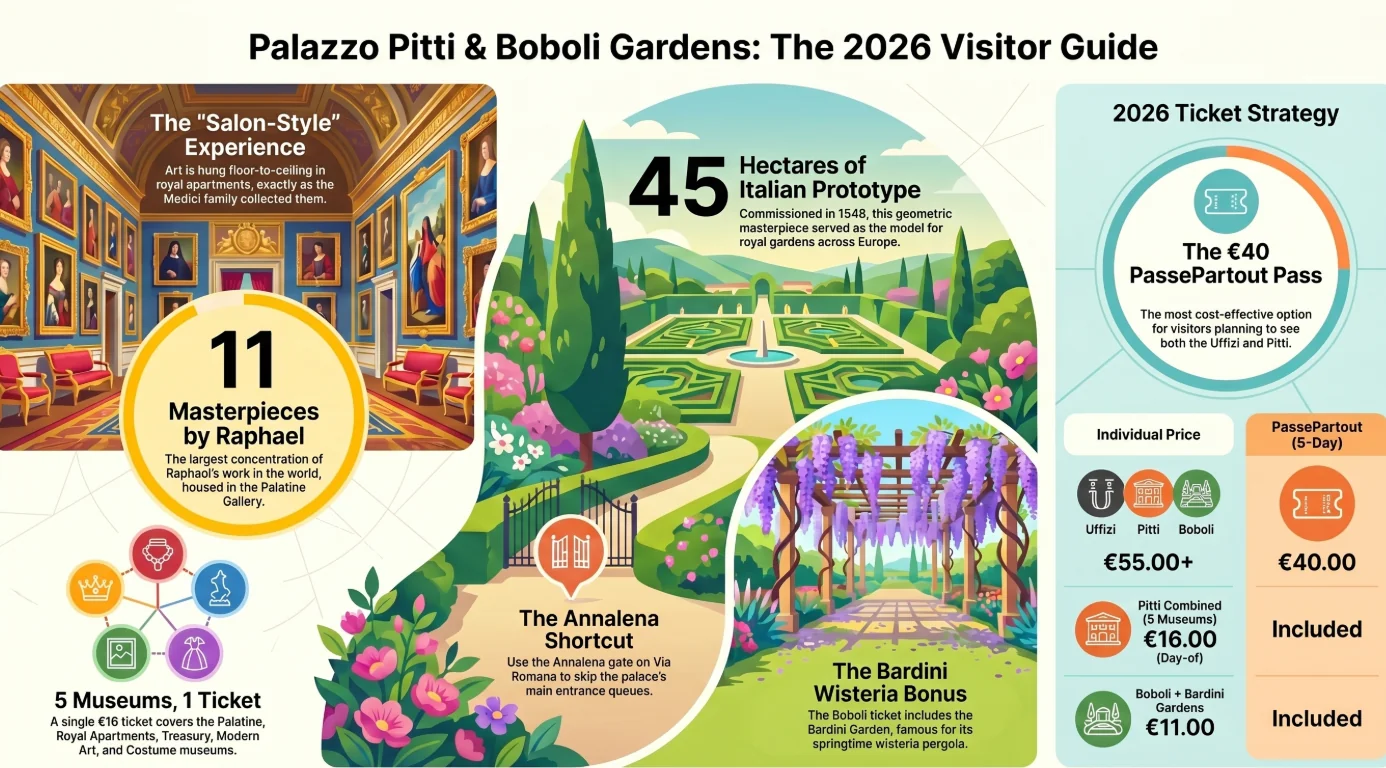
- The PassePartout 5-day ticket at EUR 40 covers the Uffizi, the entire Pitti complex, and Boboli plus Bardini. It pays off the moment a visitor plans to do both the Uffizi (EUR 25 standalone) and Pitti (EUR 16) on the same trip.
- The Vasari Corridor reopened on 21 December 2024 after eight years of restoration and is now sold only as a EUR 43 combo with the Uffizi entry, with timed slots and a 25-person cap.
- The honest verdict for travellers with one day in Florence: Uffizi for the iconic Greatest Hits, Pitti for the royal-residence experience plus the Raphaels plus the garden walk. With two days, do both on separate days.
The Pitti complex at a glance: 5 museums in one palazzo + a 45-hectare garden
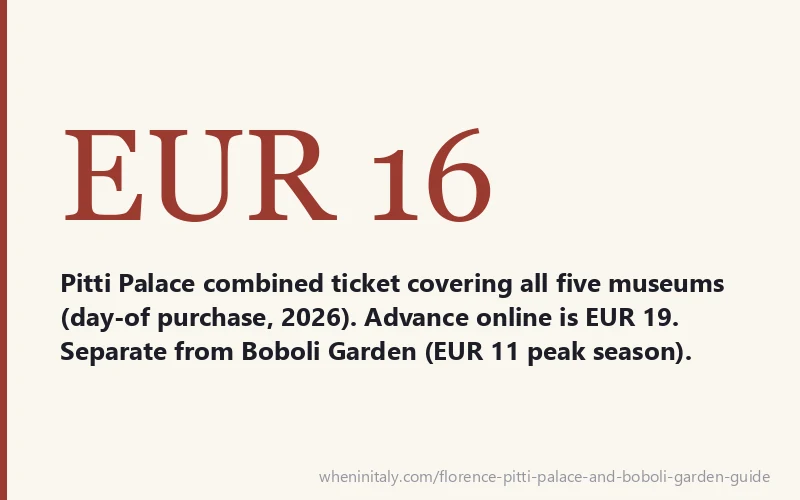
Palazzo Pitti is a single building in the Oltrarno neighbourhood of Florence that contains five separate state museums, plus a 45-hectare Italian garden behind it that is ticketed independently. The single combined Pitti ticket (EUR 16 day-of, EUR 19 advance per the official Uffizi Galleries fares page) covers all five museums for one calendar day. The Boboli Garden ticket is sold separately at EUR 11 in peak season and includes the Bardini Garden on the other side of the river. The most common booking mistake travellers make in Florence is assuming Pitti and Boboli share a ticket, walking up at 11 a.m., and discovering they need two purchases plus a queue restart. They do not share a ticket. Plan for both, or commit to one.
The complex is run by the Uffizi Galleries (Gallerie degli Uffizi), the same state body that operates the Uffizi proper across the river. That central management is why a single PassePartout pass at EUR 40 unlocks all three sites for five consecutive days, and why the opening calendar splits: the palazzo is closed Mondays, while Boboli is closed only on the first and last Monday of each month, plus Christmas Day.
The five museums of Palazzo Pitti, in honest priority order
If a visitor has three full hours inside the palazzo, the priority order is non-negotiable. Spend two hours on the Palatine Gallery and Royal Apartments, 30 minutes in the Treasury, and pick one of the remaining three based on personal interest.
Galleria Palatina (Palatine Gallery) plus Royal Apartments. 90 to 120 minutes. This is the showpiece and the reason most serious art travellers cross the Arno. The Palatine occupies 28 rooms on the first noble floor and hangs Renaissance and Baroque paintings salon-style: stacked floor to ceiling, frame to frame, in the original Medici and Lorraine arrangement rather than the modern museum grid. The collection includes 11 paintings by Raphael (the largest concentration in the world per uffizi.it), 14 Titians, Caravaggio’s Sleeping Cupid, Rubens, and the Pietro da Cortona ceiling fresco cycle from the 1640s in the Planet Rooms. The Royal Apartments are part of the same ticket and the same flow: 14 successive rooms occupied by the Medici, then the House of Lorraine, then the House of Savoy when Florence served as capital of newly unified Italy from 1865 to 1871.
Tesoro dei Granduchi (Treasury of the Grand Dukes). 30 to 45 minutes. Until recently called the Silver Museum. Houses Medici silver, gold, hardstones, the grand-ducal cameos, and Lorenzo il Magnifico’s celebrated collection of antique vases. The Sala di Giovanni da San Giovanni, with its baroque ceiling, is the standout space.
Galleria d’Arte Moderna (Gallery of Modern Art). 45 to 60 minutes, optional. Italian paintings from Neoclassicism through the 1930s, with the most important holdings being the Macchiaioli school: Fattori, Lega, Signorini, the Tuscan painters who anticipated French Impressionism by a decade. A genuine highlight for anyone interested in 19th-century painting, a polite skip for everyone else.
Museo della Moda e del Costume (Museum of Costume and Fashion). 30 to 45 minutes, optional. The only state-museum-level fashion collection in Italy. Rotates exhibitions drawing from a permanent inventory that includes pieces by Galileo Chini, Pucci, and historical court dress.
Museo delle Porcellane (Porcelain Museum). 30 minutes, optional but charming. Located in the Casino del Cavaliere at the highest point of Boboli, technically reached via the garden ticket rather than the palazzo ticket. Houses table porcelain from the Medici, Lorraine, and Savoy households: Sèvres, Meissen, and the Tuscan Doccia manufactory. The terrace view down over the Bellosguardo vineyards is worth the climb on its own. Note that the Uffizi’s official Pitti page now lists a Museum of Russian Icons (the oldest such collection in Western Europe) among the five; the Porcelain Museum sits inside the Boboli ticket flow rather than the palazzo flow as of 2026.
The Treasury is a 60-minute skip if running tight. The Palatine is the 3-hour highlight that justifies the trip.
Boboli Garden: the 45-hectare back garden everyone underestimates
Boboli is not a garden in the English sense. It is a 45-hectare Italian garden, the prototype for the form, established in 1549 by Niccolò Tribolo on commission from Eleonora di Toledo, wife of Cosimo I de’ Medici. Tribolo died the following year and work continued under Bartolomeo Ammannati, with later contributions from Giorgio Vasari and Bernardo Buontalenti. The plan is geometric, axial, and intentionally theatrical: long sight lines, terraces that climb the Boboli Hill behind the palazzo, sculptural set-pieces at the focal points.
The set-pieces worth walking out to:
- Buontalenti Grotto (the Grotta Grande): a mannerist cave-architecture folly built between 1583 and 1593, with stalactites, frescoes, and copies of Michelangelo’s Prisoners (the originals are in the Accademia).
- Isolotto: an oval pond with the Fountain of the Ocean by Giambologna at its centre, surrounded by lemon trees in terracotta pots in season.
- Viottolone: the cypress avenue lined with antique sculpture, descending from the Kaffeehaus terrace to the Isolotto. The single most photographed sight line in the garden.
- Forte di Belvedere: not technically inside Boboli but reached from the upper garden, with the panoramic view of Florence’s red rooftops that ends up on most postcards.
- Kaffeehaus: a green-and-white Rococo pavilion built 1775, now a seasonal café with the best terrace coffee in Florence on a clear morning.
The garden also contains the Lemon House (built 1777-1778 by Zanobi del Rosso) and the long Cypress Avenue, plus several formal parterres around the upper amphitheatre directly behind the palazzo.
Annalena entrance shortcut. The main palazzo entrance feeds the longest queue. Boboli has three other gates: Annalena on Via Romana (a short walk south of the palazzo), Forte di Belvedere on the upper side, and Porta Romana at the southern boundary. The Annalena gate is the smartest workaround on a busy spring morning: it skips the palazzo crowd entirely and drops a visitor straight onto the lower Viottolone axis.
UNESCO inscribed Boboli as part of the Florence historic centre in 1982 and recognised it again as part of the wider Medici Villas and Gardens listing in 2013. The grounds are open year-round (closed only the first and last Monday of each month, and Christmas Day), with seasonal hours running 8:15 a.m. to 4:30 p.m. in winter and stretching to 7:10 p.m. between June and August.
2026 ticket landscape: Pitti combined, Boboli combined, PassePartout
Three tickets, three price points, three logical use cases. The math is straightforward once the structure is visible.
Pitti combined ticket. EUR 16 day-of, EUR 19 advance (per uffizi.it official fares as of 2026). Covers all five Pitti museums for one calendar day. Reservation is mandatory for the Royal Apartments time slot. Reduced fares: EUR 2 for EU citizens aged 18 to 25, free for under-18s of any nationality.
Boboli plus Bardini combined ticket. EUR 11 in peak season (March through October), EUR 6 in low season, valid one day. Includes the Porcelain Museum at Casino del Cavaliere and the Bardini Garden across the river. The Bardini portion is genuinely worth it in April and May for the wisteria pergola, the single best reason to bother with the combined version.
PassePartout 5-day pass. EUR 40 regular. Covers the Uffizi, the entire Pitti complex, and Boboli plus Bardini, with one entry per site over five consecutive days. The Vasari Corridor add-on brings the price to EUR 58 and is the cheapest legitimate way to access the Corridor on top of the other three sites.
Free entry days. First Sunday of each month, free for everyone. This sounds like a deal until queues materialise. On a first Sunday in May or October, the line at the Uffizi can stretch ninety minutes and the Pitti walk-up is similar. A paid mid-week morning will save more time than the free Sunday will save euros for any traveller whose schedule has any flexibility at all.
Booking fees. Direct online booking through uffizi.it carries a small handling fee. Third-party resellers add their own margins; the official site is the cheapest legitimate option for advance purchase. The day-of price is genuinely lower than the advance price, but day-of availability in May, June, July, September, and October cannot be relied on for the Uffizi (Pitti walk-up is usually viable even in peak months).
The PassePartout pays off arithmetically the moment both Uffizi and Pitti enter the plan: EUR 25 (Uffizi advance) plus EUR 19 (Pitti advance) plus EUR 11 (Boboli) equals EUR 55 for separate tickets versus EUR 40 for the bundle. Add Bardini and the gap widens further.
Pitti or Uffizi: which to choose with one day in Florence?
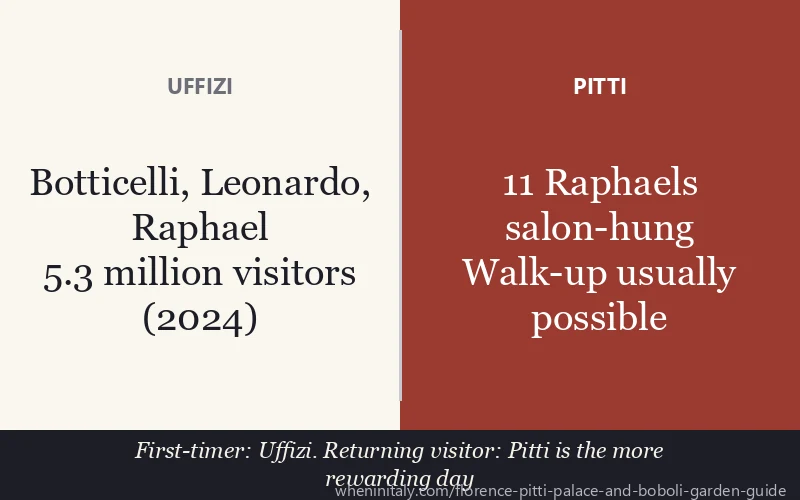
If forced to choose one, choose the Uffizi. It holds the Renaissance Greatest Hits a first-time visitor will want to see in person. But the question deserves a more honest answer than that, because the audience-fit really does shift depending on what kind of museum experience the traveller wants.
The Uffizi case. Botticelli’s Birth of Venus and Primavera. Leonardo’s Annunciation and the unfinished Adoration of the Magi. Michelangelo’s Doni Tondo. Caravaggio’s Medusa and Bacchus. Raphael’s Madonna del Cardellino and the Doni portraits. The collection is the canon of early Renaissance painting in one building. Italy’s second most-visited museum complex in 2024 with 5,294,968 visitors per the Uffizi Galleries’ official 2024 figures (cited by Florence Daily News, May 2025), generating EUR 61.9 million in gross revenue. Standard ticket EUR 25 advance, EUR 4 booking fee. Plan three to four hours and book at least two weeks ahead in May through October.
The Pitti case. A royal-residence experience the Uffizi cannot replicate. Walking through the Royal Apartments where Italy’s first king lived during Florence’s six-year stint as the national capital. The 11 Raphaels of the Palatine, hung in the salon-style arrangement they were collected for, including the Madonna della Seggiola and the Madonna del Granduca. Caravaggio’s Sleeping Cupid. The Pietro da Cortona ceilings. Less than a third the visitor pressure of the Uffizi. Walk-up tickets are usually possible. Plan three to four hours if doing all five museums, two if focusing on the Palatine plus Royal Apartments.
The honest split. First-time visitor with one day in Florence: Uffizi morning, Duomo climb afternoon, sunset on Piazzale Michelangelo. Pitti waits for trip number two. Two days in Florence: Uffizi day one, Pitti plus Boboli day two, on separate sides of the river to keep the walking sane. Returning visitor who has already done the Uffizi: Pitti is the more rewarding day, particularly with Boboli in the afternoon. Family with children: Pitti plus Boboli wins outright, because the garden burns off the gallery fatigue that ruins the Uffizi for kids under twelve.
The 11 Raphaels: what makes the Palatine collection unique
The Palatine’s 11 Raphael paintings constitute the single largest concentration of his work in any museum in the world, more than the Vatican has on display in its public rooms. The headline pieces are the Madonna della Seggiola (c. 1513-1514, the round-format Madonna copied more than any other in Western painting), the Madonna del Granduca (c. 1505, the panel Ferdinand III of Tuscany carried with him on his daily walks), and La Velata (c. 1516, the portrait long believed to depict Raphael’s Roman mistress Margherita Luti). The Madonna del Baldacchino, the Madonna dell’Impannata, and the portraits of Tommaso Inghirami, Cardinal Bibbiena, and Pope Julius II round out the wall.
The presentation matters. The Palatine hangs paintings the way the Medici grand dukes hung them: floor to ceiling, frame against frame, in rooms originally built as private apartments. A Raphael shares a wall with a Titian shares a wall with a Veronese shares a wall with a Pietro da Cortona ceiling. The effect is the opposite of the Uffizi’s modern, well-spaced, chronological grid. It is denser and more theatrical, more honest to how 17th-century princely collectors actually lived with their pictures. For a viewer who has only seen Renaissance paintings in the white-cube format, the Palatine recalibrates the eye.
The 14 Titians include the Portrait of a Gentleman, the Magdalene, and the Concert. The Caravaggio Sleeping Cupid (1608) hangs in the Sala dell’Educazione di Giove. The Pietro da Cortona ceiling cycle in the Planet Rooms (1641 to 1647), painted for Ferdinand II de’ Medici, anticipates the high-Baroque ceiling decoration that would dominate Roman palaces for the next half century.
What does it cost in 2026, and when to skip the bundle?
The straightforward answer: EUR 16 to EUR 58 depending on what gets included, with the EUR 40 PassePartout being the right pick for any visitor who plans to enter both the Uffizi and the Pitti complex on the same trip.
Per-component 2026 pricing summary:
- Uffizi standalone: EUR 25 advance, plus EUR 4 booking fee
- Pitti combined (5 museums): EUR 16 day-of, EUR 19 advance
- Boboli plus Bardini combined: EUR 11 peak / EUR 6 low season
- PassePartout (Uffizi + Pitti + Boboli/Bardini, 5 days): EUR 40
- PassePartout plus Vasari Corridor: EUR 58
- Vasari Corridor combo with Uffizi entry only: EUR 43
When the bundle pays off: Both Uffizi and Pitti on the same trip. Separate-ticket math comes out to roughly EUR 55 to EUR 60; the PassePartout bundles all three sites at EUR 40 with five days of flexibility. Free re-entry within the window also lets a visitor split the Uffizi across two morning visits, the actual sane way to digest it.
When to skip the bundle: Pitti only, no Uffizi planned. Pitti combined plus separate Boboli (EUR 16 + EUR 11 = EUR 27) sits well under the bundle price. Same logic for visitors who only want both gardens for an afternoon walk: EUR 11 buys Boboli plus Bardini with no museum-fatigue tax attached.
The Bardini bonus. Giardino Bardini sits across the Arno from Pitti, on the slope behind Santa Croce. It is included in the Boboli combined ticket and sees a fraction of the visitor pressure. The wisteria pergola in late April and early May is the single most photogenic spot in Florence in spring; the terrace at the top, with its panoramic view of the Duomo dome, rivals Piazzale Michelangelo with a tenth of the crowd. For any visit between mid-April and mid-May, Bardini alone justifies the combined garden ticket regardless of whether Boboli enters the plan.
Best time, with kids, with limited mobility
Best entry slots. The crowd window at Pitti runs 10:30 a.m. to 1:00 p.m., when tour-bus arrivals and morning walking-tour groups converge. The smart slots are 8:15 a.m. (first entry, the only realistic chance of having the Sala di Saturno to oneself for a quiet five minutes with the Madonna della Seggiola) or 4:00 p.m. and later (last entry around 5:30 p.m., closing at 6:30 p.m.). Boboli rewards a different rhythm: arrive at 8:15 a.m. for the golden-hour Viottolone photographs, or after 4:00 p.m. when the upper terraces catch the western light. Midday Boboli in July, with no shade on the upper amphitheatre, is brutal.
A combined day plan that works: Pitti opening at 8:15 a.m., Palatine and Royal Apartments until 11:00 a.m., Treasury at 11:00 to 11:45 a.m., lunch in Piazza Santo Spirito, Boboli entry via the Annalena gate at 1:30 p.m., garden walk and Porcelain Museum until 4:00 p.m., aperitivo at the Kaffeehaus terrace if it is open. One full day, two tickets, all five museums plus the garden.
With kids. Pitti is a hard sell for under-tens. Boboli is a brilliant sell: 45 hectares of running-around space, fountains, sculptures to find, the Buontalenti Grotto’s spooky cave aesthetic, the amphitheatre lawn. The strategic move is one parent runs the Palatine while the other does Boboli with the kids, then swap. With under-18s free on the museum side, a family-of-four day comes in well under EUR 60.
With limited mobility. Palazzo Pitti has elevator access to all main floors. Wheelchair entry is via a side door (signposted at the main entrance). Boboli is the harder ask: it is built into the Boboli Hill, which is genuinely steep. Accessible paths exist along the lower Viottolone axis and around the Isolotto, but the upper terraces, the Grotto, and the Casino del Cavaliere require negotiating real slopes and irregular gravel. A slow lower-garden loop entering through the Annalena gate, skipping the upper amphitheatre, returns the most reward.
Practicalities. Bag check is required at the Pitti entrance for anything larger than a small handbag. Photography without flash is permitted in the galleries; tripods and selfie sticks are not. Food and drink are fine at the Kaffeehaus and at seasonal kiosks inside Boboli. The Vasari Corridor reopened on 21 December 2024 after eight years of restoration and is now sold only as a EUR 43 combined pass with the Uffizi, with timed entry slots, a 25-person cap, and a 45-minute walk-through (no guided commentary, two staff escorts). Verify availability on uffizi.it; the special Friday evening openings (7 p.m. to 11 p.m.) ran through December 2025 and may or may not extend into 2026.
Sources and References
- Tickets | Uffizi Galleries (official 2026 ticket fares) — primary source for Pitti EUR 16 / EUR 19, PassePartout EUR 40, Vasari add-on EUR 58
- Pitti Palace | Uffizi Galleries (official museum overview) — five-museum structure, opening hours, Mondays-closed rule
- Boboli Gardens | Uffizi Galleries (official garden overview) — Annalena entrance, seasonal hours, first-and-last-Monday closure
- Combined ticket Pitti + Boboli | Uffizi Galleries — combined Pitti+Boboli day pass details
- Combined ticket for Boboli Gardens and Bardini Gardens | Uffizi Galleries — Bardini-included garden ticket
- Vasari Corridor | Uffizi Galleries (official) — December 2024 reopening, EUR 43 combo
- Palatine Gallery, Pitti Palace | Uffizi Galleries — 11 Raphaels claim, salon-style hang, Pietro da Cortona ceilings
- Florence Daily News, “Uffizi Confirmed as Italy’s Second Most Visited Museum in 2024” (15 May 2025) — 5,294,968 visitors, EUR 61.9M revenue
- Boboli Gardens | Britannica — 1549/1550 founding, Tribolo, Eleonora di Toledo, 45-hectare size
- Porcelain Museum (Florence) | Wikipedia — Casino del Cavaliere location, 1973 transfer, Sèvres/Meissen/Doccia collection
- Visit Florence: Pitti Palace Palatine Gallery and Royal Apartments — Royal Apartments succession (Medici, Lorraine, Savoy)
- Palazzo Pitti | Wikipedia — architectural history, Luca Pitti, Brunelleschi/Fancelli attribution, Ammannati courtyard