TL;DR / Key Takeaways
- The 131R rapid bus from Florence Santa Maria Novella to Siena is faster than the train (about 1h 15min, EUR 8.40 one way) and drops you walking distance from the centro storico.
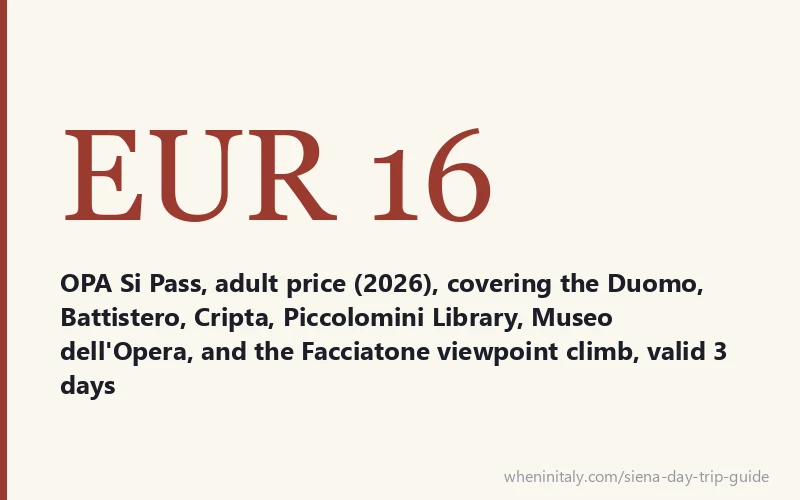
- Book the OPA Si Pass (EUR 16 adult), not a single Cathedral ticket. It covers the Duomo, Battistero, Cripta, Piccolomini Library, Museo dell’Opera and the Facciatone climb, valid for 3 days.
- The Pavimento (the marble inlay floor) is uncovered in 2026 from 27 June to 31 July and again from 18 August to 15 November. Outside that window the floor is largely carpeted over.
- The Palio runs 2 July and 16 August 2026. On race day Siena is unwalkable for casual tourists. Visit on a trial-race day (the four days before each Palio) for atmosphere without race-day crush, or skip Palio week entirely.
- Cathedral dress code is enforced: shoulders covered, no shorts or skirts above the knee. A scarf in your bag solves it.
- The single artwork worth coming for is Lorenzetti’s Allegory of Good and Bad Government (1338-1339) inside the Museo Civico (EUR 6).
The honest Siena-from-Florence day trip
The smart move is the bus, not the train. The 131R run by Autolinee Toscane departs the bus terminal on Via Santa Caterina da Siena, opposite Firenze SMN station, takes about 1 hour 15 minutes, costs EUR 8.40 one way, and drops you at Piazza Gramsci, a 4-minute walk from Piazza del Campo. The train takes 1h 30min to 1h 45min, requires a change at Empoli on most departures, and arrives at a station downhill from the historic centre that requires a city bus or a long escalator ride to reach Piazza Matteotti. The bus wins on every metric except scenery.
A four-hour visit (arrive 10:00, leave 14:00) covers Piazza del Campo, the Cathedral Complex with the Acropoli pass, and a stand-up coffee. It does not cover the Museo Civico frescoes, and that is the single biggest sacrifice. An eight-hour visit (arrive 10:00, leave 18:00) lets you add the Museo Civico, climb the Torre del Mangia, sit down for a long lunch, and walk the contrada districts behind the Campo. Most visitors should aim for the eight-hour version.
Renting a car only makes sense if you are combining Siena with the Chianti countryside, San Gimignano, or Volterra. Inside Siena the centro storico is a ZTL (Zona a Traffico Limitato) with automatic camera enforcement and a fine of around EUR 90 for non-residents who drift in. Park at Santa Caterina (underground, escalator straight up to the Duomo, EUR 2 per hour) or Stadio (cheaper, 10-minute walk).
“The 131R is the rapid bus, no intermediate stops, runs on the Florence-Siena freeway. From Firenze SMN to Siena Piazza Gramsci in roughly 75 minutes.” (Autolinee Toscane, line 131R timetable, 2026)
The OPA Si Pass tiers, decoded
For nearly every visitor, the right product is the OPA Si Pass at EUR 16 adult, EUR 5 for children 7-11, free under 7. It is sold by Opera della Metropolitana di Siena (the cathedral chapter) and bundles six monuments: the Cathedral itself, the Battistero di San Giovanni, the Cripta below the Duomo, the Piccolomini Library inside the Cathedral, the Museo dell’Opera, and the Facciatone, the panoramic walkway atop the unfinished “New Cathedral” wall. The pass is valid for three days and includes a smartphone audio guide. Each monument can be entered once.
A single Cathedral ticket on its own runs about EUR 7 in the off-Pavimento period and rises to roughly EUR 13 during the Pavimento window. Once you account for the Battistero and the Facciatone climb (which gives the best photograph in Siena, looking back at the Duomo from above), the Si Pass pays for itself by the second monument.
The upgrade most people miss: Porta del Cielo, the “Gate of Heaven” tour, is a separate timed-entry guided walk along the rooftop walkways inside the Cathedral itself, behind the gold-star ceiling. Adult EUR 21, child 7-11 EUR 6. It is small-group, sells out, and during the Pavimento period adds a surcharge of up to EUR 3. Book at operaduomo.siena.it before you leave home. The tour runs 1 March to 6 January, with hours 10:00-19:00 from March to October and 10:30-17:30 from November to 24 December.
The combined OPA Si Pass + San Gimignano Cathedral ticket exists if you are doing both cities the same day, but the saving is only a couple of euros and the San Gimignano portion is timed: do the maths only if you have a confirmed San Gimignano window.
Why does the Pavimento window in late summer matter?
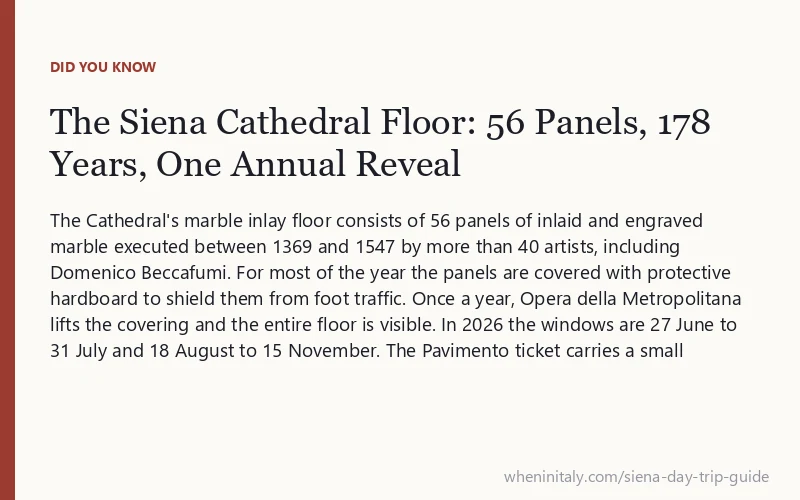
The Cathedral’s marble inlay floor (the Pavimento) is the rarest sight in the building, and most visitors never see it. The floor consists of 56 panels of inlaid and engraved marble executed between 1369 and 1547 by more than 40 artists, including Domenico Beccafumi. For most of the year the panels are covered with protective hardboard to shield them from foot traffic. Once a year, Opera della Metropolitana lifts the covering and the entire floor is visible.
For 2026 the Opera Metropolitana has confirmed two windows: 27 June to 31 July and 18 August to 15 November. The August gap is deliberate: the Palio dell’Assunta on 16 August disrupts the city, and the floor goes back under wraps for those few days. There is a special Jubilee dimension this year: 2026 is the 25th Ordinary Jubilee of the Catholic Church, themed on Hope, and the panel depicting Hope, executed in 1870 by Leopoldo Maccari with Giuseppe and Antonio Radichi, will be fully visible to the public for the first time.
“The cathedral floor will be exceptionally and fully uncovered from 27 June to 31 July and from 18 August to 15 November 2026, with the inlay depicting Hope on public view for the first time.” (Opera della Metropolitana di Siena, official 2026 calendar)
If you can move your trip to land in the window, do. The Pavimento ticket carries a small surcharge over the standard EUR 16 Si Pass, typically EUR 19-21 depending on booking channel. For art-history visitors this is the highest-value upgrade in Siena. Children find the panels surprisingly engaging because the imagery is figurative (sibyls, Hermes Trismegistus, the Massacre of the Innocents) rather than abstract.
The Palio: 2 July, 16 August, and what to do on the other 363 days
The Palio is a 90-second bareback horse race around Piazza del Campo, run twice a year. Its dates do not move: 2 July (Palio di Provenzano, in honour of Madonna of Provenzano) and 16 August (Palio dell’Assunta, in honour of Madonna dell’Assunta). Ten of Siena’s seventeen contrade (neighbourhood associations, each with its own colours, animal symbol, museum and church) compete each Palio. Three laps of the dirt-covered piazza, no saddle, no rules against riding an opponent off into the mattresses, and the prize is a painted silk banner.
The full festival around each Palio takes four days and includes six trial races (prove). The 2026 sequence for the July Palio: 1st prova 29 June 19:45, 2nd 30 June 09:00, 3rd 30 June 19:45, 4th 1 July 09:00, 5th (Prova Generale) 1 July 19:45, 6th (Provaccia) 2 July 09:00, then the Palio itself on the evening of 2 July around 19:30. The August sequence shifts up a few days, with the Palio on 16 August around 19:00.
What this means for a day-tripper: 2 July and 16 August are not viable visit days unless you are committed to the spectacle, prepared to stand five hours in the Campo for free (centre-piazza is unticketed but you cannot leave once it starts), or have a balcony ticket booked through a contrada or hotel a year in advance. Trial-race days (the four days preceding) are arguably the best Siena experience: contrade dinners spill into the streets, the dirt is laid, drum corps practise, and the city hums. Off-Palio summer is busy but normal.
“On Palio day the Campo is closed off by midday. If you are not committed to standing five hours in the centre or paying for a balcony seat, plan around it.” (Comune di Siena tourism office, visitor guidance)
Piazza del Campo and the Museo Civico
Piazza del Campo is the soul of the city. Shell-shaped, bricked in red, sloping toward the Palazzo Pubblico like water to a drain, it is one of the half-dozen great medieval public spaces in Europe. Sit on the bricks, do not eat at the cafes lining the piazza (overpriced, indifferent food), and walk into the Museo Civico inside Palazzo Pubblico.
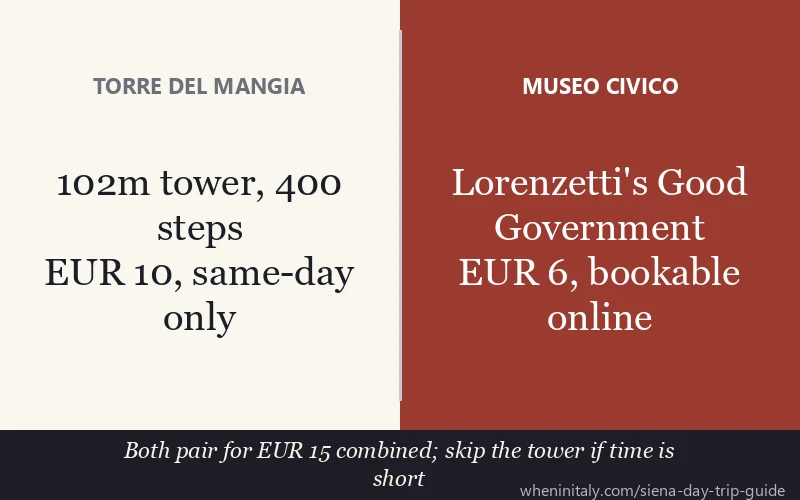
The Museo Civico is small, costs EUR 6, and contains the single artwork worth coming to Siena for: Ambrogio Lorenzetti’s Allegory and Effects of Good and Bad Government, painted on the walls of the Sala dei Nove between 1338 and 1339. It is the most important secular fresco cycle of the early Renaissance, a political programme commissioned by the Council of Nine who governed Siena from 1287 to 1355. The frescoes show what happens to a city and its countryside under wise versus tyrannical rule, and the city in the “Good Government” panel is recognisably Siena, with the Duomo on the hill.
The Torre del Mangia rises from the same Palazzo, 102 metres tall (matching the Cathedral on the opposite hill, an architectural statement that secular and sacred power were equal in 14th-century Siena). The climb is roughly 400 narrow stone steps, no elevator, and access cannot be reserved online: tickets are sold on the day at the Museo Civico ticket office, EUR 10 alone or EUR 15 combined with the Museo Civico. The Comune discourages the climb for those with heart or respiratory conditions, vertigo, or claustrophobia, and minors under 14 must be accompanied. Hours are 10:00-19:00 March to October (last entry 18:15) and 10:00-16:00 November to February.
A combined Torre del Mangia + Museo Civico + Santa Maria della Scala ticket runs EUR 20, and is the right buy for a full-day visit.
Combining Siena with San Gimignano (or Chianti, or Volterra)
The standard Florence-based excursion package is Siena + San Gimignano + Chianti vineyard lunch, sold by every Florence operator for EUR 100-180 per person, running 10 to 11 hours. It is a real day. You see Siena for two hours, San Gimignano for an hour and a half, eat in a Chianti winery, and arrive back in Florence after dark. For a first-time visitor with one day for Tuscany, this is the right shape: you trade depth for breadth.
If you are doing this on your own with a rental car, the Siena + San Gimignano combination is roughly 50 minutes apart by SR2 and SS429. San Gimignano is a perched town of 14 surviving medieval tower-houses (it once had 72), UNESCO-listed since 1990, free to wander, and best visited late afternoon when the day-tour buses leave. Siena + Chianti vineyard works best the other direction: lunch at a winery in the Chianti Classico zone (Castellina, Radda, Greve), then Siena for the late afternoon and evening light on the Campo.
Two combinations to skip on a first visit. Siena + Pisa is geographically possible but editorially weak: different terrain, no thematic glue, and it forces a transit-heavy day. Siena + Volterra is the connoisseur’s swap for San Gimignano (smaller crowds, Etruscan museum, alabaster workshops) but adds another hour of driving and is harder by public transit.
“Most visitors regret not staying overnight in Siena. The city changes the moment the day-trip buses leave at 17:30.” (Tour leader, multi-day Tuscany operator, 2025 interview)
Practical: tickets, dress code, getting in and out
Buy Cathedral Complex tickets through one official channel: operaduomo.siena.it (Opera della Metropolitana, the chapter that runs the Duomo and the Si Pass) or operalaboratori.com (their booking partner). Civic Museum and Torre del Mangia tickets are sold by the Comune di Siena via enjoysiena.it; the Torre is in-person only, same day. Avoid third-party “skip the line” listings unless you understand the markup; most charge double for a queue that, outside Pavimento weeks, rarely exceeds 20 minutes.
Cathedral dress code is enforced strictly. Shoulders covered for both men and women. No shorts or skirts above the knee. Tank tops, vest tops, sleeveless dresses without a cover-up: refused at the door. A light scarf in a day-pack solves it for women; men should wear trousers or knee-covering shorts and a sleeved shirt. The same rule applies at the Battistero and the Cripta.
The Cathedral is open roughly 10:00-19:00 March to October and 10:00-17:30 November to February. Sunday opening is afternoon-only, after Mass, typically 13:30-17:30. The Pavimento period draws larger crowds: book a 10:30 or 11:00 entry to skip the morning bus surge.
Centro storico is closed to non-resident vehicles. Park at Santa Caterina (underground, EUR 2 per hour, escalator to the Duomo), Il Campo (paid, closer to the piazza), or Stadio / Fortezza (cheaper, 10-minute walk). The central station is downhill from the historic centre and is connected by city bus or a long escalator system to Piazza Matteotti.
With kids, with limited mobility, with limited time?
This is the matrix to use depending on who you are travelling with.
With kids (ages 6-12). Piazza del Campo is the win: open, safe, sloping bricks they can run on. Climb the Torre del Mangia only if they are comfortable with 400 narrow steps and you have no stroller. The Cathedral works well during the Pavimento window because the floor designs are figurative and visible. Skip the Pinacoteca Nazionale (Sienese-school panel paintings, hours of saints in gold leaf, tedious for kids). Gelato at Kopa Kabana on Via dei Rossi or La Vecchia Latteria on Via San Pietro. Total: half a day max before they break.
With limited mobility. Siena is brutally hilly and largely paved in flagstones or brick, with the Duomo, the Campo, and Santa Maria della Scala all on different elevations. The Santa Caterina underground parking has an escalator straight up to the Duomo: this is your entry. Inside the Cathedral and Museo Civico ground floors are accessible. Torre del Mangia, Facciatone climb, Porta del Cielo and the Cripta are all stairs-only. The Comune publishes an accessible-route map at enjoysiena.it.
With four hours. Bus 131R from Florence at 09:30, arrive Siena 10:45. Walk to Piazza del Campo, sit on the bricks for 15 minutes. OPA Si Pass entry to the Duomo + Battistero + Facciatone (90 minutes). Stand-up coffee. Bus back at 14:30. You will not see the Museo Civico, the Lorenzetti frescoes, or eat sitting down. That is the trade.
With a full day. Same arrival. Add the Museo Civico (EUR 6, 60 minutes for the Lorenzetti frescoes alone), the Torre del Mangia climb (EUR 10, 30 minutes including queue), and Santa Maria della Scala (the medieval pilgrim hospital opposite the Duomo, EUR 9-12, 60 minutes). Lunch at Osteria Nonna Gina or Trattoria La Torre. Bus back at 18:30 or, better, stay overnight: Siena empties at 17:30 and the city in the evening light is the version locals know.
With two days. Add a Palio contrada museum visit (each contrada operates its own small museum, by reservation), an evening at a contrada osteria, and a half-day in the surrounding Crete Senesi or a Chianti winery. This is when Siena stops being a day trip and becomes the trip.
Sources and References
- Opera Duomo Siena — official Cathedral, Pavimento and Porta del Cielo source — Opera della Metropolitana di Siena, the chapter that owns and runs the Cathedral complex.
- OPA Si Pass official — pricing, validity, included monuments — direct Si Pass booking and 2026 pricing reference.
- Opera Duomo Siena — Floor (Pavimento) page with 2026 uncovering dates — confirms 27 June–31 July and 18 August–15 November 2026 windows, and the Hope-panel Jubilee debut.
- Finestre sull’Arte — confirmation of 2026 Pavimento window dates — independent Italian art press cross-check.
- Autolinee Toscane — line 131R Florence-Siena timetable — official bus operator, route and price reference.
- Comune di Siena — Civic Museum (Museo Civico) — official Comune source, ticket prices and combined-ticket options.
- Comune di Siena — Torre del Mangia — official tower ticketing and access policy.
- Visit Tuscany — OPA Si Pass overview — Tuscany regional tourism board’s plain-language Si Pass guide.
- Visit Siena Official — Palio festival page — Palio mechanics, dates, contrada participation.
- The Palio EU — full timetable for 2026 Palio races and prove — trial-race schedule for 29 June–2 July and 13–16 August 2026.
- Siena Cathedral Dress Code reference — enforcement and what is refused at the door.
- Porta del Cielo official page — booking, pricing, and seasonal hours for the rooftop walkway tour.
- Santa Maria della Scala official site — opening hours and museum-complex ticketing.