Nerano is the village that stops the road. Twelve kilometres from Sorrento along a switchback track through lemon groves and terraced vineyards, at the tip of the Sorrentine Peninsula where the land runs out and Capri appears just 2.5 kilometres across the water, the asphalt terminates at a tiny marina called Marina del Cantone. There is no road through. There is no through traffic. The coach tours do not come. The day-tripper crowds that fill Positano and Amalfi village in July have no practical way in.
This is not an accident, and it is not a problem once you understand what Nerano is for.
It is for eating one specific dish. It is for swimming in a marine reserve where the corals are still intact. It is for looking at Capri from the closest mainland point, where the island is 2.5 kilometres away and visible in full detail on a clear morning. And it is, for travellers who find Positano beautiful but exhausting, the honest answer to what the Sorrentine Peninsula looks like when no one is watching.
Spaghetti alla Nerano
The most-searched thing about Nerano is a pasta dish. Spaghetti alla Nerano is zucchini, Provolone del Monaco (a DOP-protected aged cow’s milk cheese from the Lattari Mountains above the coast), and basil. The zucchini is fried in seed oil, then left to macerate overnight to develop sweetness. The cheese melts into the pasta water to form a cream without flour or cream. The result is the flavour of the Sorrentine summer in one bowl.
The dish was invented at Da Maria Grazia, a beachfront restaurant at Marina del Cantone that has been in the same family since 1932. Maria Grazia herself created it in the 1950s as a way to use the local zucchini crop. The overnight rest is not negotiable: restaurants that skip it produce a competent fried-zucchini pasta; the version with the overnight maceration is something different.
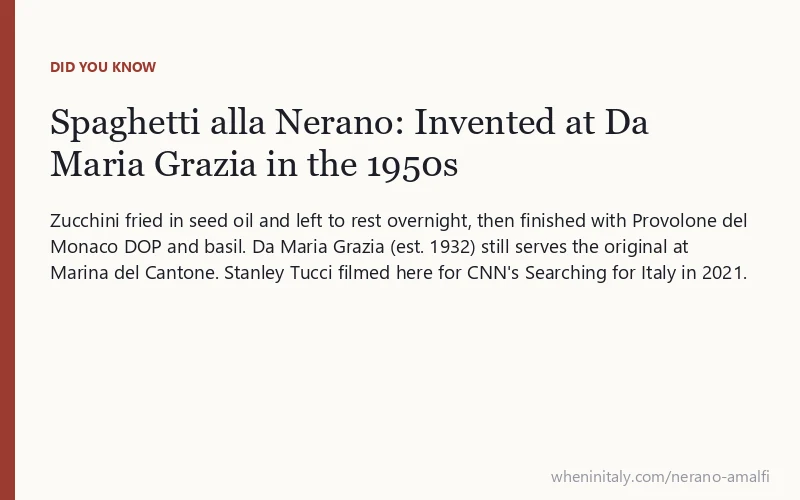
Stanley Tucci filmed the Da Maria Grazia sequence for CNN’s Searching for Italy in 2021, and the restaurant’s bookings have not fully returned to pre-broadcast levels since. Reserving a table for the beachside terrace in June, July, or August is advisable two to three days in advance.
Two alternatives on the same strip: Lo Scoglio (which sources produce from its own farm, unusual on this coast, and serves a version using the farm’s own zucchini), and Il Cantuccio (simpler, cheaper, shorter queue). In the village above the marina, several trattorias also serve it at prices noticeably below the waterfront seats.
Marina del Cantone
The beach at Marina del Cantone is a 200-metre arc of coarse sand and pebble, sheltered by headlands on both sides. It is not the photogenic cliff-and-parasol image the Amalfi Coast exports. What it is: uncrowded by coast standards, genuinely swimmable (clear water, gradual entry, no boat traffic in the immediate swimming area), and backed by restaurants rather than sun-lounger concessions charging EUR 30 for a branded towel.
The water here runs cleaner than at the main Amalfi Coast beaches because motorboat volume is lower and the Punta Campanella Marine Reserve begins at the western headland. The reserve’s protected-area rules push most motorized traffic back.
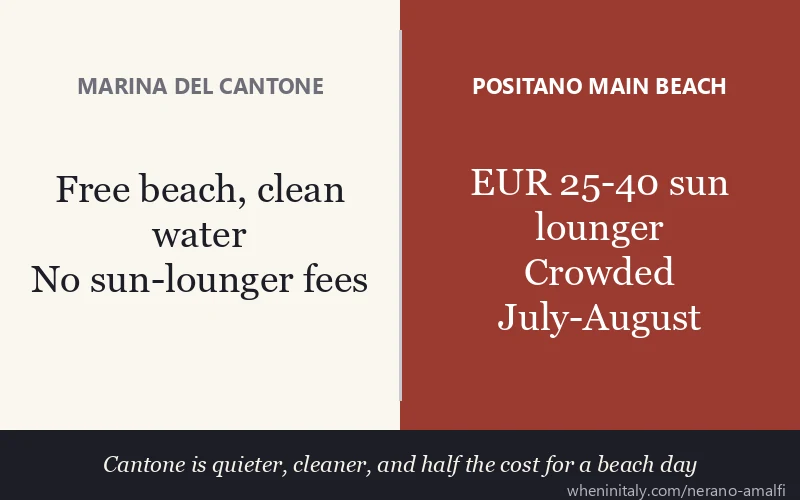
In July and August the beach fills by 10 AM. The practical move: arrive by 8:30, or book a snorkeling boat trip that takes you into the reserve water rather than the beach proper, and use the beach in the late afternoon when the day-trip boats have left.
Punta Campanella Marine Reserve
The western end of Marina del Cantone bay opens into the Riserva Marina di Punta Campanella, established in 1997, protecting the final five kilometres of the Sorrentine Peninsula and the sea around it. Three zones: Zone A (no motorboats), Zone B (low-speed access), Zone C (limited traffic). The inner zone’s corals, posidonia meadows, and fish populations are in measurably better condition than in the unprotected waters to the east.
For snorkelers, the sea caves and rocky formations at Cala di Mitigliano and along the cliff base toward the Punta Campanella lighthouse are accessible by swimming from the beach or by kayak from Marina del Cantone. Visibility in June and September (outside the murkier mid-summer algae period) reaches 15-20 metres on a calm day.
Motorboat access to Zone A requires a reserve permit, which is why guided boat trips are the practical choice here even for experienced snorkelers: the operator handles the permit paperwork, and the licensed guide knows the access points that independent swimmers miss. A self-guided kayak avoids the permit issue and reaches much of the same water.
Getting there
Nerano is the hardest village on the peninsula to reach, which is also the reason it remains the least crowded.
By bus from Sorrento. SITA line 5090 connects Sorrento to Nerano-Marina del Cantone via Massa Lubrense and Sant’Agata sui Due Golfi. About 45-55 minutes depending on traffic. A single ticket is EUR 1.30 (Campania regional tariff). The bus runs at limited frequency: check the SITA timetable before you go, and note the last return time. Missing the last bus means a taxi.
By taxi from Sorrento. EUR 25-35 for the 12km ride. Faster in the morning; not noticeably faster on summer afternoons when the Massa Lubrense road slows. Book a return taxi for the evening if you plan to stay for dinner: taxis at Marina del Cantone after dark are not a reliable find.
By boat from Positano or the Amalfi Coast. Several operators on the Amalfi Coast include Nerano or Marina del Cantone as a lunch stop on longer Capri and coast circuits. This is the most scenic approach and the practical choice if you are based on the coast rather than in Sorrento. The boat from Positano takes 30-40 minutes.
By car. Paid parking at the bottom of the descent road (EUR 3-5 per hour in season). The lot fills by 10 AM on summer weekends. The access roads from Sorrento are narrow. Driving in works well in April, May, June, and September; it is slow and frustrating in July and August. Leave the car in Sorrento and take the bus.
Capri from Nerano
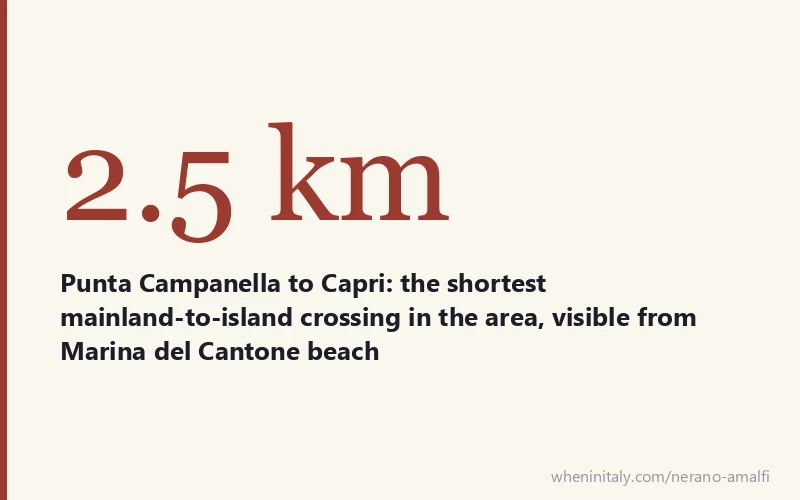
Punta Campanella, at the western end of the marine reserve, is the closest point on the Italian mainland to Capri: 2.5 kilometres of open water. On a clear day, which is most days from April through October, you can see the Faraglioni rock stacks from Marina del Cantone beach and pick out individual buildings on Capri’s cliff face.
Capri ferry connections run from Sorrento, Naples, and Positano, not from Marina del Cantone itself. But boat tours that depart from Positano and stop at Nerano for lunch frequently continue to Capri for the afternoon, making it a logical two-stop day from an Amalfi Coast base. The “Boat Tour Positano to Capri with Stop in Nerano for Lunch” listing on GetYourGuide names this route explicitly.
If the view from shore is sufficient, the hike to the Punta Campanella lighthouse (4km round trip from the village of Termini, above Nerano) is one of the best Capri viewpoints on the peninsula. The path is unmarked in sections. Go in the morning before heat, and carry water: there is none on the route.
When to go
May and June are the best months: the marine reserve water is clear, buses run full schedules, restaurants are open and not overwhelmed, and the beach is not yet crowded. The local zucchini crop peaks from June through August.
September is the second-best window: cooler than July-August, summer crowds gone, water still warm enough for full-day snorkeling.
July and August: the beach fills early, Da Maria Grazia books out days ahead, and the SITA bus is hot and crowded. Still worth the trip: just arrive early and book dinner in advance.
October through March: most restaurants close or reduce hours. The beach is empty and cold. The hike to Punta Campanella is quietly excellent. Not a conventional choice, but the peninsula is genuinely peaceful out of season.